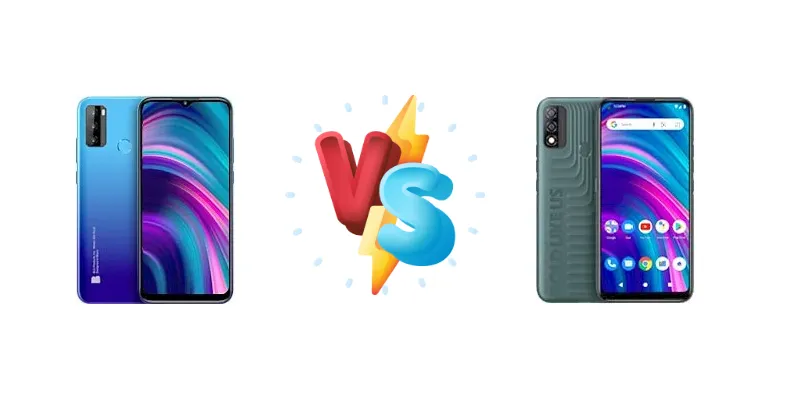
BLU Mobile consistently targets the ultra-budget segment, and the G51 Plus and G51S represent their latest offerings. While appearing similar on paper, a closer look reveals potential differences in software support and long-term usability. This comparison dissects the nuances to help you choose the right device for your needs.
🏆 Quick Verdict
For the average user prioritizing a functional, no-frills Android experience, the BLU G51S is the slightly better choice. While both phones share the same CPU, the 'S' model likely benefits from minor software optimizations and potentially longer software support, making it a more future-proof investment.
| Network |
|---|
| 2G bands | GSM 850 / 900 / 1800 / 1900 | GSM 850 / 900 / 1800 / 1900 |
| 3G bands | HSDPA 850 / 900 / 1700(AWS) / 1900 / 2100 | HSDPA 850 / 900 / 1700(AWS) / 1900 / 2100 |
| 4G bands | 1, 2, 3, 4, 5, 7, 12, 17, 28 | 1, 2, 3, 4, 5, 7, 12, 17, 28 |
| Speed | HSPA, LTE | HSPA, LTE |
| Technology | GSM / HSPA / LTE | GSM / HSPA / LTE |
| Launch |
|---|
| Announced | 2021, May 22. Released 2021, May 22 | 2022, January |
| Status | Discontinued | Available. Released 2022, January |
| Body |
|---|
| Dimensions | 165 x 76.5 x 9.3 mm (6.50 x 3.01 x 0.37 in) | 162.4 x 77.5 x 9 mm (6.39 x 3.05 x 0.35 in) |
| SIM | Nano-SIM + Nano-SIM | Dual SIM (Nano-SIM, dual stand-by) |
| Weight | 200 g (7.05 oz) | 185 g (6.53 oz) |
| Display |
|---|
| Resolution | 720 x 1600 pixels, 20:9 ratio (~270 ppi density) | 720 x 1560 pixels, 19.5:9 ratio (~268 ppi density) |
| Size | 6.5 inches, 102.0 cm2 (~80.8% screen-to-body ratio) | 6.4 inches, 100.5 cm2 (~79.9% screen-to-body ratio) |
| Type | IPS LCD | IPS LCD |
| Platform |
|---|
| CPU | Octa-core 1.6 GHz Cortex-A55 | Octa-core 1.6 GHz Cortex-A55 |
| OS | Android 11 | Android 11 (Go edition) |
| Memory |
|---|
| Card slot | microSDXC | microSDXC |
| Internal | 64GB 3GB RAM | 32GB 2GB RAM |
| | eMMC 5.1 | - |
| Main Camera |
|---|
| Dual | - | 13 MP
Auxiliary lens |
| Features | LED flash, HDR, panorama | LED flash |
| Single | 8 MP | - |
| Triple | 13 MP
0.3 MP (macro)
Auxiliary lens | - |
| Video | 1080p@30fps | 1080p@30fps |
| Selfie camera |
|---|
| Single | 8 MP | 8 MP |
| Video | 720p@30fps | 720p@30fps |
| Sound |
|---|
| 3.5mm jack | Yes | Yes |
| 35mm jack | Yes | Yes |
| Loudspeaker | Yes | Yes |
| Comms |
|---|
| Bluetooth | 4.1, A2DP, LE | 4.2, A2DP, LE |
| NFC | No | No |
| Positioning | GPS | GPS |
| Radio | FM radio | FM radio |
| USB | microUSB 2.0 | USB Type-C 2.0 |
| WLAN | Wi-Fi 802.11 b/g/n, Wi-Fi Direct | Wi-Fi 802.11 b/g/n, Wi-Fi Direct |
| Features |
|---|
| Sensors | Fingerprint (rear-mounted), accelerometer, proximity | Fingerprint (rear-mounted), accelerometer, proximity |
| Battery |
|---|
| Type | Li-Po 4000 mAh | Li-Po 4000 mAh |
| Misc |
|---|
| Colors | Black, Blue, Red, Green | Bronze, Gradient Blue, Green, Red |
| Price | About 110 EUR | About 80 EUR |
BLU G51 Plus
- Potentially lower price point
- Functional for basic smartphone tasks
- Adequate battery life for light users
- Likely slower software updates
- May exhibit more performance slowdowns under load
- Camera performance limited in low light
BLU G51S
- Potential for improved software optimization
- Slightly better long-term software support
- Potentially more efficient power management
- May be slightly more expensive
- Performance gains over G51 Plus likely minimal
- Camera still limited by sensor size and optics
Display Comparison
Both the BLU G51 Plus and G51S are expected to feature similar LCD panels, given their price bracket. Without specific resolution or brightness data, it's reasonable to assume both offer a 720p+ resolution. The absence of details regarding panel technology (IPS, TFT) or refresh rates suggests standard 60Hz displays. Bezels are likely to be substantial on both devices, maximizing screen real estate within a budget-friendly design. Color accuracy will likely be standard for this price point, prioritizing power efficiency over color fidelity.
Camera Comparison
Camera performance is likely to be similar on both devices, with the G51S potentially offering slightly improved image processing. Both will likely feature a primary camera, potentially 13MP, alongside depth and macro sensors (often 2MP). The usefulness of the 2MP macro camera is limited due to its low resolution and lack of optical image stabilization (OIS). Image quality will be acceptable in well-lit conditions, but expect significant noise and softness in low-light scenarios. The primary differentiator will be software algorithms for noise reduction and dynamic range.
Performance
The core of both devices is the Octa-core 1.6 GHz Cortex-A55 CPU. This indicates a MediaTek Helio P22 or similar chipset, commonly found in entry-level smartphones. Performance will be adequate for basic tasks like web browsing, social media, and light app usage. However, demanding games or multitasking will likely result in noticeable slowdowns. The shared CPU means performance differences will hinge on RAM management and software optimization – areas where the G51S *may* have a slight edge. The lack of LPDDR5x RAM specification suggests the use of slower LPDDR4x, further limiting performance potential.
Battery Life
Battery capacity is a critical factor in the budget segment. Without specific mAh ratings, we can assume both phones will feature batteries in the 4000-5000 mAh range. Charging wattage is also unspecified, suggesting slow charging speeds (likely 10W or 15W). Real-world battery life will depend heavily on usage patterns, but both devices should comfortably last a full day with moderate use. The G51S *might* benefit from slightly more efficient power management due to potential software optimizations, translating to marginally longer battery life.
Buying Guide
Buy the BLU G51 Plus if you need a functional smartphone *right now* and are finding it at a significantly lower price point. It's a perfectly adequate device for basic tasks. Buy the BLU G51S if you prioritize potential longevity and slightly improved software experience, even if it means spending a little more upfront. The 'S' model suggests a commitment to iterative improvements.
Frequently Asked Questions
❓ Will the BLU G51S receive Android updates?
BLU Mobile's update track record is inconsistent. While the 'S' model suggests a commitment to iterative improvements, don't expect frequent or long-term Android version updates. Security patches are more likely, but even those aren't guaranteed. Expect at least one major Android update, potentially to Android 13 or 14, depending on the initial Android version.
❓ Is the performance difference between the G51 Plus and G51S noticeable in everyday use?
The performance difference will be subtle. Both phones share the same CPU, so the impact of any software optimizations on the G51S will be minimal for basic tasks like calling, texting, and browsing. However, if you frequently switch between apps or play demanding games, the G51S *might* feel slightly smoother.
❓ How well will these phones handle popular games like PUBG Mobile or Call of Duty Mobile?
Expect to play these games at the lowest graphics settings and frame rates. The Cortex-A55 CPU and limited GPU power will struggle with demanding titles. Frame drops and stuttering are likely, even on minimal settings. These phones are not designed for serious mobile gaming.
❓ What type of charging port do these phones use?
Given the budget nature of these devices, they almost certainly use a Micro-USB port for charging and data transfer. This is slower and less convenient than USB-C, but it helps keep the cost down.