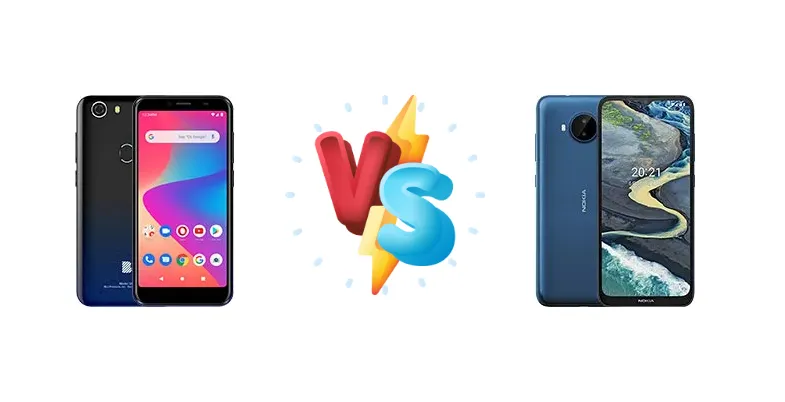
The BLU G50 and Nokia C20 Plus represent the extreme end of the smartphone price spectrum, targeting users who prioritize affordability above all else. Both devices aim to provide essential smartphone functionality without breaking the bank, but they achieve this with different approaches to chipset design and core configuration. This comparison dissects their specifications to determine which offers the best experience for the money.
🏆 Quick Verdict
For the average user prioritizing responsiveness in basic tasks, the BLU G50 edges out the Nokia C20 Plus. While both utilize Cortex-A55 cores, the G50’s consistent octa-core configuration provides a smoother experience than the C20 Plus’s mixed core setup, despite the latter’s slightly more efficient manufacturing process.
| Network |
|---|
| 2G bands | GSM 850 / 900 / 1800 / 1900 | GSM 850 / 900 / 1800 / 1900 |
| 3G bands | HSDPA 850 / 900 / 1700(AWS) / 1900 / 2100 | HSDPA 850 / 900 / 1900 / 2100 |
| 4G bands | 1, 2, 3, 4, 5, 7, 12, 17, 28 | 1, 3, 5, 8, 34, 38, 29, 40, 41 |
| Speed | HSPA, LTE | HSPA 42.2/5.76 Mbps, LTE Cat4 150/50 Mbps |
| Technology | GSM / HSPA / LTE | GSM / HSPA / LTE |
| Launch |
|---|
| Announced | 2020, September 18. Released 2020, September 18 | 2021, June 11 |
| Status | Discontinued | Available. Released 2021, June 16 |
| Body |
|---|
| Dimensions | 147.8 x 70.9 x 10.1 mm (5.82 x 2.79 x 0.40 in) | 165.4 x 75.9 x 9.4 mm (6.51 x 2.99 x 0.37 in) |
| SIM | Nano-SIM + Nano-SIM | · Nano-SIM· Nano-SIM + Nano-SIM |
| Weight | 190 g (6.70 oz) | 204.7 g (7.23 oz) |
| Display |
|---|
| Resolution | 720 x 1440 pixels, 18:9 ratio (~293 ppi density) | 720 x 1600 pixels, 20:9 ratio (~270 ppi density) |
| Size | 5.5 inches, 78.1 cm2 (~74.5% screen-to-body ratio) | 6.5 inches, 102.0 cm2 (~81.3% screen-to-body ratio) |
| Type | IPS LCD | IPS LCD |
| Platform |
|---|
| CPU | Octa-core 1.6 GHz Cortex-A55 | Octa-core (4x1.6 GHz Cortex-A55 & 4x1.2 GHz Cortex-A55) |
| Chipset | - | Unisoc SC9863A (28 nm) |
| GPU | IMG8322 | IMG8322 |
| OS | Android 10 | Android 11 (Go edition) |
| Memory |
|---|
| Card slot | microSDXC | microSDXC |
| Internal | 32GB 2GB RAM | 32GB 3GB RAM |
| | eMMC 5.1 | eMMC 5.1 |
| Main Camera |
|---|
| Dual | - | 8 MP
Auxiliary lens |
| Features | LED flash, HDR, panorama | LED flash |
| Single | 13 MP, AF | 5 MP |
| Video | 1080p@30fps | 720p@30fps |
| Selfie camera |
|---|
| Single | 8 MP | 5 MP |
| Video | 720p@30fps | 720p |
| Sound |
|---|
| 3.5mm jack | Yes | Yes |
| 35mm jack | Yes | Yes |
| Loudspeaker | Yes | Yes |
| Comms |
|---|
| Bluetooth | 4.1, A2DP, LE | 4.2, A2DP |
| NFC | No | No |
| Positioning | GPS | GPS |
| Radio | FM radio | FM radio |
| USB | USB Type-C 2.0 | microUSB 2.0 |
| WLAN | Wi-Fi 802.11 b/g/n, Wi-Fi Direct | Wi-Fi 802.11 b/g/n |
| Features |
|---|
| Sensors | Fingerprint (rear-mounted), accelerometer, proximity | Accelerometer, proximity |
| Battery |
|---|
| Charging | 10W wired | 10W wired |
| Type | Li-Po 4000 mAh | Li-Ion 4950 mAh, removable |
| Misc |
|---|
| Colors | Black, Blue, Red, Green | Ocean Blue, Graphite black |
| Models | - | TA-1388, TA-1380 |
| Price | About 70 EUR | About 90 EUR |
BLU G50
- Consistent Octa-Core Performance
- Potentially smoother multitasking
- Simpler CPU architecture for predictable behavior
- Likely less efficient processor node
- Basic camera system
Nokia C20 Plus
- Potentially better idle battery life
- Nokia’s software support reputation
- Unisoc chipset power management features
- Heterogeneous core configuration can lead to performance hiccups
- Slower cores may struggle with demanding tasks
Display Comparison
Neither device boasts a standout display. Both are likely to feature basic LCD panels, given their price point. Detailed display specs (resolution, brightness) are unavailable, but we can infer that both will prioritize power efficiency over visual fidelity. The absence of features like high refresh rates or even full HD resolution is expected in this segment.
Camera Comparison
Camera performance is expected to be basic on both devices. Without detailed sensor information, it’s safe to assume both rely on low-resolution sensors. Focusing on megapixel counts alone is misleading; image quality will heavily depend on software processing and lens quality, areas where neither manufacturer is known for excelling. Any secondary cameras (depth or macro) are likely to be of limited utility.
Performance
The core difference lies in the CPU configuration. The BLU G50 features an octa-core processor clocked at 1.6 GHz, utilizing eight Cortex-A55 cores. The Nokia C20 Plus, powered by the Unisoc SC9863A, employs a heterogeneous octa-core setup: four Cortex-A55 cores at 1.6 GHz paired with four slower Cortex-A55 cores at 1.2 GHz. This 'big.LITTLE' approach aims to balance performance and power consumption, but in practice, the G50’s consistent core speed is likely to provide a more predictable and responsive experience, especially when multitasking. The Unisoc SC9863A’s 28nm process node is less efficient than more modern fabrication processes, potentially impacting thermal performance under sustained load, though both phones are unlikely to be pushed to their limits.
Battery Life
Both phones feature 10W wired charging, indicating a similar charging experience – slow by modern standards. Battery capacity is not specified, but given the focus on affordability, both are likely to have batteries in the 3000-4000 mAh range. The Unisoc SC9863A’s 28nm process *could* offer slightly better idle power consumption, potentially translating to marginally longer battery life for the Nokia C20 Plus, but this advantage will likely be minimal in real-world usage.
Buying Guide
Buy the BLU G50 if you need a consistently responsive experience for everyday tasks like browsing, social media, and light messaging. Its uniform octa-core processor delivers a more predictable performance profile. Buy the Nokia C20 Plus if you prioritize potential battery efficiency and are comfortable with a slightly less fluid user experience, potentially benefiting from the Unisoc chipset’s power management features, and prefer the Nokia brand’s software support.
Frequently Asked Questions
❓ Will the Nokia C20 Plus receive Android updates?
Nokia generally provides a more reliable software update schedule than BLU, even for its entry-level devices. While major Android version updates are unlikely, the C20 Plus is more likely to receive security patches and minor improvements over its lifespan.
❓ Is the performance difference between the BLU G50 and Nokia C20 Plus noticeable in everyday use?
Yes, the BLU G50’s consistent octa-core processor should result in a smoother experience when switching between apps, browsing the web, and performing basic tasks. The Nokia C20 Plus’s mixed core configuration might exhibit occasional lag or stuttering, particularly when handling multiple processes simultaneously.
❓ Can either of these phones handle popular mobile games like PUBG Mobile or Call of Duty Mobile?
Both phones will struggle with demanding games like PUBG Mobile or Call of Duty Mobile. While they might be able to run the games at the lowest settings, expect significant frame rate drops and a generally poor gaming experience. These phones are not designed for gaming.
❓ What type of storage does each phone use, and is it expandable?
Storage type and expandability are not specified. However, given the price point, both are likely to use eMMC storage, which is slower than UFS. Expandability via microSD card is highly probable, but confirmation is needed.