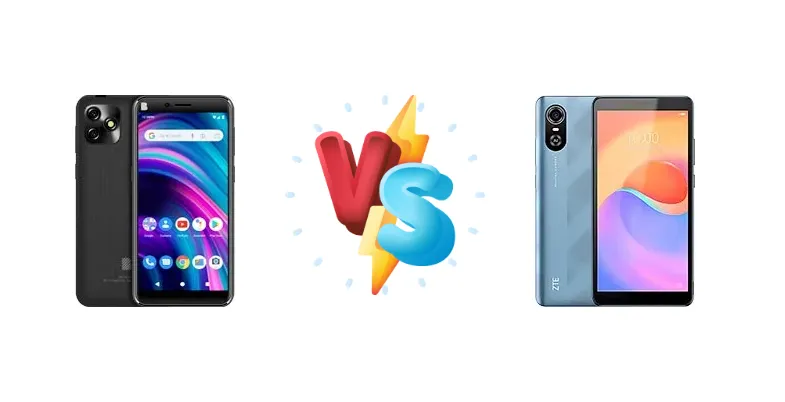
The BLU G40 and ZTE Blade A31 Plus represent the fiercely competitive sub-$150 smartphone market. Both aim to deliver essential functionality at an accessible price, but they take different approaches to achieving this. The G40 prioritizes a faster single-core performance, while the A31 Plus opts for an octa-core configuration, raising the question of which strategy delivers a better user experience.
🏆 Quick Verdict
For the average user prioritizing responsiveness in everyday tasks, the BLU G40 is the better choice. Its quad-core Cortex-A75 CPU, clocked at 2.0 GHz, offers significantly higher single-core performance than the ZTE Blade A31 Plus’s Cortex-A55 cores, resulting in snappier app launches and smoother multitasking.
| Network |
|---|
| 2G bands | GSM 850 / 900 / 1800 / 1900 | GSM 850 / 900 / 1800 / 1900 |
| 3G bands | HSDPA 850 / 900 / 1700(AWS) / 1900 / 2100 | HSDPA 850 / 900 / 2100 |
| 4G bands | 2, 3, 4, 5, 7, 12, 17, 28, 66 | 1, 2, 3, 5, 7, 8, 20, 28, 38, 40, 41 |
| Speed | HSPA, LTE | HSPA, LTE |
| Technology | GSM / HSPA / LTE | GSM / HSPA / LTE |
| Launch |
|---|
| Announced | 2022, June | 2021, October 31 |
| Status | Available. Released 2022, June | Available. Released 2021, October 31 |
| Body |
|---|
| Dimensions | 163.4 x 78.8 x 10.8 mm (6.43 x 3.10 x 0.43 in) | 159.2 x 77.5 x 9.6 mm (6.27 x 3.05 x 0.38 in) |
| SIM | Nano-SIM + Nano-SIM | Nano-SIM + Nano-SIM |
| Weight | 203 g (7.16 oz) | - |
| Display |
|---|
| Resolution | 720 x 1440 pixels, 18:9 ratio (~268 ppi density) | 480 x 960 pixels, 18:9 ratio (~179 ppi density) |
| Size | 6.0 inches, 92.9 cm2 (~72.2% screen-to-body ratio) | 6.0 inches, 92.9 cm2 (~75.3% screen-to-body ratio) |
| Type | IPS LCD | IPS LCD |
| Platform |
|---|
| CPU | Quad-core 2.0 GHz Cortex-A75 | Octa-core (4x1.6 GHz Cortex-A55 & 4x1.2 GHz Cortex-A55) |
| Chipset | - | Unisoc SC9863A (28 nm) |
| GPU | - | IMG8322 |
| OS | Android 11 | Android 11 (Go edition) |
| Memory |
|---|
| Card slot | microSDXC | microSDXC |
| Internal | 32GB 3GB RAM | 32GB 1GB RAM |
| | eMMC 5.1 | eMMC 5.1 |
| Main Camera |
|---|
| Dual | 13 MP
0.3 MP | - |
| Features | LED flash, HDR, panorama | LED flash, HDR |
| Single | 8 MP | 5 MP (up-scaled to 8 MP) |
| Video | 1080p@30fps | 720p@30fps |
| Selfie camera |
|---|
| Single | 8 MP | 2 MP (up-scaled to 5 MP) |
| Video | 1080p@30fps | - |
| Sound |
|---|
| 3.5mm jack | Yes | Yes |
| 35mm jack | Yes | Yes |
| Loudspeaker | Yes | Yes |
| Comms |
|---|
| Bluetooth | 4.2, A2DP, LE | 4.2, A2DP, LE |
| NFC | No | Yes |
| Positioning | GPS | GPS, GLONASS |
| Radio | FM radio | FM radio |
| USB | microUSB 2.0 | microUSB 2.0 |
| WLAN | Wi-Fi 802.11 a/b/g/n, Wi-Fi Direct | Wi-Fi 802.11 b/g/n |
| Features |
|---|
| Sensors | Accelerometer | Accelerometer |
| Battery |
|---|
| Type | Li-Ion 3000 mAh, removable | Li-Ion 3000 mAh |
| Misc |
|---|
| Colors | Black, Blue, Green, Cyan, Teal, White | Blue, Gray |
| Price | About 100 EUR | - |
BLU G40
- Faster single-core performance with Cortex-A75 CPU
- Potentially better battery life due to CPU efficiency
- More responsive user experience for everyday tasks
- Lower core count compared to ZTE Blade A31 Plus
- Display specifications unknown, likely basic
ZTE Blade A31 Plus
- Octa-core CPU may handle multitasking slightly better
- Potentially lower price point
- May include more camera sensors (though quality is uncertain)
- Slower individual core performance with Cortex-A55
- Less efficient CPU leading to potentially shorter battery life
- Older chipset built on a less efficient 28nm process
Display Comparison
Display specifications are not provided for either device. However, given their price point, both likely feature 720p LCD panels. The ZTE Blade A31 Plus, being a slightly older model, may have narrower viewing angles and lower peak brightness. Without specific data, it's reasonable to assume both displays prioritize functionality over visual fidelity.
Camera Comparison
Camera details are absent for both devices. Given the market segment, expect basic camera setups. The ZTE Blade A31 Plus may include a larger number of sensors (including potentially useless 2MP macro/depth sensors), but sensor size and image processing quality are likely to be similar. Without further information, it’s difficult to declare a clear winner; image quality will likely depend more on software optimization than hardware.
Performance
The core difference lies in the CPU architecture. The BLU G40’s quad-core 2.0 GHz Cortex-A75 is a significantly more powerful core than the Cortex-A55 cores found in the ZTE Blade A31 Plus. While the A31 Plus boasts an octa-core configuration (4x1.6 GHz & 4x1.2 GHz Cortex-A55), the A75’s superior IPC (Instructions Per Clock) and higher clock speed translate to faster single-core performance. This impacts app launch times and overall system responsiveness. The Unisoc SC9863A in the A31 Plus, built on a 28nm process, is less efficient than a more modern design, potentially leading to more heat generation under sustained load. The G40's CPU, while lacking core count, will likely handle demanding tasks more efficiently.
Battery Life
Battery capacity is not specified for either device. However, the Unisoc SC9863A’s 28nm process is less power-efficient than a more modern CPU. This suggests the ZTE Blade A31 Plus may require more frequent charging despite potentially having a larger battery. The BLU G40’s more efficient CPU could translate to longer battery life, even with a smaller capacity. Charging wattage is also unknown, making it difficult to assess 0-100% charge times.
Buying Guide
Buy the BLU G40 if you need a phone that feels responsive for basic tasks like browsing, social media, and messaging, and you occasionally play less demanding mobile games. Buy the ZTE Blade A31 Plus if you prioritize potentially better multi-tasking capabilities for running multiple apps simultaneously, even if individual app performance is slower, and you are looking for the absolute lowest price point.
Frequently Asked Questions
❓ Will the ZTE Blade A31 Plus struggle with modern mobile games?
Yes, the Unisoc SC9863A and its Cortex-A55 cores are not designed for demanding gaming. While it can handle simpler titles, expect low frame rates and graphical settings on popular games like PUBG or Call of Duty Mobile. The BLU G40, with its Cortex-A75, will offer a slightly better experience, but still won't be ideal for serious gaming.
❓ Is the octa-core processor in the ZTE Blade A31 Plus always better than the quad-core in the BLU G40?
Not necessarily. While more cores can be beneficial for heavily multi-threaded tasks, the individual performance of each core matters significantly. The BLU G40’s Cortex-A75 cores are much more powerful than the Cortex-A55 cores in the ZTE Blade A31 Plus. For most everyday tasks, the faster single-core performance of the G40 will result in a smoother and more responsive experience.
❓ Which phone is better for streaming videos?
Both phones will likely be adequate for streaming videos at lower resolutions (480p or 720p). However, the BLU G40’s more powerful CPU may offer slightly smoother playback and faster loading times for video content. The display quality, which is unknown for both, will be a more significant factor in the overall viewing experience.