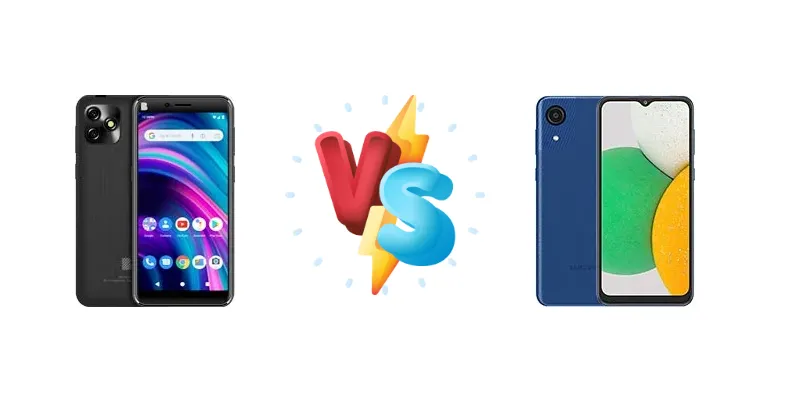
The sub-$150 smartphone market is fiercely competitive. Both the BLU G40 and the Samsung Galaxy A03 Core aim to deliver essential smartphone functionality at an accessible price point. However, they take drastically different approaches to achieving this, with the BLU G40 prioritizing raw CPU power while the A03 Core opts for an octa-core configuration on a more power-efficient chipset.
🏆 Quick Verdict
For users prioritizing responsiveness and occasional multitasking, the BLU G40 offers a noticeable performance edge thanks to its Cortex-A75 based CPU. However, the Samsung Galaxy A03 Core’s more efficient Unisoc chipset may translate to slightly better battery life and sustained performance under load, making it a better choice for light, consistent use.
| Network |
|---|
| 2G bands | GSM 850 / 900 / 1800 / 1900 | GSM 850 / 900 / 1800 / 1900 |
| 3G bands | HSDPA 850 / 900 / 1700(AWS) / 1900 / 2100 | HSDPA 850 / 900 / 2100 |
| 4G bands | 2, 3, 4, 5, 7, 12, 17, 28, 66 | 1, 3, 5, 7, 8, 20, 28, 38, 40, 41 |
| Speed | HSPA, LTE | HSPA 21.1/5.76 Mbps, LTE |
| Technology | GSM / HSPA / LTE | GSM / HSPA / LTE |
| Launch |
|---|
| Announced | 2022, June | 2021, November 15 |
| Status | Available. Released 2022, June | Available. Released 2021, December 06 |
| Body |
|---|
| Build | - | Plastic back, plastic frame |
| Dimensions | 163.4 x 78.8 x 10.8 mm (6.43 x 3.10 x 0.43 in) | 164.2 x 75.9 x 9.1 mm (6.46 x 2.99 x 0.36 in) |
| SIM | Nano-SIM + Nano-SIM | · Nano-SIM· Nano-SIM + Nano-SIM |
| Weight | 203 g (7.16 oz) | 211 g (7.44 oz) |
| Display |
|---|
| Resolution | 720 x 1440 pixels, 18:9 ratio (~268 ppi density) | 720 x 1600 pixels, 20:9 ratio (~270 ppi density) |
| Size | 6.0 inches, 92.9 cm2 (~72.2% screen-to-body ratio) | 6.5 inches, 102.0 cm2 (~81.8% screen-to-body ratio) |
| Type | IPS LCD | PLS LCD |
| Platform |
|---|
| CPU | Quad-core 2.0 GHz Cortex-A75 | Octa-core (4x1.6 GHz Cortex-A55 & 4x1.2 GHz Cortex-A55) |
| Chipset | - | Unisoc SC9863A (28 nm) |
| GPU | - | IMG8322 |
| OS | Android 11 | Android 11 (Go edition) |
| Memory |
|---|
| Card slot | microSDXC | microSDXC (dedicated slot) |
| Internal | 32GB 3GB RAM | 32GB 2GB RAM |
| | eMMC 5.1 | eMMC 5.1 |
| Main Camera |
|---|
| Dual | 13 MP
0.3 MP | - |
| Features | LED flash, HDR, panorama | LED flash |
| Single | 8 MP | 8 MP, f/2.0, AF |
| Video | 1080p@30fps | 1080p@30fps |
| Selfie camera |
|---|
| Single | 8 MP | 5 MP, f/2.2 |
| Video | 1080p@30fps | - |
| Sound |
|---|
| 3.5mm jack | Yes | Yes |
| 35mm jack | Yes | Yes |
| Loudspeaker | Yes | Yes |
| Comms |
|---|
| Bluetooth | 4.2, A2DP, LE | 4.2, A2DP |
| NFC | No | No |
| Positioning | GPS | GPS, GLONASS |
| Radio | FM radio | Unspecified |
| USB | microUSB 2.0 | microUSB 2.0, OTG |
| WLAN | Wi-Fi 802.11 a/b/g/n, Wi-Fi Direct | Wi-Fi 802.11 b/g/n, Wi-Fi Direct |
| Features |
|---|
| Sensors | Accelerometer | Accelerometer, proximity |
| Battery |
|---|
| Type | Li-Ion 3000 mAh, removable | Li-Ion 5000 mAh |
| Misc |
|---|
| Colors | Black, Blue, Green, Cyan, Teal, White | Black, Blue |
| Models | - | SM-A032F, SM-A032F/DS, SM-A032M |
| Price | About 100 EUR | £ 74.99 |
| SAR | - | 0.30 W/kg (head) |
| SAR EU | - | 0.24 W/kg (head) 1.39 W/kg (body) |
BLU G40
- Faster CPU for smoother app performance
- Potentially better multitasking capabilities
- Likely more responsive user interface
- Potentially shorter battery life due to less efficient CPU
- Unknown display quality
- Limited brand recognition
Samsung Galaxy A03 Core
- More power-efficient chipset for potentially longer battery life
- Samsung’s established brand reputation
- Likely refined software experience
- Slower CPU performance compared to the BLU G40
- Octa-core configuration doesn't necessarily translate to better real-world performance
- Basic camera system
Display Comparison
Neither device boasts a standout display. Given the lack of display specifications for the BLU G40, we can assume it utilizes a standard LCD panel typical of this price range. The Samsung Galaxy A03 Core also features an LCD, but its resolution is likely 720p+, which is standard for the segment. The real difference will likely be in color accuracy and brightness, where Samsung’s experience may give it a slight edge, but without specific nit measurements, it’s difficult to quantify. Both will likely suffer from limited viewing angles.
Camera Comparison
Both phones are expected to feature basic camera systems. Without detailed sensor information, it’s safe to assume both rely on budget sensors. The A03 Core likely features a primary sensor around 8MP, while the BLU G40’s primary sensor resolution is unknown. Image quality will heavily depend on software processing, and Samsung generally offers more refined image processing algorithms. The inclusion of a 2MP macro lens on the A03 Core is largely a marketing gimmick and offers limited practical benefit. Expect similar low-light performance from both devices, which will be subpar.
Performance
The core difference lies in the CPU architecture. The BLU G40’s quad-core 2.0 GHz Cortex-A75 is a significantly more powerful core design than the Cortex-A55 cores found in the Samsung Galaxy A03 Core. While the A03 Core has eight cores (4x1.6 GHz & 4x1.2 GHz), the A75 offers superior single-core performance, crucial for app launch times and general responsiveness. The Unisoc SC9863A (28nm) in the A03 Core is built on an older, less efficient process, potentially leading to more heat generation under sustained load. The A03 Core’s octa-core setup *could* offer better multi-tasking, but the A75’s raw power will likely overcome this in most scenarios.
Battery Life
Battery capacity is not specified for either device. However, the Unisoc SC9863A’s 28nm process is less power-efficient than more modern chipsets. This suggests the A03 Core might require a larger battery to achieve comparable battery life to the BLU G40. Charging wattage is also unknown for both, but given the price point, expect slow charging speeds – likely 5W or 10W. Real-world battery life will depend heavily on usage patterns, but the A03 Core’s chipset efficiency could provide a slight advantage in standby time.
Buying Guide
Buy the BLU G40 if you need a phone that feels snappy for basic tasks and can handle occasional heavier apps without significant slowdown. This is ideal for users who frequently switch between apps or need a bit more processing power for social media and light browsing. Buy the Samsung Galaxy A03 Core if you prioritize all-day battery life and consistent, albeit slower, performance for essential tasks like calls, texts, and basic app usage. This phone is best suited for first-time smartphone users or those who need a reliable, long-lasting device.
Frequently Asked Questions
❓ Will the Unisoc SC9863A in the Samsung A03 Core struggle with demanding apps like Facebook or Instagram?
While the A03 Core can run these apps, the Unisoc SC9863A’s lower processing power may result in slower loading times, occasional lag, and a less fluid experience compared to the BLU G40, especially when multitasking.
❓ Is the BLU G40 a good choice for mobile gaming?
The BLU G40’s Cortex-A75 CPU offers a performance advantage, but neither phone is ideal for gaming. Expect to play only very basic games at low settings. More demanding titles will likely be unplayable or suffer from significant frame rate drops.
❓ How does the software experience differ between the two phones?
Samsung’s One UI is generally considered more polished and feature-rich than the software found on BLU devices. However, this comes at the cost of potentially more bloatware. The BLU G40 likely runs a near-stock version of Android, offering a cleaner experience but fewer features.
❓ Does the Samsung Galaxy A03 Core support fast charging?
The Samsung Galaxy A03 Core likely supports only 5W or 10W charging, meaning a full charge will take several hours. Don't expect quick top-ups.