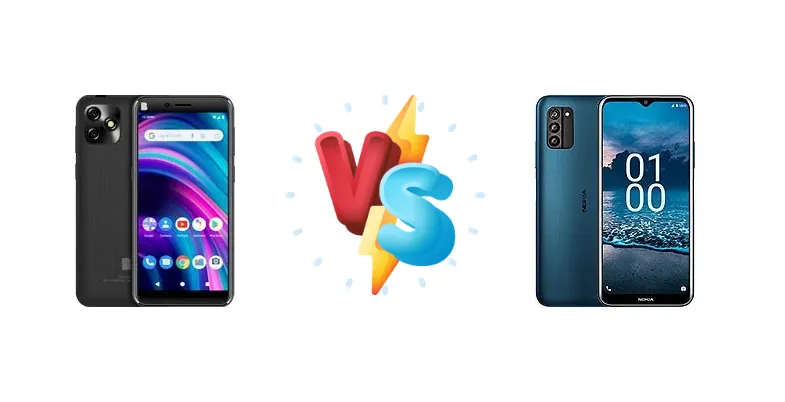
The BLU G40 and Nokia G100 represent two approaches to the ultra-budget smartphone market. The BLU G40 opts for a single, higher-clocked CPU core design, while the Nokia G100 leverages Qualcomm’s Snapdragon 662 with its octa-core architecture. This comparison dissects the implications of these choices for everyday users, focusing on performance, efficiency, and overall value.
🏆 Quick Verdict
For the average user prioritizing consistent multitasking and smoother app switching, the Nokia G100 is the better choice. Its Snapdragon 662 chipset, with its eight cores, provides a more balanced and responsive experience than the BLU G40’s quad-core Cortex-A75, despite the latter’s higher peak clock speed.
| Network |
|---|
| 2G bands | GSM 850 / 900 / 1800 / 1900 | GSM 850 / 900 / 1800 / 1900 |
| 3G bands | HSDPA 850 / 900 / 1700(AWS) / 1900 / 2100 | HSDPA 850 / 1700(AWS) / 1900 |
| 4G bands | 2, 3, 4, 5, 7, 12, 17, 28, 66 | 2, 4, 5, 7, 12, 13, 17, 44, 66, 71 |
| Speed | HSPA, LTE | HSPA, LTE |
| Technology | GSM / HSPA / LTE | GSM / HSPA / LTE |
| Launch |
|---|
| Announced | 2022, June | 2022, September 22 |
| Status | Available. Released 2022, June | Available. Released 2022, October |
| Body |
|---|
| Build | - | Glass front, plastic frame, plastic back |
| Dimensions | 163.4 x 78.8 x 10.8 mm (6.43 x 3.10 x 0.43 in) | 166.6 x 76.7 x 8.9 mm (6.56 x 3.02 x 0.35 in) |
| SIM | Nano-SIM + Nano-SIM | Nano-SIM |
| Weight | 203 g (7.16 oz) | 195.1 g (6.88 oz) |
| Display |
|---|
| Resolution | 720 x 1440 pixels, 18:9 ratio (~268 ppi density) | 720 x 1600 pixels, 20:9 ratio (~269 ppi density) |
| Size | 6.0 inches, 92.9 cm2 (~72.2% screen-to-body ratio) | 6.52 inches, 102.6 cm2 (~80.3% screen-to-body ratio) |
| Type | IPS LCD | IPS LCD |
| Platform |
|---|
| CPU | Quad-core 2.0 GHz Cortex-A75 | Octa-core (4x2.0 GHz Kryo 260 Gold & 4x1.8 GHz Kryo 260 Silver) |
| Chipset | - | Qualcomm SM6115 Snapdragon 662 (11 nm) |
| GPU | - | Adreno 610 |
| OS | Android 11 | Android 12 |
| Memory |
|---|
| Card slot | microSDXC | microSDXC |
| Internal | 32GB 3GB RAM | 32GB 3GB RAM, 128GB 4GB RAM |
| | eMMC 5.1 | - |
| Main Camera |
|---|
| Dual | 13 MP
0.3 MP | - |
| Features | LED flash, HDR, panorama | LED flash, HDR, panorama |
| Single | 8 MP | - |
| Triple | - | 13 MP, f/1.8, (wide), AF
5 MP, f/2.2, 115˚ (ultrawide), 1/5.0"
Auxiliary lens |
| Video | 1080p@30fps | 1080p@30fps |
| Selfie camera |
|---|
| Single | 8 MP | 8 MP, f/2.0, (wide), 1/4.0", 1.12µm |
| Video | 1080p@30fps | 1080p@30fps |
| Sound |
|---|
| 3.5mm jack | Yes | - |
| 35mm jack | Yes | Yes |
| Loudspeaker | Yes | Yes |
| Comms |
|---|
| Bluetooth | 4.2, A2DP, LE | 5.0, A2DP, LE |
| NFC | No | No |
| Positioning | GPS | GPS |
| Radio | FM radio | FM radio |
| USB | microUSB 2.0 | USB Type-C 2.0, OTG |
| WLAN | Wi-Fi 802.11 a/b/g/n, Wi-Fi Direct | Wi-Fi 802.11 b/g/n/ac, dual-band |
| Features |
|---|
| Sensors | Accelerometer | Fingerprint (side-mounted), accelerometer, gyro, proximity, barometer |
| Battery |
|---|
| Charging | - | 15W wired |
| Type | Li-Ion 3000 mAh, removable | Li-Po 5000 mAh |
| Misc |
|---|
| Colors | Black, Blue, Green, Cyan, Teal, White | Nordic Blue |
| Price | About 100 EUR | About 60 EUR |
BLU G40
- Potentially higher peak CPU performance for single-threaded tasks.
- May offer a simpler, less cluttered software experience.
- Likely the more affordable option.
- Limited multitasking capability due to quad-core CPU.
- Potential for thermal throttling under sustained load.
- Unknown charging speed may result in slower charging times.
Nokia G100
- Octa-core CPU provides smoother multitasking and app switching.
- Qualcomm Snapdragon 662 offers optimized power efficiency.
- 15W wired charging provides a known charging speed.
- Individual CPU cores have lower clock speeds than the BLU G40.
- May be slightly more expensive than the BLU G40.
- Nokia’s software update policy, while generally good, isn’t guaranteed long-term.
Display Comparison
Display specifications are absent from the provided data, making a direct comparison impossible. However, given the price points, both devices likely utilize LCD panels with 720p or 1080p resolution. The Nokia G100, benefiting from Nokia’s brand reputation, *may* have slightly better color calibration, but this is speculative. Bezels are likely comparable, prioritizing cost reduction over premium aesthetics.
Camera Comparison
Camera details are limited. Without sensor size or aperture information, a meaningful comparison is difficult. Both phones likely feature basic camera setups geared towards casual photography. The Nokia G100, leveraging Qualcomm’s image signal processor (ISP) within the Snapdragon 662, *may* offer slightly better image processing, particularly in low-light conditions, due to optimized algorithms. Any 2MP macro or depth sensors on either device should be considered marketing features with limited real-world utility.
Performance
The core difference lies in the CPU architecture. The BLU G40’s quad-core 2.0 GHz Cortex-A75 is a relatively powerful core for its class, but its limited core count will struggle with sustained multitasking. The Nokia G100’s Snapdragon 662, built on an 11nm process, features an octa-core configuration (4x2.0 GHz Kryo 260 Gold & 4x1.8 GHz Kryo 260 Silver). This allows for more efficient task distribution and better performance under load. While the A75 has a higher peak clock, the Snapdragon 662’s architecture and core count provide a more consistent experience. The 11nm process also contributes to better thermal management, reducing the likelihood of throttling during prolonged use.
Battery Life
Battery capacity is not specified for either device. However, the Nokia G100’s 15W wired charging is a known quantity. The BLU G40’s charging speed is unknown, but likely similar or slower. The Snapdragon 662’s 11nm process generally offers better power efficiency than comparable Cortex-A75 implementations, potentially translating to longer battery life for the Nokia G100, even with similar battery capacities. A slower charging speed on the BLU G40, if present, would further exacerbate any battery life differences.
Buying Guide
Buy the BLU G40 if you primarily need a phone for basic tasks like calls, texts, and light social media, and value a potentially simpler software experience. Buy the Nokia G100 if you frequently multitask, play casual games, or demand a more consistently fluid user interface, and appreciate the Qualcomm ecosystem’s optimizations.
Frequently Asked Questions
❓ Will the Nokia G100 struggle with demanding games like PUBG Mobile?
While the Snapdragon 662 isn't a gaming powerhouse, it can handle PUBG Mobile at medium settings with reasonable frame rates. Expect some occasional frame drops during intense action. The BLU G40’s single core focus may lead to more frequent stuttering in graphically demanding scenarios.
❓ Is the difference in CPU architecture noticeable in everyday tasks like browsing and social media?
Yes, the Nokia G100’s octa-core CPU will provide a smoother and more responsive experience when switching between apps, scrolling through social media feeds, and general web browsing. The BLU G40 may exhibit slight lag or stuttering during these tasks, especially with multiple apps open.
❓ How does the Snapdragon 662’s power efficiency impact real-world battery life?
The Snapdragon 662’s 11nm process is more power-efficient than many comparable processors. This translates to longer battery life, allowing you to use the Nokia G100 for a full day on a single charge with moderate usage. The BLU G40 may require more frequent charging.