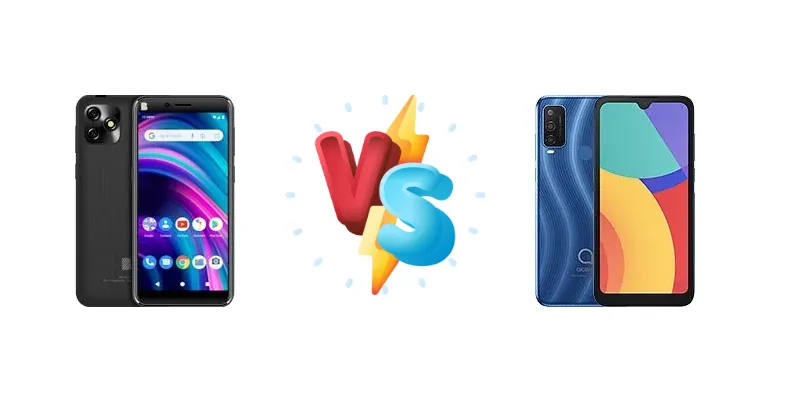
The BLU G40 and the alcatel 1L Pro (2021) represent the extreme end of the smartphone price spectrum. Both aim to deliver essential functionality at a minimal cost, but they take different approaches to achieving this. The G40 opts for a single, faster core design, while the 1L Pro leverages an octa-core setup with a focus on efficiency. This comparison will dissect their key differences to determine which offers the best value.
🏆 Quick Verdict
For the average user prioritizing responsiveness in everyday tasks, the BLU G40 emerges as the better choice. Its quad-core Cortex-A75 CPU, clocked at 2.0 GHz, provides a noticeable performance advantage over the alcatel 1L Pro’s Unisoc SC9863A, despite the latter’s octa-core configuration. While the 1L Pro may offer slightly better multi-tasking in theory, the G40’s superior single-core performance translates to a smoother user experience.
| Network |
|---|
| 2G bands | GSM 850 / 900 / 1800 / 1900 | GSM 850 / 900 / 1800 / 1900 |
| 3G bands | HSDPA 850 / 900 / 1700(AWS) / 1900 / 2100 | HSDPA 850 / 900 / 1700(AWS) / 1900 / 2100 |
| 4G bands | 2, 3, 4, 5, 7, 12, 17, 28, 66 | 2, 3, 4, 5, 7, 8, 12, 17, 28, 66 - USA |
| Speed | HSPA, LTE | HSPA 21.1/5.76 Mbps, LTE Cat4 150/50 Mbps |
| Technology | GSM / HSPA / LTE | GSM / HSPA / LTE |
| Launch |
|---|
| Announced | 2022, June | 2021, June 25 |
| Status | Available. Released 2022, June | Available. Released 2021, Q2 |
| Body |
|---|
| Build | - | Glass front, plastic back, plastic frame |
| Dimensions | 163.4 x 78.8 x 10.8 mm (6.43 x 3.10 x 0.43 in) | 156.4 x 74.8 x 9.7 mm (6.16 x 2.94 x 0.38 in) |
| SIM | Nano-SIM + Nano-SIM | · Nano-SIM· Nano-SIM + Nano-SIM |
| Weight | 203 g (7.16 oz) | 190 g (6.70 oz) |
| Display |
|---|
| Resolution | 720 x 1440 pixels, 18:9 ratio (~268 ppi density) | 720 x 1560 pixels, 19.5:9 ratio (~282 ppi density) |
| Size | 6.0 inches, 92.9 cm2 (~72.2% screen-to-body ratio) | 6.1 inches, 91.3 cm2 (~78.1% screen-to-body ratio) |
| Type | IPS LCD | IPS LCD |
| Platform |
|---|
| CPU | Quad-core 2.0 GHz Cortex-A75 | Octa-core (4x1.6 GHz Cortex-A55 & 4x1.2 GHz Cortex-A55) |
| Chipset | - | Unisoc SC9863A (28 nm) |
| GPU | - | IMG8322 |
| OS | Android 11 | Android 11 (Go edition) |
| Memory |
|---|
| Card slot | microSDXC | microSDXC (uses shared SIM slot) |
| Internal | 32GB 3GB RAM | 32GB 2GB RAM |
| | eMMC 5.1 | eMMC 5.1 |
| Main Camera |
|---|
| Dual | 13 MP
0.3 MP | 13 MP, f/2.2, 26mm (wide), 1/3.06", 1.12µm, AF
Auxiliary lens |
| Features | LED flash, HDR, panorama | LED flash, HDR, panorama |
| Single | 8 MP | - |
| Video | 1080p@30fps | 1080p@30fps |
| Selfie camera |
|---|
| Features | - | HDR |
| Single | 8 MP | 5 MP, f/2.2, 27mm (wide), 1/5.0", 1.12µm |
| Video | 1080p@30fps | 1080p@30fps |
| Sound |
|---|
| 3.5mm jack | Yes | Yes |
| 35mm jack | Yes | Yes |
| Loudspeaker | Yes | Yes |
| Comms |
|---|
| Bluetooth | 4.2, A2DP, LE | 4.2, A2DP |
| NFC | No | No |
| Positioning | GPS | GPS |
| Radio | FM radio | FM radio |
| USB | microUSB 2.0 | microUSB 2.0, OTG |
| WLAN | Wi-Fi 802.11 a/b/g/n, Wi-Fi Direct | Wi-Fi 802.11 b/g/n, Wi-Fi Direct |
| Features |
|---|
| Sensors | Accelerometer | Fingerprint (rear-mounted), accelerometer, proximity |
| Battery |
|---|
| Type | Li-Ion 3000 mAh, removable | Li-Ion 3000 mAh |
| Misc |
|---|
| Colors | Black, Blue, Green, Cyan, Teal, White | Power Grey, Twilight Blue |
| Price | About 100 EUR | About 110 EUR |
BLU G40
- Faster CPU for smoother performance
- Potentially better power efficiency under load
- More responsive user experience
- Limited detailed specifications available
- Likely basic camera performance
alcatel 1L Pro (2021)
- Octa-core CPU may handle multitasking slightly better
- Potentially lower price point
- Slightly newer model (potential for minor software improvements)
- Less powerful CPU architecture
- Less efficient 28nm process node
- Likely slower app launch times
Display Comparison
Neither device is known for display prowess, and detailed display specs are unavailable. Given their price points, both likely utilize LCD panels with 720p+ resolutions. The alcatel 1L Pro, being a slightly newer model, *may* benefit from minor improvements in color calibration, but this is speculative. Bezels are expected to be substantial on both devices, and neither is likely to offer high brightness or wide color gamut support. The display experience will be functional, but not a highlight for either phone.
Camera Comparison
Camera performance on both devices will be limited. Detailed sensor information is scarce, but both are likely to feature a primary sensor paired with basic auxiliary lenses (potentially a depth or macro sensor). The alcatel 1L Pro’s Unisoc chipset includes a basic image signal processor (ISP), but it won’t compete with the ISPs found in higher-end phones. Expect limited dynamic range and detail in challenging lighting conditions. The G40’s camera performance will likely be similar, relying heavily on software processing to enhance images. Given the likely sensor quality, the camera is best suited for casual snapshots in good lighting.
Performance
The core difference lies in the CPU architecture. The BLU G40’s quad-core 2.0 GHz Cortex-A75 is a significantly more powerful core design than the alcatel 1L Pro’s Unisoc SC9863A. The Unisoc chip utilizes an octa-core configuration with four Cortex-A55 cores clocked at 1.6 GHz and another four at 1.2 GHz. While more cores *can* be beneficial, the A75’s architectural advantages – larger caches, wider instruction pipelines – translate to superior single-core performance. This means the G40 will feel snappier in app launches and general navigation. The 28nm process node of the Unisoc chip also suggests it will be less power efficient than a more modern fabrication process, potentially impacting battery life under sustained load. The G40's lack of detailed GPU information suggests it relies on the integrated GPU within the CPU, while the Unisoc chip includes a Mali-T830 MP2, which may offer slightly better graphics performance, but is still entry-level.
Battery Life
Battery capacity is not specified for either device. However, given their price points, both likely house batteries in the 3000-4000 mAh range. The Unisoc SC9863A’s less efficient 28nm process could lead to faster battery drain under load compared to the G40, despite the latter’s more powerful CPU. Charging wattage is also unknown, but both are likely to support slow charging speeds (5W-10W). Real-world battery life will depend heavily on usage patterns, but the G40’s more efficient CPU architecture *could* translate to slightly longer standby times.
Buying Guide
Buy the BLU G40 if you need a phone that feels responsive for basic tasks like browsing, social media, and messaging, and you occasionally play less demanding mobile games. Buy the alcatel 1L Pro (2021) if you prioritize potentially better multi-tasking capabilities and are willing to accept a trade-off in overall processing speed, or if you find it at a significantly lower price point.
Frequently Asked Questions
❓ Will the alcatel 1L Pro (2021) struggle with popular social media apps like TikTok or Instagram?
The Unisoc SC9863A in the alcatel 1L Pro (2021) is an entry-level chipset. While it can run these apps, you may experience occasional lag or stuttering, especially when multitasking or scrolling through content-heavy feeds. The BLU G40’s Cortex-A75 CPU should provide a smoother experience with these apps.
❓ Is the BLU G40 a good choice for playing mobile games?
The BLU G40 is suitable for casual mobile gaming, but it's not a gaming phone. Less demanding titles will run acceptably, but you'll likely need to lower graphics settings for more intensive games. The lack of detailed GPU information suggests it won't deliver a high-framerate gaming experience. The alcatel 1L Pro will likely offer similar or slightly worse gaming performance.
❓ How much storage does each phone offer, and can it be expanded?
Storage capacity is not specified in the provided data. However, both phones likely offer a base storage of 32GB or 64GB. Given their target market, both are highly likely to include a microSD card slot for storage expansion, allowing users to add more space for photos, videos, and apps.