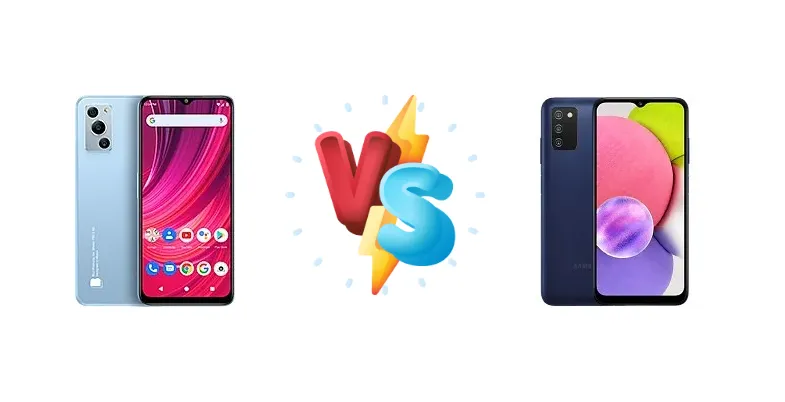
The BLU F92e and Samsung Galaxy A03s represent opposite ends of the ultra-budget smartphone spectrum. The F92e aims to deliver a surprisingly modern experience with its 5G-capable Dimensity 700 chipset, while the A03s focuses on maximizing battery life and leveraging Samsung’s brand recognition at the lowest possible price point. This comparison dissects their key differences to determine which phone offers the best value.
🏆 Quick Verdict
For most users, the BLU F92e is the superior choice. Its Mediatek Dimensity 700 chipset provides a significantly faster and more responsive experience than the Galaxy A03s’ Helio P35, making it better suited for multitasking, gaming, and future-proofing. While the A03s offers comparable battery endurance, the F92e’s performance advantage outweighs this benefit.
| Network |
|---|
| 2G bands | GSM 850 / 900 / 1800 / 1900 | GSM 850 / 900 / 1800 / 1900 |
| 3G bands | HSDPA 850 / 1700(AWS) / 1900 / 2100 | HSDPA 850 / 900 / 2100 |
| 4G bands | 2, 4, 5, 12, 13, 17, 25, 26, 41, 66, 71 | 1, 3, 5, 7, 8, 20, 28, 38, 40, 41 |
| 5G bands | 2, 5, 25, 41, 66, 71, 77 SA/NSA/Sub6 | - |
| Speed | HSPA, LTE, 5G | HSPA 42.2/5.76 Mbps, LTE Cat4 150/50 Mbps |
| Technology | GSM / HSPA / LTE / 5G | GSM / HSPA / LTE |
| | - | 2, 4, 5, 7, 12, 13, 14, 25, 26, 41, 66, 71 - SM-A037U |
| Launch |
|---|
| Announced | 2023, January 19 | 2021, August 18 |
| Status | Available. Released 2023, January 19 | Available. Released 2021, August 18 |
| Body |
|---|
| Build | - | Glass front, plastic frame, plastic back |
| Dimensions | 164.7 x 76 x 8.9 mm (6.48 x 2.99 x 0.35 in) | 164.2 x 75.9 x 9.1 mm (6.46 x 2.99 x 0.36 in) |
| SIM | Nano-SIM + Nano-SIM | Nano-SIM + Nano-SIM |
| Weight | 202 g (7.13 oz) | 196 g (6.91 oz) |
| Display |
|---|
| Resolution | 720 x 1600 pixels, 20:9 ratio (~270 ppi density) | 720 x 1600 pixels, 20:9 ratio (~270 ppi density) |
| Size | 6.5 inches, 102.0 cm2 (~81.5% screen-to-body ratio) | 6.5 inches, 102.0 cm2 (~81.8% screen-to-body ratio) |
| Type | IPS LCD | PLS LCD |
| Platform |
|---|
| CPU | Octa-core (2x2.2 GHz Cortex-A76 & 6x2.0 GHz Cortex-A55) | Octa-core (4x2.35 GHz Cortex-A53 & 4x1.8 GHz Cortex-A53) |
| Chipset | Mediatek Dimensity 700 (7 nm) | Mediatek MT6765 Helio P35 (12 nm) |
| GPU | Mali-G57 MC2 | PowerVR GE8320 |
| OS | Android 12 | Android 11, upgradable to Android 13, One UI 5.1 Core |
| Memory |
|---|
| Card slot | microSDXC | microSDXC (dedicated slot) |
| Internal | 128GB 4GB RAM | 32GB 2GB RAM, 32GB 3GB RAM, 32GB 4GB RAM, 64GB 3GB RAM, 64GB 4GB RAM |
| | - | eMMC 5.1 |
| Main Camera |
|---|
| Features | LED flash, HDR, panorama | LED flash |
| Single | 13 MP | 5 MP, f/2.2 |
| Triple | 50 MP, f/1.8, (wide), PDAF
2 MP, f/2.4, 115˚ (ultrawide)
Auxiliary lens | 13 MP, f/2.2, (wide), AF
2 MP (macro)
Auxiliary lens |
| Video | 1080p@30fps | 1080p@30fps |
| Selfie camera |
|---|
| Single | 13 MP | 5 MP, f/2.2 |
| Video | Yes | 1080p@30fps |
| Sound |
|---|
| 3.5mm jack | Yes | Yes |
| 35mm jack | Yes | Yes |
| Loudspeaker | Yes | Yes |
| Comms |
|---|
| Bluetooth | 5.0, A2DP, LE | 5.0, A2DP |
| NFC | No | Yes (market/region dependent) |
| Positioning | GPS | GPS, GLONASS, GALILEO, BDS |
| Radio | FM radio | No |
| USB | USB Type-C 2.0 | USB Type-C 2.0 |
| WLAN | Wi-Fi 802.11 a/b/g/n/ac | Wi-Fi 802.11 b/g/n, Wi-Fi Direct |
| Features |
|---|
| Sensors | Fingerprint (side-mounted), unspecified sensors | Fingerprint (side-mounted), accelerometer, proximity |
| Battery |
|---|
| Charging | 10W wired | 15W wired |
| Type | Li-Po 5000 mAh | Li-Po 5000 mAh |
| Misc |
|---|
| Colors | Blue, Black, Lime | Black, Blue, White |
| Models | - | SM-A037F, SM-A037F/DS, SM-A037M, SM-A037G, SM-A037U, SM-S134DL, SM-A037W, SM-A037U1, SM-S135DL |
| Price | About 190 EUR | $ 65.65 / £ 82.99 / ₹ 10,800 |
| SAR EU | - | 0.36 W/kg (head) 1.09 W/kg (body) |
| Tests |
|---|
| Battery life | - |
Endurance rating 122h
|
| Camera | - |
Photo / Video |
| Display | - |
Contrast ratio: 1718:1 (nominal) |
| Loudspeaker | - |
-27.4 LUFS (Good)
|
| Performance | - |
AnTuTu: 103465 (v8), 101299 (v9)
GeekBench: 889 (v5.1)
GFXBench: 5.5fps (ES 3.1 onscreen) |
BLU F92e
- Significantly faster processor (Dimensity 700)
- 5G connectivity for faster data speeds
- Better thermal management for sustained performance
- Slower charging speed (10W)
- Display specifications are unknown
Samsung Galaxy A03s
- Long battery life (122h endurance)
- Faster charging (15W)
- Brighter display (488 nits)
- Slow and outdated processor (Helio P35)
- Limited performance for demanding tasks
- Potentially underwhelming camera quality
Display Comparison
Both the BLU F92e and Samsung Galaxy A03s share a 1718:1 contrast ratio, suggesting similar image quality in terms of black levels. However, the Galaxy A03s boasts a measured peak brightness of 488 nits, which will provide better visibility outdoors. While the F92e’s display specifications are not provided, it’s likely to be in a similar range. The lack of high refresh rate panels on either device means scrolling and animations won’t be as fluid as on more expensive phones.
Camera Comparison
Both phones feature a 'Photo / Video' camera setup, but details are sparse. Without specific sensor sizes or aperture information, it’s difficult to make a definitive judgment. However, the inclusion of a 2MP macro camera on the A03s is likely to offer limited practical benefit due to its low resolution and lack of optical image stabilization. The F92e’s camera performance will likely be more consistent due to the overall processing power of the Dimensity 700 chipset, enabling faster image processing and potentially better low-light performance.
Performance
The performance disparity is the most significant difference between these two phones. The BLU F92e’s Mediatek Dimensity 700, built on a 7nm process, offers a substantial leap in processing power compared to the Samsung Galaxy A03s’ Mediatek Helio P35 (12nm). The Dimensity 700’s octa-core configuration, featuring two high-performance Cortex-A76 cores clocked at 2.2 GHz, provides a much more responsive experience for demanding applications. The A03s’ Helio P35, with its four Cortex-A53 cores peaking at 2.35 GHz, struggles with multitasking and graphically intensive tasks. The 7nm fabrication process of the Dimensity 700 also translates to better thermal efficiency, reducing the likelihood of performance throttling under sustained load.
Battery Life
Both the BLU F92e and Samsung Galaxy A03s achieve an endurance rating of 122 hours, indicating comparable battery life under similar usage conditions. However, the Galaxy A03s supports 15W wired charging, while the F92e is limited to 10W. This means the A03s will recharge faster, though neither offers particularly rapid charging speeds. The efficiency gains of the Dimensity 700 in the F92e may partially offset the slower charging, potentially leading to similar real-world usage times despite the charging wattage difference.
Buying Guide
Buy the BLU F92e if you prioritize performance and want a phone that can handle more demanding tasks like streaming, social media, and light gaming. You’ll benefit from faster app loading times and a smoother overall experience. Buy the Samsung Galaxy A03s if your primary concern is maximizing battery life and you only need a phone for basic communication – calls, texts, and occasional light browsing – and value the Samsung brand.
Frequently Asked Questions
❓ Will the Helio P35 in the Galaxy A03s struggle with modern mobile games like PUBG or Call of Duty?
Yes, the Helio P35 is a relatively weak chipset and will likely struggle to run demanding games like PUBG or Call of Duty smoothly, even at low settings. Expect significant frame rate drops and potential lag. The BLU F92e’s Dimensity 700 is far better equipped to handle these titles.
❓ Does the BLU F92e support carrier aggregation for improved 5G speeds?
While the Dimensity 700 supports carrier aggregation, the specific bands and implementation will vary depending on the BLU F92e’s regional variant and carrier compatibility. Check with your carrier to confirm which 5G bands are supported for optimal performance.
❓ Is the 15W charging on the Galaxy A03s a significant advantage over the F92e's 10W charging?
While 15W is faster than 10W, neither phone offers particularly rapid charging. The difference in charging time from 0-100% will likely be around 30-60 minutes, which isn't a massive disparity. The F92e's more efficient chipset may mitigate some of this difference in real-world usage.
❓ How does the software experience differ between BLU and Samsung?
Samsung’s One UI is a more polished and feature-rich software experience compared to BLU’s typically more stock Android approach. However, BLU often offers faster software updates for their devices. The A03s will likely receive more long-term software support from Samsung.