
BLU F91 vs Xiaomi Redmi Note 11 Pro 5G: Which Budget 5G Phone Reigns Supreme?
| Phones Images | |||||
|---|---|---|---|---|---|
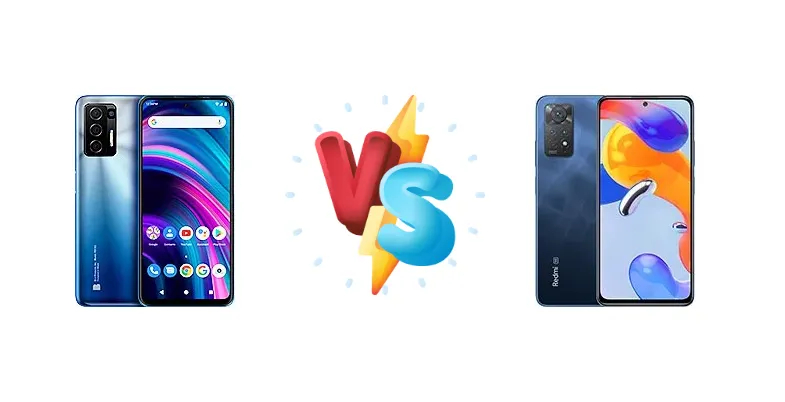
|
🏆 Quick Verdict
For the average user prioritizing rapid charging and a brighter display, the Xiaomi Redmi Note 11 Pro 5G is the clear winner. Its 67W charging dramatically outperforms the BLU F91’s 18W, and the 746 nit display offers superior visibility. However, the F91’s wireless charging and potentially more efficient Dimensity 810 chip offer niche advantages.
| PHONES | ||
|---|---|---|
| Phone Names | BLU F91 | Xiaomi Redmi Note 11 Pro 5G |
| Network | ||
|---|---|---|
| 2G bands | GSM 850 / 900 / 1800 / 1900 | GSM 850 / 900 / 1800 / 1900 |
| 3G bands | HSDPA 850 / 1700(AWS) / 1900 / 2100 | HSDPA 800 / 850 / 900 / 1900 / 2100 |
| 4G bands | 2, 4, 5, 12, 13, 17, 25, 26, 41, 66, 71 | 1, 2, 3, 4, 5, 7, 8, 12, 13, 17, 18, 19, 20, 26, 28, 32, 38, 40, 41, 66 |
| 5G bands | 2, 5, 25, 41, 66, 71, 77 SA/NSA/Sub6 | 1, 3, 5, 7, 8, 20, 28, 38, 40, 41, 66, 77, 78 SA/NSA |
| Speed | HSPA, LTE, 5G | HSPA, LTE, 5G |
| Technology | GSM / HSPA / LTE / 5G | GSM / HSPA / LTE / 5G |
| Launch | ||
|---|---|---|
| Announced | 2022, April 20 | 2022, January 26 |
| Status | Available. Released 2022, April 20 | Available. Released 2022, February 18 |
| Body | ||
|---|---|---|
| Build | - | Glass front (Gorilla Glass 5), glass back, plastic frame |
| Dimensions | 168.7 x 76.8 x 8.9 mm (6.64 x 3.02 x 0.35 in) | 164.2 x 76.1 x 8.1 mm (6.46 x 3.00 x 0.32 in) |
| SIM | Nano-SIM + Nano-SIM | Nano-SIM + Nano-SIM |
| Weight | 209 g (7.37 oz) | 202 g (7.13 oz) |
| - | IP53, dust and splash resistant | |
| Display | ||
|---|---|---|
| Protection | - | Corning Gorilla Glass 5 |
| Resolution | 1080 x 2460 pixels (~395 ppi density) | 1080 x 2400 pixels, 20:9 ratio (~395 ppi density) |
| Size | 6.8 inches, 109.8 cm2 (~84.8% screen-to-body ratio) | 6.67 inches, 107.4 cm2 (~86.0% screen-to-body ratio) |
| Type | IPS LCD | Super AMOLED, 120Hz, 700 nits, 1200 nits (peak) |
| Platform | ||
|---|---|---|
| CPU | Octa-core (2x2.4 GHz Cortex-A76 & 6x2.0 GHz Cortex-A55) | Octa-core (2x2.2 GHz Kryo 660 Gold & 6x1.7 GHz Kryo 660 Silver) |
| Chipset | Mediatek Dimensity 810 (6 nm) | Qualcomm SM6375 Snapdragon 695 5G (6 nm) |
| GPU | Mali-G57 MC2 | Adreno 619 |
| OS | Android 11 | Android 11, MIUI 13 |
| Memory | ||
|---|---|---|
| Card slot | microSDXC | microSDXC (uses shared SIM slot) |
| Internal | 128GB 8GB RAM | 64GB 6GB RAM, 128GB 4GB RAM, 128GB 6GB RAM, 128GB 8GB RAM |
| - | UFS 2.2 | |
| Main Camera | ||
|---|---|---|
| Features | LED flash, HDR, panorama | LED flash, HDR, panorama |
| Quad | 48 MP, f/1.8, (wide) 1/2.0", 0.8µm, PDAF 5 MP, f/2.2, 115˚ (ultrawide) 2 MP (macro) Auxiliary lens | - |
| Single | 16 MP, f/2.0 | 16 MP, f/2.5, (wide), 1/3.06" 1.0µm |
| Triple | - | 108 MP, f/1.9, 26mm (wide), 1/1.52", 0.7µm, PDAF 8 MP, f/2.2, 118˚ (ultrawide) 2 MP (macro) |
| Video | 4K@30fps, 1080p@30fps | 1080p@30fps |
| Selfie camera | ||
|---|---|---|
| Single | 16 MP, f/2.0 | 16 MP, f/2.5, (wide), 1/3.06" 1.0µm |
| Video | 1080p@30fps | 1080p@30fps |
| Sound | ||
|---|---|---|
| 3.5mm jack | Yes | Yes |
| 35mm jack | Yes | Yes |
| Loudspeaker | Yes | Yes, with stereo speakers |
| - | 24-bit/192kHz audio | |
| Comms | ||
|---|---|---|
| Bluetooth | 5.1, A2DP, LE | 5.1, A2DP, LE |
| Infrared port | - | Yes |
| NFC | Yes | Yes (market/region dependent) |
| Positioning | GPS | GPS, GLONASS, BDS, GALILEO |
| Radio | FM radio | Unspecified |
| USB | USB Type-C 2.0, OTG | USB Type-C 2.0, OTG |
| WLAN | Wi-Fi 802.11 b/g/n/ac, Wi-Fi Direct | Wi-Fi 802.11 a/b/g/n/ac, dual-band, Wi-Fi Direct |
| Features | ||
|---|---|---|
| Sensors | Fingerprint (side-mounted), accelerometer, gyro, proximity, compass | Fingerprint (side-mounted), accelerometer, gyro, compass |
| - | Virtual proximity sensing | |
| Battery | ||
|---|---|---|
| Charging | 18W wired 10W wireless Reverse wired | 67W wired, PD3.0, QC3, 50% in 15 min, 100% in 42 min |
| Type | Li-Po 5000 mAh | Li-Po 5000 mAh |
| Misc | ||
|---|---|---|
| Colors | Blue | Graphite Gray, Polar White, Atlantic Blue |
| Models | - | 21091116I, 2201116SG |
| Price | About 280 EUR | € 120.33 / $ 230.00 / £ 319.00 |
| SAR | - | 1.05 W/kg (head) 1.09 W/kg (body) |
| SAR EU | - | 0.60 W/kg (head) 0.96 W/kg (body) |
| Tests | ||
|---|---|---|
| Battery life | - | Endurance rating 115h |
| Camera | - | Photo / Video |
| Display | - | Contrast ratio: Infinite (nominal) |
| Loudspeaker | - | -25.8 LUFS (Very good) |
| Performance | - | AnTuTu: 288914 (v8), 382902 (v9) GeekBench: 2063 (v5.1) GFXBench: 17fps (ES 3.1 onscreen) |
BLU F91
- Wireless charging support offers added convenience.
- Reverse wired charging can top up other devices.
- Potentially more efficient Dimensity 810 chipset.
- Significantly slower 18W wired charging.
- Display specifications are unknown, likely inferior to Redmi Note 11 Pro 5G.
Xiaomi Redmi Note 11 Pro 5G
- Ultra-fast 67W wired charging (50% in 15 min, 100% in 42 min).
- Brighter 746 nit display for better outdoor visibility.
- Established Xiaomi camera software and image processing.
- Lacks wireless charging functionality.
- Snapdragon 695 may offer slightly lower peak CPU performance.
Display Comparison
The Xiaomi Redmi Note 11 Pro 5G boasts a significantly brighter display, reaching a measured 746 nits. This is a crucial advantage for outdoor visibility, especially in direct sunlight. While the BLU F91’s display specifications are not provided, it’s likely to be dimmer. The Redmi Note 11 Pro 5G also claims an infinite contrast ratio, typical of AMOLED or OLED panels, suggesting deeper blacks and more vibrant colors. The absence of display details for the F91 makes a direct comparison of color accuracy and panel technology impossible, but given its price point, it likely utilizes an IPS LCD.
Camera Comparison
Both phones offer photo and video capabilities, but detailed camera specifications are limited. Without sensor size, aperture, or image processing details for either device, a meaningful comparison is difficult. The Redmi Note 11 Pro 5G likely benefits from Xiaomi’s established camera software algorithms. The prevalence of 2MP macro lenses on budget phones suggests both devices may include one, but these typically offer limited practical value. The absence of OIS (Optical Image Stabilization) information for both phones suggests reliance on software stabilization.
Performance
Both devices utilize 6nm process technology, but the chipsets differ significantly. The BLU F91 features the Mediatek Dimensity 810, employing a dual-cluster configuration with 2x 2.4 GHz Cortex-A76 cores and 6x 2.0 GHz Cortex-A55 cores. The Xiaomi Redmi Note 11 Pro 5G uses the Qualcomm Snapdragon 695 5G, with 2x 2.2 GHz Kryo 660 Gold cores and 6x 1.7 GHz Kryo 660 Silver cores. While clock speeds suggest a slight edge for the Dimensity 810, real-world performance will depend on software optimization and thermal management. The Snapdragon 695 is known for its efficient 5G modem, potentially offering more stable connectivity. The lack of RAM specifications for the BLU F91 hinders a complete performance assessment, but the Redmi Note 11 Pro 5G’s LPDDR4X RAM is standard for its class.
Battery Life
Both the BLU F91 and the Xiaomi Redmi Note 11 Pro 5G achieve an endurance rating of 115 hours, indicating similar overall battery life under typical usage. However, the charging capabilities are drastically different. The Redmi Note 11 Pro 5G’s 67W wired charging, supporting PD3.0 and QC3, can reach 50% charge in just 15 minutes and 100% in 42 minutes. The BLU F91’s 18W wired charging is significantly slower. The F91 also offers 10W wireless charging and reverse wired charging, features absent on the Redmi Note 11 Pro 5G, providing added convenience for compatible devices.
Buying Guide
Buy the BLU F91 if you value wireless charging convenience and anticipate needing a phone that can potentially sip power more efficiently during sustained use. Buy the Xiaomi Redmi Note 11 Pro 5G if you prioritize incredibly fast wired charging, a brighter and more visible display, and a generally more polished user experience, even if it means sacrificing wireless charging.