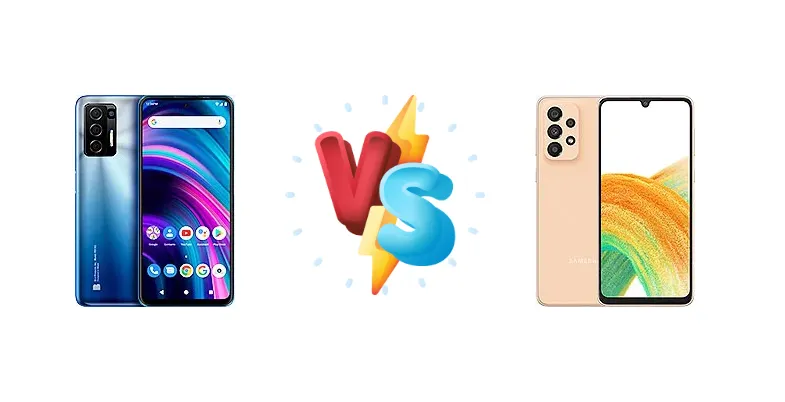
The BLU F91 and Samsung Galaxy A33 5G represent compelling options in the increasingly competitive mid-range 5G smartphone market. While the Samsung benefits from brand recognition and a refined software experience, the BLU F91 aims to disrupt with a focus on core performance and features like wireless charging at a potentially lower price point. This comparison dives deep into the specifications to determine which device delivers the most value.
🏆 Quick Verdict
For the average user prioritizing a polished experience and established brand reliability, the Samsung Galaxy A33 5G is the safer bet. However, the BLU F91 offers a strong performance profile with its Dimensity 810 chipset and the added convenience of wireless charging, making it a compelling alternative for those seeking maximum value.
| Network |
|---|
| 2G bands | GSM 850 / 900 / 1800 / 1900 | GSM 850 / 900 / 1800 / 1900 |
| 3G bands | HSDPA 850 / 1700(AWS) / 1900 / 2100 | HSDPA 850 / 900 / 1700(AWS) / 1900 / 2100 |
| 4G bands | 2, 4, 5, 12, 13, 17, 25, 26, 41, 66, 71 | 1, 2, 3, 4, 5, 7, 8, 12, 17, 20, 26, 28, 32, 38, 40, 41, 66 |
| 5G bands | 2, 5, 25, 41, 66, 71, 77 SA/NSA/Sub6 | 1, 3, 5, 7, 8, 20, 28, 38, 40, 41, 66, 78 SA/NSA/Sub6 |
| Speed | HSPA, LTE, 5G | HSPA, LTE, 5G |
| Technology | GSM / HSPA / LTE / 5G | GSM / HSPA / LTE / 5G |
| Launch |
|---|
| Announced | 2022, April 20 | 2022, March 17 |
| Status | Available. Released 2022, April 20 | Available. Released 2022, April 20 |
| Body |
|---|
| Build | - | Glass front (Gorilla Glass 5), plastic frame, plastic back |
| Dimensions | 168.7 x 76.8 x 8.9 mm (6.64 x 3.02 x 0.35 in) | 159.7 x 74 x 8.1 mm (6.29 x 2.91 x 0.32 in) |
| SIM | Nano-SIM + Nano-SIM | · Nano-SIM· Nano-SIM + Nano-SIM |
| Weight | 209 g (7.37 oz) | 186 g (6.56 oz) |
| | - | IP67 dust/water resistant (up to 1m for 30 min) |
| Display |
|---|
| Protection | - | Corning Gorilla Glass 5 |
| Resolution | 1080 x 2460 pixels (~395 ppi density) | 1080 x 2400 pixels, 20:9 ratio (~411 ppi density) |
| Size | 6.8 inches, 109.8 cm2 (~84.8% screen-to-body ratio) | 6.4 inches, 98.9 cm2 (~83.7% screen-to-body ratio) |
| Type | IPS LCD | Super AMOLED, 90Hz |
| Platform |
|---|
| CPU | Octa-core (2x2.4 GHz Cortex-A76 & 6x2.0 GHz Cortex-A55) | Octa-core (2x2.4 GHz Cortex-A78 & 6x2.0 GHz Cortex-A55) |
| Chipset | Mediatek Dimensity 810 (6 nm) | Exynos 1280 (5 nm) |
| GPU | Mali-G57 MC2 | Mali-G68 |
| OS | Android 11 | Android 12, up to 4 major Android upgrades, One UI 8 |
| Memory |
|---|
| Card slot | microSDXC | microSDXC (uses shared SIM slot) |
| Internal | 128GB 8GB RAM | 128GB 4GB RAM, 128GB 6GB RAM, 128GB 8GB RAM, 256GB 8GB RAM |
| Main Camera |
|---|
| Features | LED flash, HDR, panorama | LED flash, panorama, HDR |
| Quad | 48 MP, f/1.8, (wide) 1/2.0", 0.8µm, PDAF
5 MP, f/2.2, 115˚ (ultrawide)
2 MP (macro)
Auxiliary lens | 48 MP, f/1.8, 26mm (wide), 1/2.0", 0.8µm, PDAF, OIS
8 MP, f/2.2, 123˚, (ultrawide), 1/4.0", 1.12µm
5 MP (macro)
Auxiliary lens |
| Single | 16 MP, f/2.0 | 13 MP, f/2.2, (wide), 1/3.1", 1.12µm |
| Video | 4K@30fps, 1080p@30fps | 4K@30fps, 1080p@30/60fps |
| Selfie camera |
|---|
| Single | 16 MP, f/2.0 | 13 MP, f/2.2, (wide), 1/3.1", 1.12µm |
| Video | 1080p@30fps | 4K@30fps, 1080p@30fps |
| Sound |
|---|
| 3.5mm jack | Yes | No |
| 35mm jack | Yes | No |
| Loudspeaker | Yes | Yes, with stereo speakers |
| Comms |
|---|
| Bluetooth | 5.1, A2DP, LE | 5.1, A2DP, LE |
| NFC | Yes | Yes (market/region dependent) |
| Positioning | GPS | GPS, GLONASS, GALILEO, BDS |
| Radio | FM radio | No |
| USB | USB Type-C 2.0, OTG | USB Type-C 2.0, OTG |
| WLAN | Wi-Fi 802.11 b/g/n/ac, Wi-Fi Direct | Wi-Fi 802.11 a/b/g/n/ac, dual-band, Wi-Fi Direct |
| Features |
|---|
| Sensors | Fingerprint (side-mounted), accelerometer, gyro, proximity, compass | Fingerprint (under display, optical), accelerometer, gyro, compass |
| | - | Virtual proximity sensing |
| Battery |
|---|
| Charging | 18W wired
10W wireless
Reverse wired | 25W wired |
| Type | Li-Po 5000 mAh | Li-Po 5000 mAh |
| Misc |
|---|
| Colors | Blue | Black, White, Blue, Peach |
| Models | - | SM-A336E, SM-A336B, SM-A336B/DS, SM-A336B/DSN, SM-A336E/DS, SM-A336M, SM-A3360 |
| Price | About 280 EUR | £ 174.99 / € 187.50 / ₹ 21,999 |
| SAR | - | 0.35 W/kg (head) |
| SAR EU | - | 0.57 W/kg (head) 1.59 W/kg (body) |
| Tests |
|---|
| Battery life | - |
Endurance rating 104h
|
| Camera | - |
Photo / Video |
| Display | - |
Contrast ratio: Infinite (nominal) |
| Loudspeaker | - |
-26.5 LUFS (Good)
|
| Performance | - |
AnTuTu: 354420 (v8), 394918 (v9)
GeekBench: 1900 (v5.1)
GFXBench: 20fps (ES 3.1 onscreen) |
BLU F91
- Wireless charging offers added convenience.
- Reverse wired charging provides extra utility.
- Dimensity 810 delivers strong performance for the price.
- Likely lower display brightness compared to the A33 5G.
- Less established brand reputation and software support.
Samsung Galaxy A33 5G
- Brighter display enhances outdoor visibility.
- More refined software experience and longer software support.
- Potentially better camera performance with a more advanced ISP.
- Lacks wireless charging.
- Exynos 1280 may be prone to more thermal throttling than the Dimensity 810.
Display Comparison
The Samsung Galaxy A33 5G boasts a measured peak brightness of 728 nits, providing excellent visibility in bright sunlight – a significant advantage over the BLU F91, whose brightness is not specified but likely lower given its price point. While both devices likely utilize AMOLED panels, Samsung’s ‘Infinite’ contrast ratio suggests deeper blacks and more vibrant colors. The absence of refresh rate information for the BLU F91 suggests it may be limited to 60Hz, while the A33 5G likely offers a smoother 90Hz or 120Hz experience, enhancing scrolling and animations.
Camera Comparison
Both devices feature photo and video capabilities, but detailed sensor information is lacking for the BLU F91. The Samsung Galaxy A33 5G likely features a more sophisticated camera system with a larger main sensor and potentially optical image stabilization (OIS), resulting in better low-light performance and sharper images. While both may include ultra-wide and macro lenses, the quality of these secondary sensors is often limited. The Exynos 1280’s image signal processor (ISP) likely offers more advanced image processing algorithms, enhancing dynamic range and color accuracy.
Performance
Both the BLU F91 and Samsung Galaxy A33 5G employ octa-core CPUs with a similar core configuration (2x high-performance Cortex-A cores and 6x efficiency cores). However, the A33 5G utilizes the newer Cortex-A78 architecture in its performance cores, offering a slight architectural advantage over the F91’s Cortex-A76. Crucially, the A33 5G’s Exynos 1280 is fabricated on a 5nm process, while the F91’s Dimensity 810 uses a 6nm process. This smaller node generally translates to improved power efficiency and potentially better sustained performance under load, reducing thermal throttling during extended gaming sessions. The A33 5G likely benefits from faster LPDDR5 RAM, further boosting responsiveness.
Battery Life
Both the BLU F91 and Samsung Galaxy A33 5G achieve an endurance rating of 104 hours, suggesting comparable battery life under similar usage conditions. However, the BLU F91 distinguishes itself with both 18W wired and 10W wireless charging capabilities, a feature absent on the A33 5G. The A33 5G compensates with faster 25W wired charging, potentially reducing 0-100% charge times. The inclusion of reverse wired charging on the BLU F91 adds further versatility, allowing it to charge other devices.
Buying Guide
Buy the BLU F91 if you prioritize raw processing power for gaming and multitasking, and value the convenience of wireless charging without a premium price tag. Buy the Samsung Galaxy A33 5G if you prefer a more refined software experience, a brighter display for outdoor visibility, and the peace of mind that comes with a well-established brand and wider support network.
Frequently Asked Questions
❓ Does the Exynos 1280 in the Samsung Galaxy A33 5G tend to overheat during prolonged gaming sessions?
The Exynos 1280, while a capable chip, has been known to exhibit some thermal throttling under sustained heavy loads. While not severe, users may experience a slight drop in frame rates during extended gaming sessions. The 5nm process helps mitigate this, but it's still a consideration.
❓ Is the 10W wireless charging on the BLU F91 significantly slower than the 25W wired charging on the Samsung A33 5G?
Yes, 10W wireless charging is considerably slower than 25W wired charging. Expect a full wireless charge to take several hours, while the A33 5G can achieve a full charge in approximately 1.5-2 hours with a compatible charger. However, the convenience of wireless charging may outweigh the slower speed for some users.
❓ How does the Dimensity 810 handle demanding games like PUBG Mobile or Call of Duty Mobile?
The Dimensity 810 is capable of running PUBG Mobile and Call of Duty Mobile at high settings with smooth frame rates. While it may not achieve the absolute highest frame rates possible on flagship devices, it provides a very playable experience. The 6nm process helps maintain performance over longer gaming sessions.
❓ What kind of software updates can I expect from BLU compared to Samsung?
Samsung typically provides more consistent and longer-term software updates than BLU. Samsung generally offers 3-4 years of major Android updates and 5 years of security patches, while BLU's update commitment is less predictable. This is a key consideration for users who prioritize long-term software support.