
BLU F91 vs OnePlus Nord N20 5G: A Deep Dive into Budget 5G Contenders
| Phones Images | |||||
|---|---|---|---|---|---|
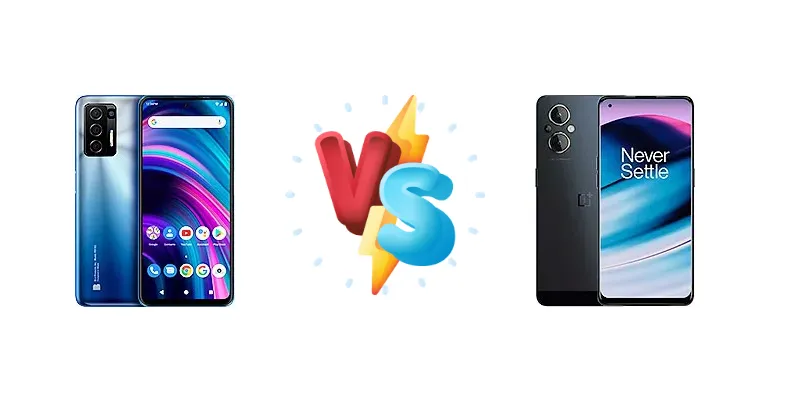
|
🏆 Quick Verdict
For the average user prioritizing a brighter display and faster wired charging, the OnePlus Nord N20 5G emerges as the better choice. However, the BLU F91’s inclusion of wireless charging and reverse wired charging provides unique utility that the Nord N20 5G lacks, making it a strong contender for specific use cases.
| PHONES | ||
|---|---|---|
| Phone Names | BLU F91 | OnePlus Nord N20 5G |
| Network | ||
|---|---|---|
| 2G bands | GSM 850 / 900 / 1800 / 1900 | GSM 850 / 900 / 1800 / 1900 |
| 3G bands | HSDPA 850 / 1700(AWS) / 1900 / 2100 | HSDPA 850 / 900 / 1700(AWS) / 1900 / 2100 |
| 4G bands | 2, 4, 5, 12, 13, 17, 25, 26, 41, 66, 71 | 1, 2, 3, 4, 5, 7, 8, 12, 13, 17, 20, 25, 26, 28, 38, 39, 40, 41, 66, 71 |
| 5G bands | 2, 5, 25, 41, 66, 71, 77 SA/NSA/Sub6 | 2, 25, 41, 66, 71 SA/NSA |
| Speed | HSPA, LTE, 5G | HSPA 42.2/5.76 Mbps, LTE Cat15 800/200 Mbps, 5G |
| Technology | GSM / HSPA / LTE / 5G | GSM / HSPA / LTE / 5G |
| Launch | ||
|---|---|---|
| Announced | 2022, April 20 | 2022, April 28 |
| Status | Available. Released 2022, April 20 | Available. Released 2022, April 28 |
| Body | ||
|---|---|---|
| Build | - | Glass front (Schott Xensation Up), plastic frame, plastic back |
| Dimensions | 168.7 x 76.8 x 8.9 mm (6.64 x 3.02 x 0.35 in) | 159.9 x 73.2 x 7.5 mm (6.30 x 2.88 x 0.30 in) |
| SIM | Nano-SIM + Nano-SIM | Nano-SIM |
| Weight | 209 g (7.37 oz) | 173 g (6.10 oz) |
| Display | ||
|---|---|---|
| Protection | - | Schott Xensation Up |
| Resolution | 1080 x 2460 pixels (~395 ppi density) | 1080 x 2400 pixels, 20:9 ratio (~409 ppi density) |
| Size | 6.8 inches, 109.8 cm2 (~84.8% screen-to-body ratio) | 6.43 inches, 99.8 cm2 (~85.3% screen-to-body ratio) |
| Type | IPS LCD | AMOLED |
| - | Always-on display | |
| Platform | ||
|---|---|---|
| CPU | Octa-core (2x2.4 GHz Cortex-A76 & 6x2.0 GHz Cortex-A55) | Octa-core (2x2.2 GHz Kryo 660 Gold & 6x1.7 GHz Kryo 660 Silver) |
| Chipset | Mediatek Dimensity 810 (6 nm) | Qualcomm SM6375 Snapdragon 695 5G (6 nm) |
| GPU | Mali-G57 MC2 | Adreno 619 |
| OS | Android 11 | Android 11, OxygenOS 11 |
| Memory | ||
|---|---|---|
| Card slot | microSDXC | microSDXC (dedicated slot) |
| Internal | 128GB 8GB RAM | 128GB 6GB RAM |
| - | UFS 2.2 | |
| Main Camera | ||
|---|---|---|
| Features | LED flash, HDR, panorama | LED flash, HDR, panorama |
| Quad | 48 MP, f/1.8, (wide) 1/2.0", 0.8µm, PDAF 5 MP, f/2.2, 115˚ (ultrawide) 2 MP (macro) Auxiliary lens | - |
| Single | 16 MP, f/2.0 | 16 MP, f/2.4, (wide) |
| Triple | - | 64 MP, f/1.8, (wide), PDAF 2 MP (macro) Auxiliary lens |
| Video | 4K@30fps, 1080p@30fps | 1080p@30fps |
| Selfie camera | ||
|---|---|---|
| Features | - | HDR |
| Single | 16 MP, f/2.0 | 16 MP, f/2.4, (wide) |
| Video | 1080p@30fps | 1080p@30fps |
| Sound | ||
|---|---|---|
| 3.5mm jack | Yes | Yes |
| 35mm jack | Yes | Yes |
| Loudspeaker | Yes | Yes |
| Comms | ||
|---|---|---|
| Bluetooth | 5.1, A2DP, LE | 5.1, A2DP, LE |
| NFC | Yes | Yes |
| Positioning | GPS | GPS (L1+L5), GLONASS, GALILEO, BDS |
| Radio | FM radio | No |
| USB | USB Type-C 2.0, OTG | USB Type-C 2.0, OTG |
| WLAN | Wi-Fi 802.11 b/g/n/ac, Wi-Fi Direct | Wi-Fi 802.11 a/b/g/n/ac, dual-band, Wi-Fi Direct |
| Features | ||
|---|---|---|
| Sensors | Fingerprint (side-mounted), accelerometer, gyro, proximity, compass | Fingerprint (under display, optical), accelerometer, gyro, proximity, compass, barometer |
| Battery | ||
|---|---|---|
| Charging | 18W wired 10W wireless Reverse wired | 33W wired |
| Type | Li-Po 5000 mAh | Li-Po 4500 mAh |
| Misc | ||
|---|---|---|
| Colors | Blue | Blue |
| Models | - | GN2200, CPH2459 |
| Price | About 280 EUR | About 120 EUR |
| Tests | ||
|---|---|---|
| Battery life | - | Endurance rating 129h |
| Display | - | Contrast ratio: Infinite (nominal) |
| Performance | - | AnTuTu: 316974 (v8), 380672 (v9) GeekBench: 1945 (v5.1) GFXBench: 16fps (ES 3.1 onscreen) |
BLU F91
- Includes wireless charging for added convenience.
- Offers reverse wired charging to top up other devices.
- Potentially slightly faster CPU performance due to Dimensity 810.
- Slower 18W wired charging.
- Likely lower display brightness compared to the Nord N20 5G.
OnePlus Nord N20 5G
- Faster 33W wired charging for quicker power-ups.
- Brighter display (647 nits) for better outdoor visibility.
- Qualcomm Snapdragon 695 potentially offers better GPU performance.
- Lacks wireless charging functionality.
- No reverse charging capability.
Display Comparison
The OnePlus Nord N20 5G boasts a significantly brighter display, reaching a measured 647 nits, compared to an unspecified brightness for the BLU F91. This difference is crucial for outdoor visibility. While both displays are likely to utilize LCD technology given the price point, the Nord N20 5G’s higher peak brightness provides a superior viewing experience in bright conditions. The Nord N20 5G also claims an 'Infinite' contrast ratio, typical of LCDs, but the lack of detailed display specs for the F91 makes a direct comparison difficult. Bezels are likely comparable, given the similar overall phone sizes in this segment.
Camera Comparison
Without detailed camera specifications beyond the main sensors, a direct comparison is challenging. Both phones likely feature multi-camera setups, but the quality will heavily depend on sensor size, lens aperture, and image processing algorithms. Given the price bracket, expect similar performance in good lighting conditions. The absence of Optical Image Stabilization (OIS) on either device suggests that low-light performance will be a weakness for both. Focusing on the main sensors is key, as the inclusion of 2MP macro or depth sensors adds little practical value.
Performance
The core difference lies in the chipsets: the BLU F91 utilizes the Mediatek Dimensity 810 (6nm) while the OnePlus Nord N20 5G features the Qualcomm Snapdragon 695 5G (6nm). Both are 6nm chips, suggesting similar efficiency, but the Dimensity 810’s CPU configuration – 2x2.4 GHz Cortex-A76 and 6x2.0 GHz Cortex-A55 – indicates a slight edge in raw CPU performance compared to the Nord N20 5G’s 2x2.2 GHz Kryo 660 Gold and 6x1.7 GHz Kryo 660 Silver. However, Qualcomm’s Snapdragon typically excels in GPU performance and software optimization, potentially leading to a smoother gaming experience on the Nord N20 5G. The impact of RAM speed (likely LPDDR4X on both) is less significant than the chipset choice.
Battery Life
Both the BLU F91 and OnePlus Nord N20 5G achieve an endurance rating of 129 hours, suggesting comparable battery life under similar usage patterns. However, the charging speeds differ significantly. The Nord N20 5G supports 33W wired charging, enabling faster top-ups compared to the F91’s 18W wired charging. The BLU F91 uniquely offers 10W wireless charging and reverse wired charging, allowing it to charge other devices – a feature absent on the Nord N20 5G. While 10W wireless charging is slow, it provides added convenience.
Buying Guide
Buy the BLU F91 if you value the convenience of wireless charging and the ability to top up other devices with reverse wired charging, even if it means sacrificing some peak performance and display brightness. Buy the OnePlus Nord N20 5G if you prioritize a brighter, more easily visible display in sunlight and faster 33W wired charging for quicker power-ups, accepting that wireless charging isn't available.