
BLU F91 vs. Motorola Moto G Stylus 5G (2022): A Detailed Performance and Feature Comparison
| Phones Images | |||||
|---|---|---|---|---|---|
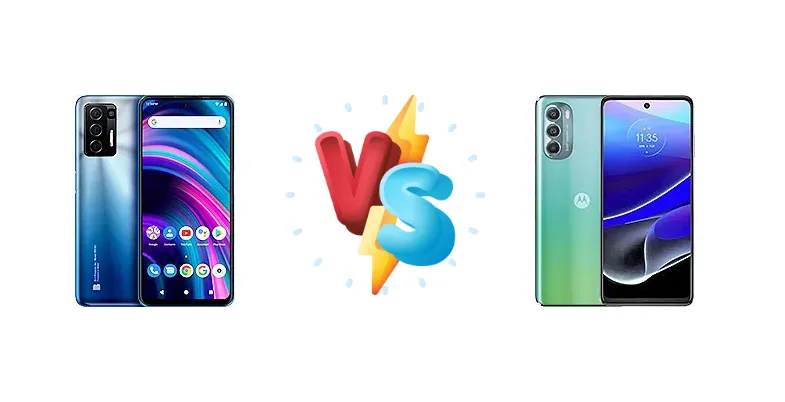
|
🏆 Quick Verdict
For users prioritizing raw performance and faster charging speeds, the BLU F91 emerges as the winner. Its Mediatek Dimensity 810 chipset offers a noticeable CPU performance edge, complemented by both wired and wireless charging capabilities, features absent in the Motorola. However, the Moto G Stylus's integrated stylus remains a unique advantage.
| PHONES | ||
|---|---|---|
| Phone Names | BLU F91 | Motorola Moto G Stylus 5G (2022) |
| Network | ||
|---|---|---|
| 2G bands | GSM 850 / 900 / 1800 / 1900 | GSM 850 / 900 / 1800 / 1900 |
| 3G bands | HSDPA 850 / 1700(AWS) / 1900 / 2100 | HSDPA 850 / 900 / 1700(AWS) / 1900 / 2100 |
| 4G bands | 2, 4, 5, 12, 13, 17, 25, 26, 41, 66, 71 | 1, 2, 3, 4, 5, 7, 8, 12, 13, 17, 18, 19, 20, 25, 26, 28, 29, 30, 38, 39, 40, 41, 48, 66, 71 - USA |
| 5G bands | 2, 5, 25, 41, 66, 71, 77 SA/NSA/Sub6 | 1, 2, 5, 12, 14, 24, 26, 29, 30, 41, 48, 66, 70, 71, 77, 78 SA/NSA - USA |
| Speed | HSPA, LTE, 5G | HSPA, LTE, 5G |
| Technology | GSM / HSPA / LTE / 5G | GSM / HSPA / LTE / 5G |
| Launch | ||
|---|---|---|
| Announced | 2022, April 20 | 2022, April 22 |
| Status | Available. Released 2022, April 20 | Available. Released 2022, April 27 |
| Body | ||
|---|---|---|
| Build | - | Glass front, plastic frame, plastic back |
| Dimensions | 168.7 x 76.8 x 8.9 mm (6.64 x 3.02 x 0.35 in) | 168.9 x 75.8 x 9.3 mm (6.65 x 2.98 x 0.37 in) |
| SIM | Nano-SIM + Nano-SIM | Nano-SIM |
| Weight | 209 g (7.37 oz) | 215 g (7.58 oz) |
| - | Stylus Water-repellent design | |
| Display | ||
|---|---|---|
| Resolution | 1080 x 2460 pixels (~395 ppi density) | 1080 x 2460 pixels (~395 ppi density) |
| Size | 6.8 inches, 109.8 cm2 (~84.8% screen-to-body ratio) | 6.8 inches, 109.8 cm2 (~85.8% screen-to-body ratio) |
| Type | IPS LCD | IPS LCD, 120Hz |
| Platform | ||
|---|---|---|
| CPU | Octa-core (2x2.4 GHz Cortex-A76 & 6x2.0 GHz Cortex-A55) | Octa-core (2x2.2 GHz Kryo 660 Gold & 6x1.7 GHz Kryo 660 Silver) |
| Chipset | Mediatek Dimensity 810 (6 nm) | Qualcomm SM6375 Snapdragon 695 5G (6 nm) |
| GPU | Mali-G57 MC2 | Adreno 619 |
| OS | Android 11 | Android 12, planned upgrade to Android 13 |
| Memory | ||
|---|---|---|
| Card slot | microSDXC | microSDXC (dedicated slot) |
| Internal | 128GB 8GB RAM | 128GB 4GB RAM, 128GB 6GB RAM, 128GB 8GB RAM, 256GB 8GB RAM |
| Main Camera | ||
|---|---|---|
| Features | LED flash, HDR, panorama | LED flash, HDR, panorama |
| Quad | 48 MP, f/1.8, (wide) 1/2.0", 0.8µm, PDAF 5 MP, f/2.2, 115˚ (ultrawide) 2 MP (macro) Auxiliary lens | - |
| Single | 16 MP, f/2.0 | - |
| Triple | - | 50 MP, f/1.9, 26mm (wide), 0.64µm, PDAF, OIS 8 MP, f/2.2, 118˚ (ultrawide), 1/4.0, 1.12µm Auxiliary lens |
| Video | 4K@30fps, 1080p@30fps | 1080p@30/60fps; gyro-EIS |
| Selfie camera | ||
|---|---|---|
| Features | - | HDR |
| Single | 16 MP, f/2.0 | 16 MP, f/2.2, (wide), 1/3.06", 1.0µm |
| Video | 1080p@30fps | 1080p@30fps |
| Sound | ||
|---|---|---|
| 3.5mm jack | Yes | Yes |
| 35mm jack | Yes | Yes |
| Loudspeaker | Yes | Yes |
| Comms | ||
|---|---|---|
| Bluetooth | 5.1, A2DP, LE | 5.1, A2DP, LE |
| NFC | Yes | Yes |
| Positioning | GPS | GPS, GLONASS, BDS, GALILEO |
| Radio | FM radio | FM radio |
| USB | USB Type-C 2.0, OTG | USB Type-C 2.0 |
| WLAN | Wi-Fi 802.11 b/g/n/ac, Wi-Fi Direct | Wi-Fi 802.11 a/b/g/n/ac, dual-band, Wi-Fi Direct |
| Features | ||
|---|---|---|
| Sensors | Fingerprint (side-mounted), accelerometer, gyro, proximity, compass | Fingerprint (side-mounted), accelerometer, gyro, proximity |
| Battery | ||
|---|---|---|
| Charging | 18W wired 10W wireless Reverse wired | 10W wired, QC3 |
| Type | Li-Po 5000 mAh | Li-Po 5000 mAh |
| Misc | ||
|---|---|---|
| Colors | Blue | Steel Blue, Seafoam Green |
| Models | - | XT2215, XT2215-1, XT2215-2, XT2215-3, XT2215-4 |
| Price | About 280 EUR | $ 66.60 |
BLU F91
- Faster CPU performance with the Dimensity 810
- 18W wired and 10W wireless charging
- Reverse wired charging capability
- Brand recognition is lower than Motorola
- Software update support may be less frequent
Motorola Moto G Stylus 5G (2022)
- Integrated stylus for note-taking and navigation
- Larger battery capacity (typically 5000mAh)
- Established brand with potentially better software support
- Slower CPU performance with the Snapdragon 695
- Slow 10W wired charging only
- Limited wireless charging options
Display Comparison
Neither device boasts a standout display. Both likely utilize LCD panels, common in this price bracket. The focus here isn't on visual fidelity, but on functionality. While specific display specs are unavailable, the Motorola's larger screen size (typically around 6.8 inches for this series) may offer a more immersive viewing experience, but at the cost of one-handed usability. The BLU F91's display size is unknown, but likely smaller, prioritizing portability.
Camera Comparison
Without detailed camera specs, a direct comparison is difficult. Both phones likely feature multi-camera setups, but image quality will heavily depend on sensor size and image processing. Given the price point, expect primary sensors around 48MP or 50MP. The Motorola Moto G Stylus 5G (2022) often includes a dedicated macro camera (typically 2MP), which offers limited utility due to its low resolution. The BLU F91’s camera capabilities are less documented, but the chipset’s ISP (Image Signal Processor) will play a crucial role in image quality. Expect similar performance in good lighting conditions, but the Dimensity 810’s ISP may offer better low-light processing.
Performance
The core difference lies in the chipsets. The BLU F91’s Mediatek Dimensity 810 (6nm) features a CPU configuration of 2x2.4 GHz Cortex-A76 and 6x2.0 GHz Cortex-A55 cores. This contrasts with the Motorola’s Qualcomm Snapdragon 695 5G (6nm) with 2x2.2 GHz Kryo 660 Gold and 6x1.7 GHz Kryo 660 Silver cores. The Dimensity 810’s higher clock speeds on its prime cores suggest a performance advantage in CPU-intensive tasks. While both are 6nm chips, the Dimensity 810 generally benchmarks higher in Geekbench scores, indicating faster application loading and smoother multitasking. The Snapdragon 695 prioritizes efficiency, potentially leading to slightly better battery life under light loads, but will likely struggle more with demanding games.
Battery Life
The Motorola Moto G Stylus 5G (2022) typically features a large 5000mAh battery, prioritizing longevity. However, it’s limited to 10W wired charging, resulting in a slow recharge time. The BLU F91, while potentially having a smaller battery capacity (spec not provided), compensates with 18W wired charging and, crucially, 10W wireless charging. This flexibility is a significant advantage, allowing for convenient top-ups without needing a cable. The inclusion of reverse wired charging on the BLU F91 further expands its utility, enabling it to charge other devices.
Buying Guide
Buy the BLU F91 if you need a phone that prioritizes processing power for gaming or multitasking, and value the convenience of wireless charging. Buy the Motorola Moto G Stylus 5G (2022) if you frequently take notes, sketch, or navigate with a stylus, and prefer a more established brand with potentially better software support, despite the performance trade-offs.