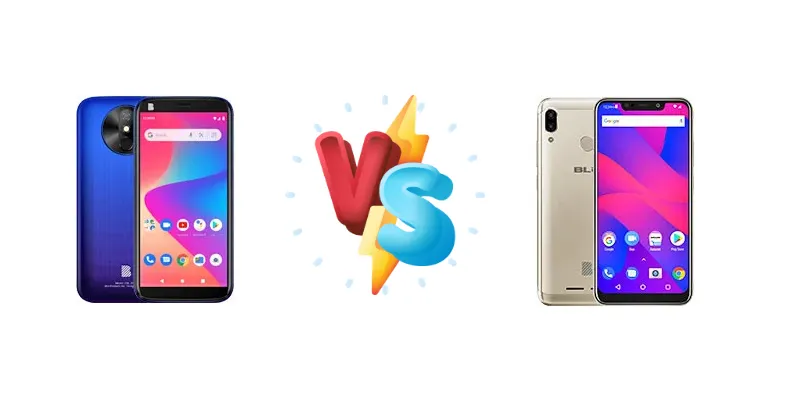
Both the BLU C6L 2020 and the BLU Vivo XL4 target the ultra-budget smartphone market, but they approach it with different hardware philosophies. The C6L 2020 relies on a basic quad-core processor, while the Vivo XL4 steps up to a Mediatek Helio P22 chipset. This comparison dissects the real-world implications of these choices, helping you determine which phone offers the best value.
🏆 Quick Verdict
For most users, the BLU Vivo XL4 is the superior choice. Its octa-core Helio P22 chipset provides a significantly smoother experience for multitasking and app loading compared to the C6L 2020’s quad-core processor. While both phones are entry-level, the XL4 offers a noticeable performance boost justifying the potential price difference.
| Network |
|---|
| 2G bands | GSM 850 / 900 / 1800 / 1900 | GSM 850 / 900 / 1800 / 1900 |
| 3G bands | HSDPA 850 / 900 / 1700(AWS) / 1900 / 2100 | HSDPA 850 / 900 / 1700(AWS) / 1900 / 2100 |
| 4G bands | 1, 2, 3, 4, 5, 7, 12, 17, 28 | 1, 2, 3, 4, 5, 7, 8, 12, 17, 28, 66 |
| Speed | HSPA, LTE | HSPA 42.2/11.5 Mbps, LTE (2CA) Cat6 300/50 Mbps |
| Technology | GSM / HSPA / LTE | GSM / HSPA / LTE |
| Launch |
|---|
| Announced | 2020, October. Released 2020, October | 2018, December. Released 2018, December |
| Status | Discontinued | Discontinued |
| Body |
|---|
| Dimensions | 155 x 74.7 x 10.9 mm (6.10 x 2.94 x 0.43 in) | 157.2 x 76.2 x 8 mm (6.19 x 3.00 x 0.31 in) |
| SIM | Nano-SIM + Micro-SIM | Nano-SIM + Micro-SIM |
| Weight | 167 g (5.89 oz) | 178 g (6.28 oz) |
| Display |
|---|
| Resolution | 720 x 1440 pixels, 18:9 ratio (~282 ppi density) | 720 x 1520 pixels, 19:9 ratio (~271 ppi density) |
| Size | 5.7 inches, 83.8 cm2 (~72.4% screen-to-body ratio) | 6.2 inches, 95.9 cm2 (~80.1% screen-to-body ratio) |
| Type | IPS LCD | IPS LCD |
| Platform |
|---|
| CPU | Quad-core 1.4 GHz Cortex-A53 | Octa-core 2.0 GHz Cortex-A53 |
| Chipset | - | Mediatek MT6762 Helio P22 (12 nm) |
| GPU | Mali-T820 | PowerVR GE8320 |
| OS | Android 10 (Go edition) | Android 8.1 (Oreo) |
| Memory |
|---|
| Card slot | microSDXC | microSDXC |
| Internal | 16GB 1GB RAM | 32GB 3GB RAM |
| | eMMC 5.1 | eMMC 5.1 |
| Main Camera |
|---|
| Dual | - | 13 MP, f/2.0, 1/3.0", PDAF
Auxiliary lens |
| Features | LED flash | LED flash |
| Single | 8 MP | - |
| Video | 720p@30fps | 1080p@30fps |
| Selfie camera |
|---|
| Features | - | LED flash |
| Single | 8 MP | 13 MP, f/2.2, 1/4.0" |
| Video | 720p@30fps | 1080p@30fps |
| Sound |
|---|
| 3.5mm jack | Yes | Yes |
| 35mm jack | Yes | Yes |
| Loudspeaker | Yes | Yes |
| Comms |
|---|
| Bluetooth | 4.0, A2DP | 4.0, A2DP |
| NFC | No | No |
| Positioning | GPS | GPS |
| Radio | FM radio | FM radio |
| USB | microUSB 2.0 | microUSB 2.0 |
| WLAN | Wi-Fi 802.11 b/g/n, Wi-Fi Direct | Wi-Fi 802.11 а/b/g/n, Wi-Fi Direct |
| Features |
|---|
| Sensors | Fingerprint (rear-mounted), accelerometer | Fingerprint (rear-mounted), accelerometer, proximity, compass |
| Battery |
|---|
| Stand-by | - | Up to 750 h (2G) / Up to 650 h (3G) |
| Talk time | - | Up to 30 h (2G) / Up to 24 h (3G) |
| Type | Li-Ion 3000 mAh | Li-Po 4000 mAh, non-removable |
| Misc |
|---|
| Colors | Red, Blue, Green | Black, Gold |
| Price | About 50 EUR | About 130 EUR |
BLU C6L 2020
- Lowest possible price point
- Simple and easy to use interface
- Potentially longer standby time due to less powerful processor
- Slow performance for multitasking
- Limited app compatibility
- Poor gaming performance
BLU Vivo XL4
- Significantly faster performance
- Smoother multitasking experience
- Better camera image processing
- Higher price than the C6L 2020
- Potentially slightly shorter battery life under heavy load
- May require more frequent software updates
Display Comparison
Neither BLU provides detailed display specifications. However, given their price points, both likely utilize IPS LCD panels. The Vivo XL4’s chipset suggests a potentially higher resolution display to take advantage of the increased processing power. The C6L 2020, with its simpler processor, likely targets a lower resolution to conserve resources. Without specific brightness or color gamut data, it’s difficult to assess visual quality, but the XL4’s chipset implies a more capable display subsystem.
Camera Comparison
Both phones likely feature basic camera setups. Without specific sensor details, it’s difficult to make a definitive comparison. However, the Helio P22 chipset in the Vivo XL4 includes an image signal processor (ISP) capable of handling more complex image processing algorithms. This could result in slightly better image quality, particularly in low-light conditions, compared to the C6L 2020. The presence of a more powerful ISP suggests the XL4 might offer features like HDR or scene detection, absent on the C6L 2020. We can assume both phones will have a primary camera and potentially a secondary depth or macro sensor, but the XL4’s ISP will be the differentiating factor.
Performance
The core difference lies in the chipset. The BLU C6L 2020’s quad-core 1.4 GHz Cortex-A53 processor is a basic design, suitable for minimal tasks. The BLU Vivo XL4, however, features the Mediatek MT6762 Helio P22, an octa-core processor clocked at 2.0 GHz, also using Cortex-A53 cores. The Helio P22’s eight cores, combined with its 12nm manufacturing process, offer a substantial performance advantage in multi-threaded applications and multitasking. This translates to faster app launch times and a more fluid user experience on the XL4. The 12nm process also contributes to better power efficiency compared to a potentially larger process node used in the C6L 2020.
Battery Life
Battery capacity isn’t specified for either device. However, the Helio P22’s 12nm process and optimized power management features likely contribute to better battery life on the Vivo XL4, despite the increased processing power. The C6L 2020’s simpler processor might consume less power under light load, but the XL4’s efficiency gains will likely be more noticeable during sustained use. Charging wattage is also unknown, but the XL4’s chipset might support faster charging protocols, potentially reducing 0-100% charge times.
Buying Guide
Buy the BLU C6L 2020 if you absolutely need the lowest possible price and your smartphone usage is limited to basic tasks like calls, texts, and light web browsing. Buy the BLU Vivo XL4 if you want a more responsive experience for social media, occasional gaming, and smoother multitasking, even if it means spending a bit more upfront.
Frequently Asked Questions
❓ Will the BLU Vivo XL4 handle popular social media apps like Facebook and Instagram smoothly?
Yes, the Helio P22 chipset in the Vivo XL4 provides enough processing power to run social media apps smoothly, with minimal lag during scrolling and content loading. The C6L 2020 may struggle with these apps, especially when multiple apps are open simultaneously.
❓ Is the BLU C6L 2020 suitable for playing mobile games?
The BLU C6L 2020 is not well-suited for gaming. Its quad-core processor and limited graphics capabilities will result in low frame rates and a poor gaming experience, even with less demanding titles. The Vivo XL4 offers a slightly better gaming experience, but it’s still limited to casual games.
❓ Does the BLU Vivo XL4 support 4G LTE connectivity?
Yes, the Mediatek Helio P22 chipset in the BLU Vivo XL4 includes a 4G LTE modem, allowing for fast data speeds on compatible networks. The BLU C6L 2020 likely also supports 4G LTE, but the Helio P22 offers potentially better connectivity performance.
❓ How much storage does each phone offer, and is it expandable?
Storage capacity isn't specified in the provided data. However, given the price point, both phones likely offer limited internal storage (e.g., 16GB or 32GB). It's highly probable that both devices include a microSD card slot for expandable storage, allowing users to add more space for photos, videos, and apps.