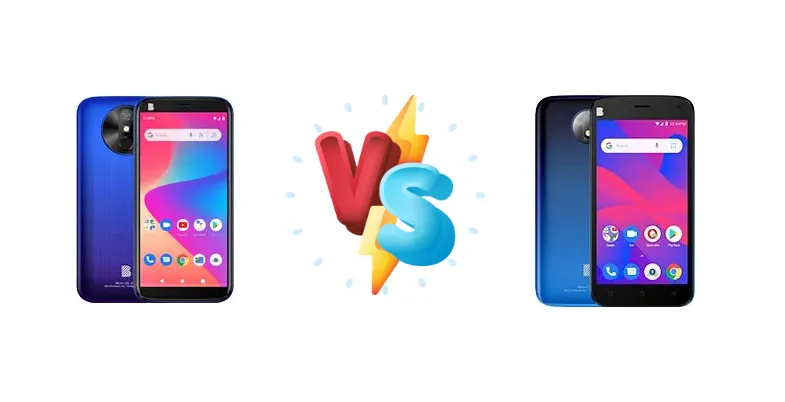
The BLU C6L 2020 and BLU C5 2019 represent the ultra-budget end of the smartphone spectrum. While both aim to provide essential functionality at a low price point, a closer look at their core components reveals a subtle but important performance difference driven by CPU architecture. This comparison dissects those differences to help you choose the best option for your needs.
🏆 Quick Verdict
For the average user prioritizing responsiveness in everyday tasks, the BLU C6L 2020 is the better choice. Its Cortex-A53 CPU, while still entry-level, offers a slight architectural advantage over the C5 2019’s Cortex-A7, resulting in a smoother user experience, despite the marginally lower clock speed.
| Network |
|---|
| 2G bands | GSM 850 / 900 / 1800 / 1900 | GSM 850 / 900 / 1800 / 1900 |
| 3G bands | HSDPA 850 / 900 / 1700(AWS) / 1900 / 2100 | HSDPA 850 / 1900 / 2100 - C110L |
| 4G bands | 1, 2, 3, 4, 5, 7, 12, 17, 28 | - |
| Speed | HSPA, LTE | HSPA 21.1/5.76 Mbps |
| Technology | GSM / HSPA / LTE | GSM / HSPA |
| | - | HSDPA 900 / 1900 / 2100 - C110V |
| Launch |
|---|
| Announced | 2020, October. Released 2020, October | 2019, October. Released 2019, October |
| Status | Discontinued | Discontinued |
| Body |
|---|
| Dimensions | 155 x 74.7 x 10.9 mm (6.10 x 2.94 x 0.43 in) | 144 x 73.1 x 10.3 mm (5.67 x 2.88 x 0.41 in) |
| SIM | Nano-SIM + Micro-SIM | Nano-SIM + Nano-SIM |
| Weight | 167 g (5.89 oz) | 146 g (5.15 oz) |
| Display |
|---|
| Resolution | 720 x 1440 pixels, 18:9 ratio (~282 ppi density) | 480 x 854 pixels, 16:9 ratio (~196 ppi density) |
| Size | 5.7 inches, 83.8 cm2 (~72.4% screen-to-body ratio) | 5.0 inches, 68.9 cm2 (~65.4% screen-to-body ratio) |
| Type | IPS LCD | IPS LCD |
| Platform |
|---|
| CPU | Quad-core 1.4 GHz Cortex-A53 | Quad-core 1.3 GHz Cortex-A7 |
| GPU | Mali-T820 | Mali-400 |
| OS | Android 10 (Go edition) | Android 8.1 Oreo (Go edition) |
| Memory |
|---|
| Card slot | microSDXC | microSDXC |
| Internal | 16GB 1GB RAM | 16GB 1GB RAM |
| | eMMC 5.1 | - |
| Main Camera |
|---|
| Features | LED flash | LED flash |
| Single | 8 MP | 5 MP |
| Video | 720p@30fps | 720p@30fps |
| Selfie camera |
|---|
| Single | 8 MP | 5 MP |
| Video | 720p@30fps | 720p@30fps |
| Sound |
|---|
| 3.5mm jack | Yes | Yes |
| 35mm jack | Yes | Yes |
| Loudspeaker | Yes | Yes |
| Comms |
|---|
| Bluetooth | 4.0, A2DP | 4.1, A2DP |
| NFC | No | No |
| Positioning | GPS | GPS |
| Radio | FM radio | FM radio |
| USB | microUSB 2.0 | microUSB 2.0 |
| WLAN | Wi-Fi 802.11 b/g/n, Wi-Fi Direct | Wi-Fi 802.11 b/g/n, Wi-Fi Direct |
| Features |
|---|
| Sensors | Fingerprint (rear-mounted), accelerometer | Accelerometer |
| Battery |
|---|
| Type | Li-Ion 3000 mAh | Li-Po 2000 mAh battery |
| Misc |
|---|
| Colors | Red, Blue, Green | Gradient Blue, Black, Red, Grey |
| Price | About 50 EUR | About 50 EUR |
BLU C6L 2020
- Slightly more efficient CPU architecture (Cortex-A53)
- Potentially smoother multitasking
- Likely better long-term software support (being a newer model)
- Marginally lower clock speed compared to the C5
- Likely similar display and camera quality to the C5
- Still an entry-level device with limited performance
BLU C5 2019
- Potentially lower price point
- Slightly higher clock speed CPU (Cortex-A7)
- May be more readily available in certain markets
- Less efficient CPU architecture (Cortex-A7)
- Potentially slower app loading and multitasking
- Older model, potentially limited software updates
Display Comparison
Given the context data focuses solely on the CPU, we can infer both devices likely utilize similar low-cost LCD panels. Expect 720p resolution as standard for this price bracket. Bezels are likely substantial on both models, and color accuracy will be basic. Without further specifications, a direct comparison is impossible, but neither device is expected to excel in display quality.
Camera Comparison
Without camera specifications, it’s safe to assume both devices feature basic camera setups geared towards casual snapshots. Expect a primary sensor of 8MP or 13MP, potentially paired with a low-resolution depth sensor. Image quality will be heavily reliant on software processing and will likely struggle in low-light conditions. The absence of OIS (Optical Image Stabilization) is almost certain on both models.
Performance
The core difference lies in the CPUs. The BLU C6L 2020 features a Quad-core 1.4 GHz Cortex-A53, while the BLU C5 2019 has a Quad-core 1.3 GHz Cortex-A7. While the A7 has a slightly higher clock speed, the A53 architecture is generally more efficient and offers better performance per clock cycle. This means the C6L 2020 will likely handle multitasking and app loading slightly faster. The impact will be most noticeable when switching between apps or browsing the web. RAM specifications are unknown, but both will likely be limited to 2GB or 3GB, further constraining performance.
Battery Life
Battery capacity is not specified for either device. However, given their budget nature, expect capacities around 3000mAh to 4000mAh. Charging wattage is also unknown, but likely limited to 5W or 10W, resulting in relatively slow charging times. Real-world battery life will depend heavily on usage patterns, but both devices should provide a full day of light use.
Buying Guide
Buy the BLU C6L 2020 if you need a phone for basic communication, social media, and light web browsing, and value a slightly more responsive experience. Buy the BLU C5 2019 if you are looking for the absolute lowest price and are willing to accept a potentially slower, less fluid user interface. Both are suitable for users on a very tight budget who prioritize functionality over performance.
Frequently Asked Questions
❓ Will the BLU C6L 2020 handle popular social media apps like Facebook and Instagram smoothly?
Yes, the Cortex-A53 CPU in the BLU C6L 2020 should provide a reasonably smooth experience with social media apps. While not a powerhouse, it's sufficient for basic scrolling, photo viewing, and video playback. Expect some lag with more demanding features or multiple apps open simultaneously.
❓ Is the difference in CPU clock speed (1.4 GHz vs 1.3 GHz) significant in real-world use?
The 0.1 GHz difference in clock speed is relatively minor. The more important factor is the CPU architecture. The Cortex-A53 in the C6L 2020 is a more efficient design, meaning it can accomplish more per clock cycle than the Cortex-A7 in the C5 2019. This translates to a more responsive overall experience.
❓ Can either of these phones play modern mobile games?
Both phones will struggle with graphically demanding modern mobile games. They may be able to run simpler 2D games or older titles at low settings, but don't expect a playable experience with games like PUBG or Genshin Impact. The limited CPU and GPU power will result in significant lag and low frame rates.