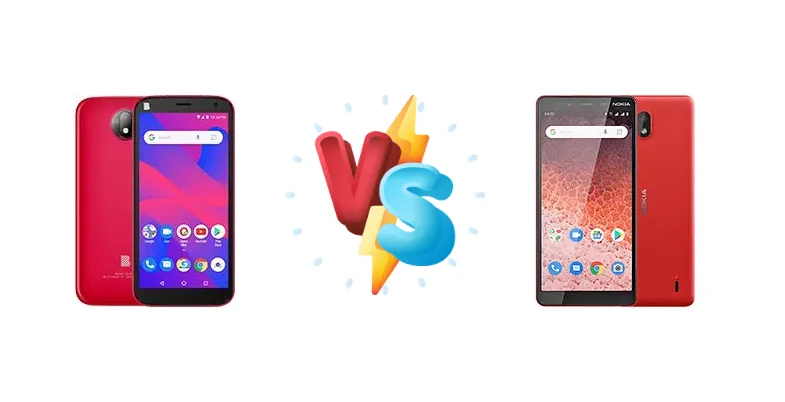
The BLU C5 Plus and Nokia 1 Plus represent the extreme lower end of the smartphone market, targeting first-time buyers or those needing a very basic secondary device. Both aim for affordability, but differ significantly in their underlying hardware. This comparison dissects those differences to determine which offers the best experience for the price.
🏆 Quick Verdict
For most users, the Nokia 1 Plus emerges as the slightly better choice. While both phones are limited, the Mediatek MT6739WW chipset with its Cortex-A53 cores provides a noticeable performance advantage over the BLU C5 Plus’s Cortex-A7, translating to a smoother, more responsive user experience, even within the constraints of Android Go.
| Network |
|---|
| 2G bands | GSM 850 / 900 / 1800 / 1900 | GSM 850 / 900 / 1800 / 1900 |
| 3G bands | HSDPA 850 / 900 / 1900 / 2100 | HSDPA 850 / 900 / 2100 - Global |
| 4G bands | - | 1, 3, 5, 7, 8, 20, 38, 40 - Global |
| Speed | HSPA 21.1/5.76 Mbps | HSPA 42.2/5.76 Mbps, LTE Cat4 150/50 Mbps |
| Technology | GSM / HSPA | GSM / HSPA / LTE |
| | - | 1, 2, 3, 4, 5, 7, 8, 12, 17, 28 - LATAM |
| Launch |
|---|
| Announced | 2019, October. Released 2019, October | 2019, February 24. Released 2019, February 24 |
| Status | Discontinued | Discontinued |
| Body |
|---|
| Build | - | Glass front, plastic back, plastic frame |
| Dimensions | 151 x 72.3 x 10 mm (5.94 x 2.85 x 0.39 in) | 145 x 70.4 x 8.6 mm (5.71 x 2.77 x 0.34 in) |
| SIM | Nano-SIM + Nano-SIM | Nano-SIM + Nano-SIM |
| Weight | 158 g (5.57 oz) | 138.4 g (4.87 oz) |
| Display |
|---|
| Resolution | 720 x 1440 pixels (~292 ppi density) | 480 x 960 pixels, 18:9 ratio (~197 ppi density) |
| Size | 5.5 inches, 77.4 cm2 (~70.9% screen-to-body ratio) | 5.45 inches, 76.7 cm2 (~75.1% screen-to-body ratio) |
| Type | IPS LCD | IPS LCD |
| Platform |
|---|
| CPU | Quad-core 1.3 GHz Cortex-A7 | Quad-core 1.5 GHz Cortex-A53 |
| Chipset | - | Mediatek MT6739WW (28 nm) |
| GPU | Mali-400 | PowerVR GE8100 |
| OS | Android 8.1 Oreo (Go edition) | Android 9.0 Pie (Go edition), upgradable to Android 10 (Go edition) |
| Memory |
|---|
| Card slot | microSDXC | microSDXC (dedicated slot) |
| Internal | 16GB 1GB RAM | 8GB 1GB RAM, 16GB 1GB RAM, 16GB 3GB RAM |
| | - | eMMC 5.1 |
| Main Camera |
|---|
| Features | LED flash | LED flash |
| Single | 8 MP, AF | 8 MP, AF |
| Video | 720p@30fps | 720p@30fps |
| Selfie camera |
|---|
| Single | 8 MP | 5 MP |
| Video | 720p@30fps | 720p |
| Sound |
|---|
| 3.5mm jack | Yes | Yes |
| 35mm jack | Yes | Yes |
| Loudspeaker | Yes | Yes |
| Comms |
|---|
| Bluetooth | 4.1, A2DP | 4.2, A2DP |
| NFC | No | No |
| Positioning | GPS | GPS, GLONASS |
| Radio | FM radio | FM radio |
| USB | microUSB 2.0 | microUSB 2.0 |
| WLAN | Wi-Fi 802.11 b/g/n, Wi-Fi Direct | Wi-Fi 802.11 a/b/g/n |
| Features |
|---|
| Sensors | Accelerometer | Accelerometer, proximity |
| Battery |
|---|
| Type | Li-Po 2200 mAh battery | Li-Ion 2500 mAh, removable |
| Misc |
|---|
| Colors | Gradient Blue, Black, Red | Black, Red, Blue |
| Models | - | TA-1130, TA-1111, TA-1123, TA-1127, TA-1131 |
| Price | About 50 EUR | About 80 EUR |
| SAR | - | 0.96 W/kg (head) 0.72 W/kg (body) |
| SAR EU | - | 0.59 W/kg (head) 1.79 W/kg (body) |
BLU C5 Plus
- Potentially lower price point than the Nokia 1 Plus.
- Functional for basic communication tasks.
- Android Go OS minimizes resource usage.
- Older Cortex-A7 CPU offers significantly lower performance.
- Likely inferior display quality.
- Limited future-proofing.
Nokia 1 Plus
- More powerful and efficient Cortex-A53 CPU.
- MT6739WW chipset offers better overall performance.
- Android Go OS optimized for low-end hardware.
- May be slightly more expensive than the BLU C5 Plus.
- Still limited by low-end hardware.
- Camera performance likely similar to BLU C5 Plus.
Display Comparison
Neither device boasts a standout display. Specifications are unavailable for the BLU C5 Plus's display, suggesting a basic panel. The Nokia 1 Plus, similarly, lacks detailed display specs. Given the price point, both likely utilize low-resolution LCDs with limited brightness and color accuracy. The absence of features like higher refresh rates or even HD+ resolution means the visual experience will be basic on both.
Camera Comparison
Camera performance on both devices will be limited. Details are scarce, but given the target market, expect basic sensors. It's highly probable both phones feature a primary camera and potentially a secondary depth sensor. Image quality will be acceptable in ideal lighting conditions, but struggle in low light. The lack of Optical Image Stabilization (OIS) on either device further exacerbates low-light performance. Focusing on megapixel counts would be misleading; image processing and sensor size are far more critical, and data is unavailable for either.
Performance
This is where the key difference lies. The BLU C5 Plus utilizes a Quad-core 1.3 GHz Cortex-A7 CPU. In contrast, the Nokia 1 Plus features a Mediatek MT6739WW chipset with a Quad-core 1.5 GHz Cortex-A53 CPU. The Cortex-A53 architecture is significantly more efficient and powerful than the older Cortex-A7. The 28nm process node of the MT6739WW also contributes to better power efficiency. This translates to faster app loading times, smoother multitasking, and a generally more responsive user interface on the Nokia 1 Plus, despite both running Android Go.
Battery Life
Battery capacity details are missing for both devices. However, given the low-power chipsets and basic displays, both should offer at least a full day of light usage. Charging speeds are also unknown, but likely slow due to the use of standard micro-USB ports and low-wattage chargers. The more efficient Mediatek chipset in the Nokia 1 Plus *may* translate to slightly longer battery life under similar usage conditions.
Buying Guide
Buy the BLU C5 Plus if your primary need is a functional, extremely affordable smartphone for basic communication and minimal app usage, and you prioritize absolute lowest cost above all else. Buy the Nokia 1 Plus if you prefer a slightly more refined experience, even within the budget segment, and value the improved CPU architecture for better responsiveness and a more future-proofed (though still limited) platform.
Frequently Asked Questions
❓ Will the Nokia 1 Plus handle popular social media apps like Facebook and WhatsApp smoothly?
The Nokia 1 Plus, with its Cortex-A53 processor, is better equipped to handle these apps than the BLU C5 Plus. While not a seamless experience, it should provide a more responsive and less frustrating experience, especially with the optimized Android Go OS. Expect some loading times and occasional lag, but it's generally usable.
❓ Is the Android Go operating system on these phones a significant limitation?
Android Go is designed for devices with limited resources. While it reduces bloat and optimizes performance, it also means some features found in standard Android are missing or simplified. This is a necessary compromise for these budget phones, but it does limit functionality compared to higher-end devices.
❓ Can either of these phones play modern mobile games?
Neither phone is suitable for playing demanding modern mobile games. The processors lack the power and the GPUs are too weak. Simple, older games might be playable at low settings, but expect significant lag and poor performance in most cases.