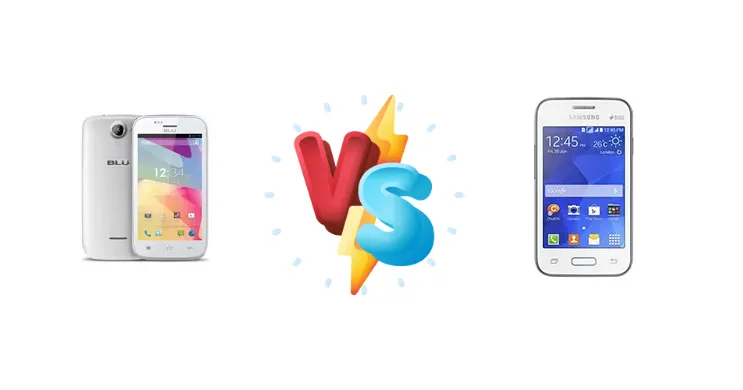
The BLU Advance 4.0 and Samsung Galaxy Young 2 represent the extreme end of the smartphone market, targeting users prioritizing affordability above all else. Both devices aim to provide basic smartphone functionality, but differ in their internal hardware. This comparison dissects those differences to determine which offers the best value for users on a tight budget.
🏆 Quick Verdict
For the average user seeking the most responsive experience within this price bracket, the BLU Advance 4.0 emerges as the better choice. Its Mediatek MT6572 chipset, built on a 28nm process, delivers a noticeable performance advantage over the Galaxy Young 2’s 1.0 GHz Cortex-A7, making everyday tasks smoother.
| Network |
|---|
| 2G bands | GSM 850 / 900 / 1800 / 1900 - SIM 1 & SIM 2 | GSM 850 / 900 / 1800 / 1900 - SIM 1 & SIM 2 |
| 3G bands | HSDPA 850 / 1900 / 1700 - A270a | HSDPA 900 / 2100 |
| Speed | HSPA 21.1/5.76 Mbps | HSPA 21.1/5.76 Mbps |
| Technology | GSM / HSPA | GSM / HSPA |
| Launch |
|---|
| Announced | 2013, December. Released 2013, December | 2014, June. Released 2014, October |
| Status | Discontinued | Discontinued |
| Body |
|---|
| Dimensions | 125 x 65 x 12.4 mm (4.92 x 2.56 x 0.49 in) | 109.8 x 59.9 x 11.8 mm (4.32 x 2.36 x 0.46 in) |
| SIM | Dual SIM (Mini-SIM, dual stand-by) | Dual SIM (Micro-SIM, dual stand-by) |
| Weight | 124 g (4.37 oz) | 108 g (3.81 oz) |
| Display |
|---|
| Resolution | 480 x 800 pixels, 5:3 ratio (~233 ppi density) | 320 x 480 pixels, 3:2 ratio (~165 ppi density) |
| Size | 4.0 inches, 45.5 cm2 (~56.1% screen-to-body ratio) | 3.5 inches, 36.5 cm2 (~55.5% screen-to-body ratio) |
| Type | TFT | TFT, 256K colors |
| Platform |
|---|
| CPU | Dual-core 1.3 GHz Cortex-A7 | 1.0 GHz Cortex-A7 |
| Chipset | Mediatek MT6572 (28 nm) | - |
| GPU | Mali-400 | - |
| OS | Android 4.2 (Jelly Bean) | Android 4.4.2 (KitKat) |
| Memory |
|---|
| Card slot | microSDHC (dedicated slot) | microSDHC (dedicated slot) |
| Internal | 4GB 512MB RAM | 4GB 512MB RAM |
| Main Camera |
|---|
| Features | LED flash | - |
| Single | 5 MP | 3.15 MP |
| Video | 720@30fps | 480p@24fps |
| Selfie camera |
|---|
| Single | VGA | - |
| | - | No |
| Sound |
|---|
| 3.5mm jack | Yes | Yes |
| 35mm jack | Yes | Yes |
| Loudspeaker | Yes | Yes |
| Comms |
|---|
| Bluetooth | 4.0, A2DP | 4.0, A2DP |
| NFC | No | No |
| Positioning | GPS | GPS, GLONASS |
| Radio | Stereo FM radio | FM radio |
| USB | microUSB 2.0 | microUSB 2.0 |
| WLAN | Wi-Fi 802.11 b/g/n, hotspot | Wi-Fi 802.11 b/g/n, Wi-Fi Direct, hotspot |
| Features |
|---|
| Sensors | Accelerometer | Accelerometer |
| Battery |
|---|
| Music play | - | Up to 24 h |
| Stand-by | Up to 600 h (2G) / Up to 400 h (3G) | - |
| Talk time | Up to 15 h (2G) / Up to 9 h (3G) | Up to 6 h (3G) |
| Type | Li-Ion 1600 mAh, removable | Li-Ion 1300 mAh, removable |
| Misc |
|---|
| Colors | Black, White | Iris Charcoal, White |
| Models | - | SM-G130H, SM-G130HN |
| Price | About 80 EUR | About 100 EUR |
| SAR | - | 0.87 W/kg (head) 0.94 W/kg (body) |
| SAR EU | - | 0.92 W/kg (head) 0.44 W/kg (body) |
BLU Advance 4.0
- More powerful processor (MT6572)
- More efficient 28nm manufacturing process
- Potentially better multitasking performance
- BLU brand recognition is lower than Samsung
- Software updates may be less frequent
Samsung Galaxy Young 2
- Samsung brand reputation
- Potentially more streamlined software experience
- Wider availability of accessories
- Slower processor (1.0 GHz Cortex-A7)
- Less efficient processor manufacturing process
- Likely slower app loading times
Display Comparison
Neither device boasts a standout display. Given the context of these phones, display specifications are likely similar – low resolution panels (likely 480x800) with TN LCD technology. The focus here isn't on color accuracy or brightness, but rather on basic readability. Without specific data, it's reasonable to assume both displays prioritize power efficiency over visual fidelity.
Camera Comparison
Camera performance on both devices will be limited. Given the target market, both likely feature low-resolution sensors (likely 3-5MP) with minimal image processing capabilities. Expect subpar image quality, particularly in low-light conditions. Any claims of advanced features should be viewed skeptically. The aperture and sensor size are likely similar, resulting in comparable image quality.
Performance
The core difference lies in the chipset. The BLU Advance 4.0’s Mediatek MT6572, featuring a dual-core 1.3 GHz Cortex-A7, benefits from being fabricated on a 28nm process. This smaller node size generally translates to improved power efficiency and potentially higher sustained clock speeds compared to the Samsung Galaxy Young 2’s 1.0 GHz Cortex-A7. While both CPUs share the same architecture, the higher clock speed and more efficient manufacturing process of the MT6572 give the BLU device an edge in application loading times and overall responsiveness. The Galaxy Young 2 will likely exhibit more noticeable slowdowns when multitasking.
Battery Life
Battery life will depend heavily on usage patterns. Without specific mAh ratings, it’s difficult to make a definitive statement. However, the more efficient Mediatek MT6572 in the BLU Advance 4.0 could contribute to slightly longer battery life despite potentially having a similar capacity battery to the Galaxy Young 2. Charging speeds will likely be slow on both devices, given the lack of fast charging technology.
Buying Guide
Buy the BLU Advance 4.0 if you need a slightly more responsive device for basic multitasking, social media, and light app usage. The 28nm chipset offers a small but tangible benefit in sustained performance. Buy the Samsung Galaxy Young 2 if you prioritize brand recognition and a potentially more streamlined software experience, accepting a trade-off in raw processing power. Both phones are best suited for first-time smartphone users or as a secondary device.
Frequently Asked Questions
❓ Will the BLU Advance 4.0 struggle with popular apps like WhatsApp or Facebook?
While the BLU Advance 4.0 won't offer a flagship-level experience, its Mediatek MT6572 chipset should handle basic app usage like WhatsApp and Facebook reasonably well. Expect some loading times and occasional slowdowns, but it's generally sufficient for these core functions.
❓ Is the Samsung Galaxy Young 2 a good choice for a first-time smartphone user?
The Samsung Galaxy Young 2 can be a suitable option for a first-time smartphone user, particularly if brand familiarity is important. However, its slower processor may lead to a less responsive experience compared to the BLU Advance 4.0, potentially causing frustration for users accustomed to faster devices.
❓ Can either of these phones run modern mobile games?
Neither phone is well-suited for modern mobile gaming. The processors lack the graphical power to run demanding games smoothly. Simple, older games may be playable at low settings, but expect significant performance limitations.