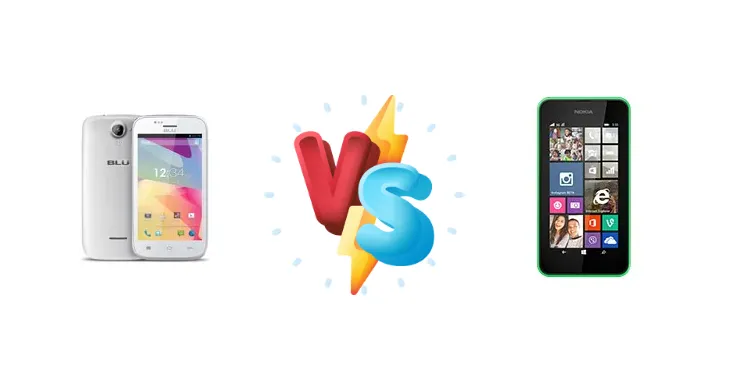
The BLU Advance 4.0 and Nokia Lumia 530 represent the extreme end of the smartphone price spectrum. Both devices aimed to deliver basic smartphone functionality at an incredibly low cost. This comparison dissects their core hardware – specifically the Mediatek MT6572 and Qualcomm Snapdragon 200 – to determine which offers the better user experience for essential tasks.
🏆 Quick Verdict
For the average user prioritizing multitasking and responsiveness, the Nokia Lumia 530 emerges as the better choice. Its quad-core Snapdragon 200, despite a slightly lower clock speed, provides a noticeable performance advantage over the BLU Advance 4.0’s dual-core Mediatek MT6572, making it more suitable for running multiple apps and navigating the user interface.
| Network |
|---|
| 2G bands | GSM 850 / 900 / 1800 / 1900 - SIM 1 & SIM 2 | GSM 850 / 900 / 1800 / 1900 |
| 3G bands | HSDPA 850 / 1900 / 1700 - A270a | HSDPA 900 / 2100 |
| Speed | HSPA 21.1/5.76 Mbps | HSPA 21.1/5.76 Mbps |
| Technology | GSM / HSPA | GSM / HSPA |
| | - | HSDPA 850 / 900 / 1900 / 2100 |
| Launch |
|---|
| Announced | 2013, December. Released 2013, December | 2014, July. Released 2014, August |
| Status | Discontinued | Discontinued |
| Body |
|---|
| Dimensions | 125 x 65 x 12.4 mm (4.92 x 2.56 x 0.49 in) | 119.7 x 62.3 x 11.7 mm, 86.8 cc (4.71 x 2.45 x 0.46 in) |
| SIM | Dual SIM (Mini-SIM, dual stand-by) | Micro-SIM |
| Weight | 124 g (4.37 oz) | 129 g (4.55 oz) |
| Display |
|---|
| Resolution | 480 x 800 pixels, 5:3 ratio (~233 ppi density) | 480 x 854 pixels, 16:9 ratio (~245 ppi density) |
| Size | 4.0 inches, 45.5 cm2 (~56.1% screen-to-body ratio) | 4.0 inches, 44.1 cm2 (~59.1% screen-to-body ratio) |
| Type | TFT | TFT |
| Platform |
|---|
| CPU | Dual-core 1.3 GHz Cortex-A7 | Quad-core 1.2 GHz Cortex-A7 |
| Chipset | Mediatek MT6572 (28 nm) | Qualcomm Snapdragon 200 (28 nm) |
| GPU | Mali-400 | Adreno 302 |
| OS | Android 4.2 (Jelly Bean) | Microsoft Windows Phone 8.1 |
| Memory |
|---|
| Card slot | microSDHC (dedicated slot) | microSDXC (dedicated slot) |
| Internal | 4GB 512MB RAM | 4GB 512MB RAM |
| | - | eMMC 4.5 |
| Main Camera |
|---|
| Features | LED flash | - |
| Single | 5 MP | 5 MP, 1/4.0" |
| Video | 720@30fps | 480p@30fps |
| Selfie camera |
|---|
| Single | VGA | - |
| | - | No |
| Sound |
|---|
| 3.5mm jack | Yes | Yes |
| 35mm jack | Yes | Yes |
| Loudspeaker | Yes | Yes |
| Comms |
|---|
| Bluetooth | 4.0, A2DP | 4.0, A2DP, LE/ aptX after WP8 Denim update |
| NFC | No | No |
| Positioning | GPS | GPS, GLONASS |
| Radio | Stereo FM radio | FM Radio |
| USB | microUSB 2.0 | microUSB 2.0 |
| WLAN | Wi-Fi 802.11 b/g/n, hotspot | Wi-Fi 802.11 b/g/n, hotspot |
| Features |
|---|
| Sensors | Accelerometer | Accelerometer |
| Battery |
|---|
| Music play | - | Up to 51 h |
| Stand-by | Up to 600 h (2G) / Up to 400 h (3G) | Up to 528 h |
| Talk time | Up to 15 h (2G) / Up to 9 h (3G) | Up to 13 h 20 min (2G) / Up to 10 h (3G) |
| Type | Li-Ion 1600 mAh, removable | Li-Ion 1430 mAh, removable (BL-5J) |
| Misc |
|---|
| Colors | Black, White | Bright orange, Bright green, White, Dark grey |
| Price | About 80 EUR | About 100 EUR |
| SAR | - | 0.77 W/kg (head) 0.99 W/kg (body) |
| SAR EU | - | 1.09 W/kg (head) 1.19 W/kg (body) |
BLU Advance 4.0
- Potentially lower price point
- Slightly higher CPU clock speed (on paper)
- Compact and lightweight design (likely)
- Dual-core processor limits multitasking
- Likely slower app loading times
- Potentially less responsive user interface
Nokia Lumia 530
- Quad-core processor for better performance
- Smoother multitasking and app switching
- Qualcomm Snapdragon chipset offers better optimization
- May be slightly more expensive
- Potentially slightly lower CPU clock speed
- Similar low-resolution display to the BLU
Display Comparison
Neither device boasts a standout display. Given the target price point, both likely utilize similar low-cost LCD panels. Detailed specs like resolution and brightness are unavailable, but we can assume both prioritize power efficiency over visual fidelity. Bezels are likely substantial on both, maximizing screen real estate within a compact form factor. Color accuracy is expected to be basic, sufficient for everyday viewing but not ideal for media consumption.
Camera Comparison
Camera performance on both devices is expected to be minimal. Without specific sensor details, it’s safe to assume both feature low-resolution sensors (likely 5MP or less) capable of basic photography in good lighting conditions. Image quality will be limited by the sensor size, lens quality, and image processing capabilities of the respective chipsets. Any claims of advanced features like HDR or panorama should be viewed with skepticism. The focus here is on functionality, not photographic excellence.
Performance
The core difference lies in the CPU configuration. The Nokia Lumia 530’s Qualcomm Snapdragon 200 features a quad-core Cortex-A7 processor clocked at 1.2 GHz, while the BLU Advance 4.0 utilizes a dual-core 1.3 GHz Cortex-A7 Mediatek MT6572. While the BLU has a slightly higher clock speed, the Snapdragon’s four cores provide a significant advantage in parallel processing. This translates to smoother app switching, faster web browsing, and a more responsive user interface. Both chipsets are built on a 28nm process, suggesting similar power efficiency, but the Snapdragon’s architecture is optimized for better sustained performance.
Battery Life
Battery capacity details are missing for both devices. However, given their low-power chipsets and basic displays, both should offer at least a full day of standby time and moderate usage. Charging speeds are also likely to be slow, as both devices likely ship with basic chargers. The Snapdragon 200’s power efficiency might give the Lumia 530 a slight edge in battery life, but the difference is unlikely to be substantial.
Buying Guide
Buy the BLU Advance 4.0 if you need a bare-bones smartphone for essential communication – calls, texts, and very light app usage – and are operating on an extremely tight budget. Buy the Nokia Lumia 530 if you prefer a slightly smoother experience with better multitasking capabilities, even if it means spending a little more. The Lumia 530 is the better option for users who want a phone that feels less sluggish during everyday use.
Frequently Asked Questions
❓ Will the Nokia Lumia 530 handle basic social media apps like Facebook and WhatsApp without significant lag?
Yes, the quad-core Snapdragon 200 in the Nokia Lumia 530 is better equipped to handle the demands of basic social media apps like Facebook and WhatsApp compared to the dual-core Mediatek MT6572 in the BLU Advance 4.0. While not a high-performance experience, it should provide a reasonably smooth experience for these essential applications.
❓ Is the BLU Advance 4.0 a suitable option for someone who primarily needs a phone for making calls and sending texts?
Yes, the BLU Advance 4.0 is a viable option for users who primarily need a phone for basic communication. Its Mediatek MT6572 chipset is sufficient for handling calls and texts without significant issues. However, be prepared for slower performance if you attempt to run more demanding apps.
❓ Can either of these phones run modern Android versions smoothly?
Neither phone was designed to run the latest Android versions smoothly. The Nokia Lumia 530 originally shipped with Windows Phone 8.1, and the BLU Advance 4.0 likely shipped with an older version of Android. Attempting to upgrade to newer versions would likely result in significant performance issues due to the limited hardware capabilities.