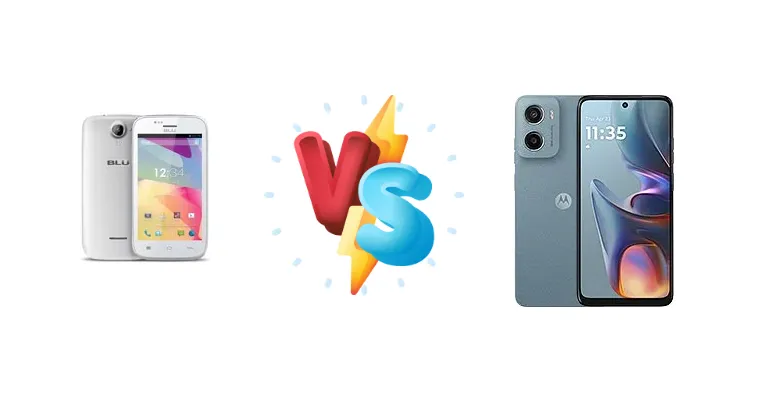
The smartphone market is flooded with ultra-affordable options, but performance and longevity vary wildly. We pit the BLU Advance 4.0, a basic entry-level device, against the Motorola Moto E15, which promises a significant leap in processing power and battery endurance, to determine which offers the best value for budget-conscious consumers.
🏆 Quick Verdict
For the vast majority of users, the Motorola Moto E15 is the clear winner. Its Helio G81 chipset and 68-hour battery life provide a dramatically improved experience compared to the BLU Advance 4.0’s aging Mediatek MT6572. While the Advance 4.0 is cheaper, the E15’s performance justifies the price difference.
| Network |
|---|
| 2G bands | GSM 850 / 900 / 1800 / 1900 - SIM 1 & SIM 2 | GSM 850 / 900 / 1800 / 1900 |
| 3G bands | HSDPA 850 / 1900 / 1700 - A270a | HSDPA 850 / 900 / 2100 |
| 4G bands | - | 1, 3, 5, 7, 8, 20, 28, 38, 40, 41 |
| Speed | HSPA 21.1/5.76 Mbps | HSPA, LTE |
| Technology | GSM / HSPA | GSM / HSPA / LTE |
| Launch |
|---|
| Announced | 2013, December. Released 2013, December | 2024, December 17 |
| Status | Discontinued | Available. Released 2025, January 22 |
| Body |
|---|
| Build | - | Glass front (Gorilla Glass 3), plastic frame, silicone polymer back (eco leather) |
| Dimensions | 125 x 65 x 12.4 mm (4.92 x 2.56 x 0.49 in) | 165.7 x 76 x 8.2 mm (6.52 x 2.99 x 0.32 in) |
| SIM | Dual SIM (Mini-SIM, dual stand-by) | Nano-SIM + Nano-SIM |
| Weight | 124 g (4.37 oz) | 188.8 g (6.67 oz) |
| Display |
|---|
| Protection | - | Corning Gorilla Glass 3, Mohs level 6 |
| Resolution | 480 x 800 pixels, 5:3 ratio (~233 ppi density) | 720 x 1604 pixels, 20:9 ratio (~264 ppi density) |
| Size | 4.0 inches, 45.5 cm2 (~56.1% screen-to-body ratio) | 6.67 inches, 107.2 cm2 (~85.2% screen-to-body ratio) |
| Type | TFT | IPS LCD, 90Hz |
| Platform |
|---|
| CPU | Dual-core 1.3 GHz Cortex-A7 | Octa-core (2x2.0 GHz Cortex-A75 & 6x1.7 GHz Cortex-A55) |
| Chipset | Mediatek MT6572 (28 nm) | Mediatek Helio G81 Extreme (12 nm) |
| GPU | Mali-400 | Mali-G52 MC2 |
| OS | Android 4.2 (Jelly Bean) | Android 14 (Go edition) |
| Memory |
|---|
| Card slot | microSDHC (dedicated slot) | microSDXC |
| Internal | 4GB 512MB RAM | 64GB 2GB RAM |
| Main Camera |
|---|
| Features | LED flash | LED flash, HDR |
| Single | 5 MP | 32 MP, f/2.2, (wide), 0.64µm, PDAF |
| Video | 720@30fps | 1080p@30fps |
| Selfie camera |
|---|
| Single | VGA | 8 MP, f/2.1, (wide), 1.12µm |
| Video | - | 1080p@30fps |
| Sound |
|---|
| 3.5mm jack | Yes | - |
| 35mm jack | Yes | Yes |
| Loudspeaker | Yes | Yes, with stereo speakers |
| Comms |
|---|
| Bluetooth | 4.0, A2DP | 5.0, A2DP, LE |
| NFC | No | No |
| Positioning | GPS | GPS, GALILEO, GLONASS |
| Radio | Stereo FM radio | FM radio (no radio in FR, IT) |
| USB | microUSB 2.0 | USB Type-C 2.0 |
| WLAN | Wi-Fi 802.11 b/g/n, hotspot | Wi-Fi 802.11 a/b/g/n/ac, dual-band |
| Features |
|---|
| Sensors | Accelerometer | Fingerprint (side-mounted), accelerometer, proximity |
| Battery |
|---|
| Charging | - | 18W wired |
| Stand-by | Up to 600 h (2G) / Up to 400 h (3G) | - |
| Talk time | Up to 15 h (2G) / Up to 9 h (3G) | - |
| Type | Li-Ion 1600 mAh, removable | 5200 mAh |
| Misc |
|---|
| Colors | Black, White | Fresh Lavender, Misty Blue, Denim Blue |
| Models | - | XT2523-6, XT2523-8 |
| Price | About 80 EUR | $ 85.00 / C$ 100.00 / £ 60.99 / € 75.99 |
| EU LABEL |
|---|
| Battery | - | 68:26h endurance, 1000 cycles |
| Energy | - | Class A |
| Free fall | - | Class B (180 falls) |
| Repairability | - | Class B |
BLU Advance 4.0
- Lowest possible price point
- Simple and easy to use
- Compact size (likely)
- Extremely limited performance
- Poor battery life
- Outdated chipset
Motorola Moto E15
- Excellent performance for the price
- Exceptional battery life (68+ hours)
- Fast 18W charging
- May be slightly more expensive
- Potentially larger size
- Software updates may be limited
Display Comparison
Neither device’s display specifications are provided, so we must infer. Given the price points, both likely utilize LCD panels with 720p+ resolutions. The Moto E15, being a newer device, likely benefits from improved color accuracy and potentially higher peak brightness. The Advance 4.0, with its older chipset, may have a lower quality panel overall. Bezels are likely substantial on both devices, reflecting their budget nature.
Camera Comparison
Without specific camera specs, a detailed comparison is difficult. However, it’s reasonable to assume the Moto E15 features a more capable camera system. Modern chipsets like the Helio G81 include enhanced image signal processors (ISPs) that improve image quality. The Advance 4.0’s older chipset will likely struggle with noise reduction and dynamic range. The presence of a 2MP macro camera on either device is largely irrelevant; image quality will be poor due to the small sensor size.
Performance
The performance gap is the most significant differentiator. The BLU Advance 4.0’s Mediatek MT6572, a dual-core Cortex-A7 processor built on a 28nm process, is severely outmatched by the Motorola Moto E15’s Mediatek Helio G81 Extreme. The G81’s octa-core configuration (2x2.0 GHz Cortex-A75 & 6x1.7 GHz Cortex-A55) and 12nm fabrication process deliver substantially higher CPU and GPU performance. This translates to smoother multitasking, faster app loading times, and the ability to handle more demanding games on the Moto E15. The E15’s chipset also benefits from improved power efficiency.
Battery Life
The Motorola Moto E15 boasts a remarkable 68:26h endurance rating and supports 18W wired charging. This suggests a significantly larger battery capacity and optimized power management compared to the BLU Advance 4.0. While the Advance 4.0’s battery capacity is unknown, its older, less efficient chipset will drain the battery faster. The 18W charging on the E15 allows for quicker top-ups, minimizing downtime. The E15’s 1000 cycle battery life also indicates a higher quality battery cell.
Buying Guide
Buy the BLU Advance 4.0 if you absolutely need the lowest possible upfront cost and only require basic functionality like calls, texts, and light web browsing. Buy the Motorola Moto E15 if you prioritize a responsive user experience, enjoy occasional gaming, or need a phone that can reliably last through a full day (and beyond) on a single charge. The E15 is the better choice for anyone who values usability over minimal expense.
Frequently Asked Questions
❓ Is the Motorola Moto E15’s Helio G81 capable of playing modern mobile games?
Yes, the Helio G81 is a capable gaming chipset for its price range. While it won’t deliver flagship-level performance, it can comfortably handle popular titles like PUBG Mobile and Call of Duty Mobile at medium settings. The improved GPU performance compared to the BLU Advance 4.0’s chipset makes a significant difference.
❓ How long will the Motorola Moto E15’s battery last with moderate usage?
With moderate usage (social media, web browsing, calls), the Motorola Moto E15 should easily last a full day, and potentially two days, on a single charge. The 68:26h endurance rating suggests it can handle up to three days of light use. The 18W charging also allows for quick top-ups when needed.
❓ Will the BLU Advance 4.0 receive software updates?
Historically, BLU devices have limited software update support. It’s unlikely the Advance 4.0 will receive major Android version updates or frequent security patches. This is a significant drawback compared to Motorola, which generally provides more consistent software support.
❓ Is the difference in chipset architecture (Cortex-A7 vs A75/A55) significant in real-world use?
Absolutely. The Cortex-A75 cores in the Helio G81 are significantly more powerful and efficient than the Cortex-A7 cores in the MT6572. This translates to faster app loading, smoother multitasking, and a more responsive user experience overall. The A55 cores also contribute to improved power efficiency.