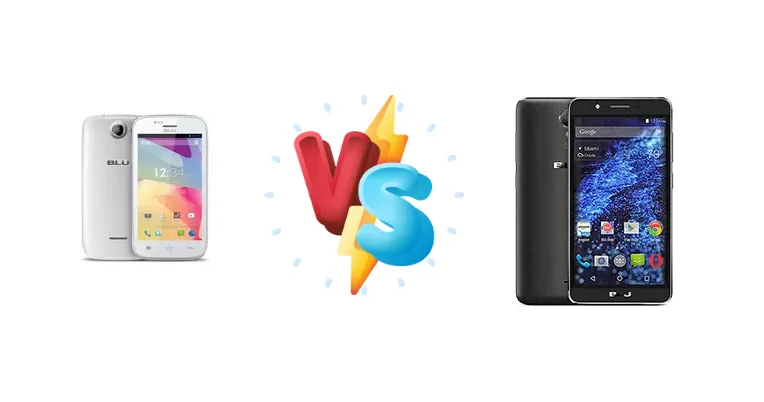
Both the BLU Advance 4.0 and BLU Studio C HD represent entry points into the smartphone market, but they differ significantly under the hood. This comparison focuses on the core performance disparity stemming from their respective Mediatek chipsets – the dual-core MT6572 in the Advance 4.0 versus the quad-core MT6582 in the Studio C HD – and how that translates to real-world usage.
🏆 Quick Verdict
For the average user prioritizing multitasking and smoother app switching, the BLU Studio C HD is the clear winner. Its quad-core MT6582 chipset provides a noticeable performance advantage over the Advance 4.0’s dual-core processor, despite both being built on the same 28nm process. However, the Advance 4.0 may suffice for very basic usage.
| Network |
|---|
| 2G bands | GSM 850 / 900 / 1800 / 1900 - SIM 1 & SIM 2 | GSM 850 / 900 / 1800 / 1900 - SIM 1 & SIM 2 |
| 3G bands | HSDPA 850 / 1900 / 1700 - A270a | HSDPA 850 / 1700(AWS) / 1900 / 2100 - S090Q |
| Speed | HSPA 21.1/5.76 Mbps | HSPA 21.1/5.76 Mbps |
| Technology | GSM / HSPA | GSM / HSPA |
| Launch |
|---|
| Announced | 2013, December. Released 2013, December | 2016, January. Released 2016, January |
| Status | Discontinued | Discontinued |
| Body |
|---|
| Dimensions | 125 x 65 x 12.4 mm (4.92 x 2.56 x 0.49 in) | 144.7 x 71.2 x 10.2 mm (5.70 x 2.80 x 0.40 in) |
| SIM | Dual SIM (Mini-SIM, dual stand-by) | Dual SIM (Micro-SIM, dual stand-by) |
| Weight | 124 g (4.37 oz) | 176 g (6.21 oz) |
| Display |
|---|
| Resolution | 480 x 800 pixels, 5:3 ratio (~233 ppi density) | 720 x 1280 pixels, 16:9 ratio (~294 ppi density) |
| Size | 4.0 inches, 45.5 cm2 (~56.1% screen-to-body ratio) | 5.0 inches, 68.9 cm2 (~66.9% screen-to-body ratio) |
| Type | TFT | IPS LCD |
| Platform |
|---|
| CPU | Dual-core 1.3 GHz Cortex-A7 | Quad-core 1.3 GHz Cortex-A7 |
| Chipset | Mediatek MT6572 (28 nm) | Mediatek MT6582 (28 nm) |
| GPU | Mali-400 | Mali-400MP2 |
| OS | Android 4.2 (Jelly Bean) | Android 5.1 (Lollipop) |
| Memory |
|---|
| Card slot | microSDHC (dedicated slot) | microSDXC |
| Internal | 4GB 512MB RAM | 8GB 1GB RAM |
| Main Camera |
|---|
| Features | LED flash | LED flash |
| Single | 5 MP | 8 MP, AF |
| Video | 720@30fps | 1080p@30fps |
| Selfie camera |
|---|
| Features | - | LED flash |
| Single | VGA | 5 MP |
| Sound |
|---|
| 3.5mm jack | Yes | Yes |
| 35mm jack | Yes | Yes |
| Loudspeaker | Yes | Yes |
| Comms |
|---|
| Bluetooth | 4.0, A2DP | 4.0, A2DP |
| NFC | No | No |
| Positioning | GPS | GPS |
| Radio | Stereo FM radio | Stereo FM radio |
| USB | microUSB 2.0 | microUSB 2.0 |
| WLAN | Wi-Fi 802.11 b/g/n, hotspot | Wi-Fi 802.11 b/g/n, Wi-Fi Direct, hotspot |
| Features |
|---|
| Sensors | Accelerometer | Accelerometer, proximity |
| Battery |
|---|
| Stand-by | Up to 600 h (2G) / Up to 400 h (3G) | Up to 750 h (2G) / Up to 700 h (3G) |
| Talk time | Up to 15 h (2G) / Up to 9 h (3G) | Up to 25 h (2G) / Up to 14 h (3G) |
| Type | Li-Ion 1600 mAh, removable | Li-Po 2000 mAh, removable |
| Misc |
|---|
| Colors | Black, White | Black, White, Gold, Green, Blue, Pink |
| Price | About 80 EUR | - |
BLU Advance 4.0
- Potentially slightly better battery life due to the dual-core processor.
- May be available at a lower price point.
- Simpler operating system experience for basic users.
- Significantly slower performance compared to the Studio C HD.
- Struggles with multitasking and demanding apps.
- Limited future-proofing.
BLU Studio C HD
- Faster and smoother performance thanks to the quad-core processor.
- Better multitasking capabilities.
- More responsive user experience.
- Potentially shorter battery life compared to the Advance 4.0.
- May be slightly more expensive.
- Still limited in terms of overall processing power.
Display Comparison
Neither BLU provides detailed display specifications. Given their market segment, both likely utilize IPS LCD panels with resolutions around 720p. The absence of information regarding peak brightness, color gamut coverage, or refresh rates suggests a focus on cost reduction. Bezels are expected to be substantial on both devices, typical for this price point. Color accuracy is likely to be standard, prioritizing visibility over fidelity.
Camera Comparison
Detailed camera specifications are unavailable. However, given the price bracket, both devices likely feature basic camera sensors. The focus should not be on image quality, but rather on functionality. Expect limited low-light performance and a reliance on software processing. Any differences in camera performance will likely be due to software optimization rather than superior hardware. The presence of a 2MP macro camera on either device is largely a marketing tactic, offering minimal practical benefit.
Performance
The core difference lies in the chipset: the BLU Advance 4.0 features the Mediatek MT6572 with a dual-core 1.3 GHz Cortex-A7 CPU, while the BLU Studio C HD boasts the Mediatek MT6582, a quad-core 1.3 GHz Cortex-A7 processor. While both are based on the same Cortex-A7 architecture and 28nm manufacturing process, the quad-core configuration of the MT6582 offers significantly improved multi-tasking capabilities. The MT6582 can handle more simultaneous processes without experiencing the same level of slowdown as the MT6572. This translates to faster app loading times and a smoother user experience when switching between applications. The GPU within the MT6582 will also provide a better, though still limited, gaming experience.
Battery Life
Battery capacity details are missing for both devices. However, given the power efficiency of the Mediatek MT6572 and MT6582, and the likely screen resolutions, both phones should achieve at least a full day of moderate use. Charging wattage is also unknown, but likely falls within the 5W-10W range, resulting in relatively slow charging times. The quad-core processor in the Studio C HD will draw more power, but the increased efficiency of handling tasks quicker may offset some of that drain.
Buying Guide
Buy the BLU Advance 4.0 if you need a smartphone for extremely basic tasks like calls, texts, and light web browsing, and are on the absolute tightest budget. Buy the BLU Studio C HD if you prefer a more responsive experience for social media, casual gaming, and running multiple apps simultaneously, even if it means spending a bit more.
Frequently Asked Questions
❓ Will the BLU Studio C HD handle popular social media apps like Facebook and Instagram smoothly?
Yes, the quad-core MT6582 processor in the Studio C HD is significantly better equipped to handle the demands of social media apps compared to the dual-core MT6572 in the Advance 4.0. You should experience smoother scrolling, faster loading times, and fewer instances of lag.
❓ Can I play games on either of these phones?
While both phones can technically run games, expectations should be tempered. The Studio C HD will offer a slightly better gaming experience due to its more powerful processor, but don't expect to play graphically intensive titles at high settings. Casual games and older titles will be more playable.
❓ Is the difference between dual-core and quad-core really that noticeable in everyday use?
Yes, especially in this price range. The quad-core MT6582 allows the Studio C HD to handle multiple tasks simultaneously without significant slowdown. This is noticeable when switching between apps, browsing the web with multiple tabs open, or running background processes.
❓ Which phone is better for someone who primarily uses their phone for calls and texts?
The BLU Advance 4.0 is sufficient for basic communication tasks like calls and texts. However, the Studio C HD offers a more future-proof experience, even for basic users, as it will remain usable for longer before becoming noticeably slow.