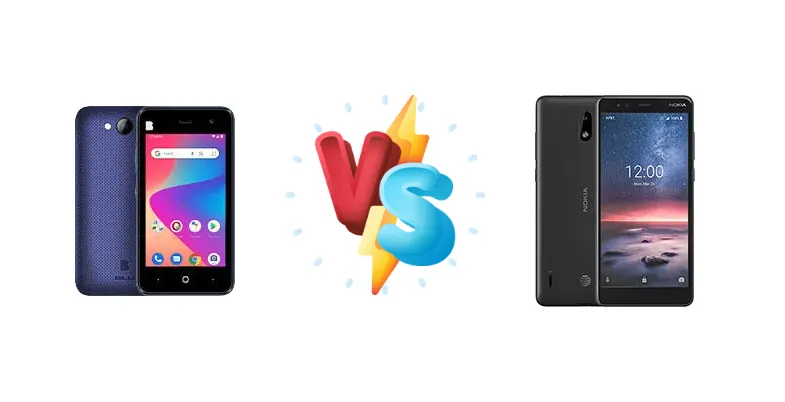
The BLU A5L and Nokia 3.1 A represent the lower end of the Android smartphone market, targeting users prioritizing affordability. However, despite similar price points, they diverge significantly in their underlying hardware. This comparison dissects the key differences, focusing on the impact of the Nokia’s Qualcomm Snapdragon 429 chipset versus the BLU’s simpler Cortex-A53 processor.
🏆 Quick Verdict
For the average user, the Nokia 3.1 A is the superior choice. Its Snapdragon 429 chipset, built on a more efficient 12nm process, delivers noticeably better performance and responsiveness than the BLU A5L’s Cortex-A53. While both phones are entry-level, the Nokia offers a smoother user experience for everyday tasks.
| Network |
|---|
| 2G bands | GSM 850 / 900 / 1800 / 1900 | GSM 850 / 900 / 1800 / 1900 |
| 3G bands | HSDPA 850 / 900 / 1900 / 2100 | HSDPA 850 / 1700(AWS) / 1900 |
| 4G bands | 2, 3, 4, 5, 7, 28 | 2, 4, 5, 12, 14, 29, 30 |
| Speed | HSPA, LTE | HSPA 42.2/5.76 Mbps, LTE Cat4 150/50 Mbps |
| Technology | GSM / HSPA / LTE | GSM / HSPA / LTE |
| Launch |
|---|
| Announced | 2021, February 09. Released 2021, February 09 | 2019, June. Released 2019, June |
| Status | Discontinued | Discontinued |
| Body |
|---|
| Dimensions | 124.5 x 64.5 x 10.6 mm (4.90 x 2.54 x 0.42 in) | 152.7 x 71.9 x 9.4 mm (6.01 x 2.83 x 0.37 in) |
| SIM | Nano-SIM + Nano-SIM | Nano-SIM |
| Weight | 118 g (4.16 oz) | 156 g (5.50 oz) |
| Display |
|---|
| Resolution | 480 x 800 pixels, 5:3 ratio (~233 ppi density) | 720 x 1440 pixels, 18:9 ratio (~295 ppi density) |
| Size | 4.0 inches, 45.5 cm2 (~56.7% screen-to-body ratio) | 5.45 inches, 76.7 cm2 (~69.8% screen-to-body ratio) |
| Type | TFT LCD | IPS LCD |
| Platform |
|---|
| CPU | Quad-core 1.4 GHz Cortex-A53 | Quad-core 1.8 GHz Cortex-A53 |
| Chipset | - | Qualcomm SDM429 Snapdragon 429 (12 nm) |
| GPU | - | Adreno 504 |
| OS | Android 10 (Go edition) | Android 9.0 (Pie) |
| Memory |
|---|
| Card slot | microSDXC | microSDXC (dedicated slot) |
| Internal | 16GB 1GB RAM | 32GB 2GB RAM |
| | eMMC 5.1 | eMMC 5.1 |
| Main Camera |
|---|
| Features | LED flash | LED flash, HDR, panorama |
| Single | 5 MP | 8 MP, f/2.0, AF |
| Video | 720p@30fps | 1080p@30fps |
| Selfie camera |
|---|
| Features | - | HDR |
| Single | 2 MP | 5 MP, f/2.2 |
| Video | 720p@30fps | 720p@30fps |
| Sound |
|---|
| 3.5mm jack | Yes | Yes |
| 35mm jack | Yes | Yes |
| Loudspeaker | Yes | Yes |
| Comms |
|---|
| Bluetooth | 4.1, A2DP, LE | 5.0, A2DP, LE |
| NFC | No | No |
| Positioning | GPS | GPS, GLONASS, BDS |
| Radio | FM radio | FM radio |
| USB | microUSB 2.0 | USB Type-C 2.0 |
| WLAN | Wi-Fi 802.11 b/g/n, Wi-Fi Direct | Wi-Fi 802.11 b/g/n |
| Features |
|---|
| Sensors | Accelerometer | Accelerometer, gyro, proximity |
| Battery |
|---|
| Charging | - | 10W wired |
| Type | Li-Po 1400 mAh | Li-Ion 2990 mAh, non-removable |
| Misc |
|---|
| Colors | Black, Blue, Red | Black |
| Models | - | TA1140 |
| Price | About 40 EUR | - |
| SAR | - | 1.11 W/kg (head) 0.81 W/kg (body) |
BLU A5L
- Potentially lower price point
- Functional for basic smartphone tasks
- Simple and straightforward Android experience
- Significantly slower processor
- Less efficient chipset
- Likely limited software support
Nokia 3.1 A
- More powerful Snapdragon 429 chipset
- Improved power efficiency
- 10W wired charging support
- Slightly higher price
- Still an entry-level device
- May not receive frequent software updates
Display Comparison
Neither device’s display specifications are provided, so a direct comparison is limited. However, given their market segment, both likely utilize LCD panels with 720p resolutions. The Nokia 3.1 A’s chipset may offer slightly better display processing capabilities, potentially resulting in marginally improved color accuracy and responsiveness. Bezels are expected to be substantial on both devices, reflecting their budget nature.
Camera Comparison
Without detailed camera specifications, a meaningful comparison is difficult. Both phones likely feature basic camera setups geared towards casual photography. It’s reasonable to assume the Nokia 3.1 A benefits from Qualcomm’s image signal processor (ISP) within the Snapdragon 429, potentially offering slightly better image processing and noise reduction compared to the BLU A5L. The presence of a 2MP macro camera on either device is unlikely to significantly impact image quality.
Performance
The core difference lies in the chipset. The Nokia 3.1 A’s Qualcomm Snapdragon 429 (12nm) boasts a 1.8 GHz clock speed for its quad-core Cortex-A53 CPUs, while the BLU A5L utilizes a 1.4 GHz quad-core Cortex-A53. The 12nm manufacturing process of the Snapdragon 429 is crucial; it allows for greater transistor density and improved power efficiency compared to the likely older, larger process node used for the A5L’s processor. This translates to better sustained performance and less thermal throttling under load. The Nokia will handle multitasking and app launches more smoothly.
Battery Life
Battery capacity isn’t specified for either device. However, the Nokia 3.1 A includes 10W wired charging, a feature absent from the BLU A5L’s specifications. The Snapdragon 429’s improved power efficiency will also contribute to longer battery life during typical usage. While a larger battery on the BLU A5L could offset the Snapdragon’s efficiency, the 10W charging on the Nokia provides a tangible benefit for quicker top-ups.
Buying Guide
Buy the BLU A5L if your primary need is a functional smartphone for very basic tasks like calls, texts, and light social media, and you are operating on an extremely tight budget. Buy the Nokia 3.1 A if you prioritize a more responsive user experience, slightly better performance for app usage, and the benefits of Qualcomm’s optimized chipset, even if it means spending a little more.
Frequently Asked Questions
❓ Will the Nokia 3.1 A handle popular apps like Facebook and WhatsApp smoothly?
Yes, the Snapdragon 429 chipset in the Nokia 3.1 A is sufficiently capable of running apps like Facebook and WhatsApp without significant lag. While it won’t offer a flagship-level experience, it provides a much smoother experience than the BLU A5L’s Cortex-A53 processor, especially when multitasking.
❓ Is the difference in processor speed (1.4 GHz vs 1.8 GHz) noticeable in everyday use?
The 400 MHz difference in clock speed, combined with the Snapdragon 429’s more efficient architecture and 12nm process, *is* noticeable. The Nokia 3.1 A will feel more responsive when opening apps, scrolling through menus, and switching between tasks. The BLU A5L will likely exhibit more noticeable lag in these scenarios.
❓ How long will it take to fully charge the Nokia 3.1 A with the 10W charger?
With a 10W charger, a full charge from 0% will likely take between 2.5 to 3.5 hours, depending on battery capacity (which is not specified). While not fast charging, it’s a significant improvement over the BLU A5L, which lacks any specified charging capabilities.