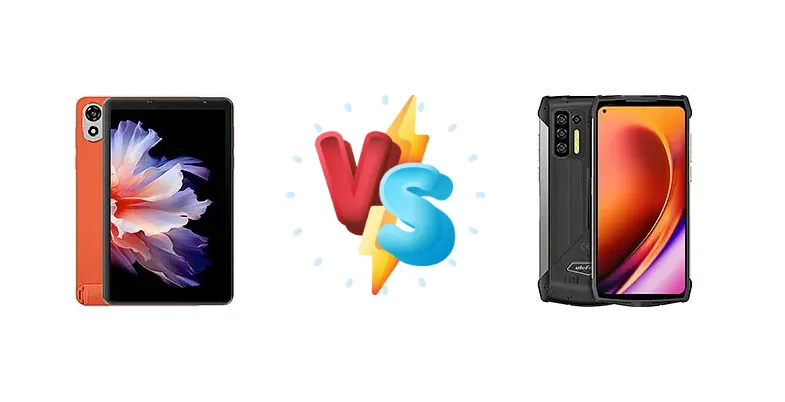
The rugged phone market caters to users demanding durability and extended battery life. The Blackview Zeno 1 and Ulefone Power Armor 13 both aim to deliver, but take different approaches. The Zeno 1 prioritizes longevity with a high battery cycle count, while the Power Armor 13 focuses on rapid replenishment with faster charging technologies. This comparison dissects their key specifications to determine which device best suits your needs.
🏆 Quick Verdict
For the average user prioritizing quick top-ups and a brighter display, the Ulefone Power Armor 13 is the better choice. Its 33W charging and 401 nits brightness offer a more convenient and visually appealing experience. However, the Blackview Zeno 1’s 800 battery cycles suggest superior long-term battery health, making it ideal for those who rarely have access to a charger.
| Network |
|---|
| 2G bands | GSM 850 / 900 / 1800 / 1900 | GSM 850 / 900 / 1800 / 1900 |
| 3G bands | HSDPA 900 / 2100 | HSDPA 850 / 900 / 1700(AWS) / 1900 / 2100 |
| 4G bands | 1, 3, 7, 8, 19, 20, 28, 40, 41 | 1, 2, 3, 4, 5, 7, 8, 12, 13, 17, 18, 19, 20, 25, 26, 28, 38, 40, 66 |
| Speed | HSPA, LTE | HSPA 42.2/11.5 Mbps, LTE Cat12 600/150 Mbps |
| Technology | GSM / HSPA / LTE | GSM / HSPA / LTE |
| Launch |
|---|
| Announced | 2025, September | 2021, July 22 |
| Status | Available. Released 2025, September | Available. Released 2021, July 26 |
| Body |
|---|
| Dimensions | 198.6 x 125.9 x 8.2 mm (7.82 x 4.96 x 0.32 in) | 183.7 x 85.4 x 20.8 mm (7.23 x 3.36 x 0.82 in) |
| SIM | Nano-SIM + Nano-SIM | Nano-SIM + Nano-SIM |
| Weight | 336.5 g (11.89 oz) | 492 g (1.08 lb) |
| | - | IP68 dust/water resistant (up to 1.5m for 30 min)
Drop-to-concrete resistance from up to 1.2m
MIL-STD-810G compliant |
| Display |
|---|
| Protection | Mohs level 5 | Corning Gorilla Glass 3 |
| Resolution | 800 x 1280 pixels, 16:10 ratio (~189 ppi density) | 1080 x 2400 pixels, 20:9 ratio (~386 ppi density) |
| Size | 8.0 inches, 185.6 cm2 (~74.2% screen-to-body ratio) | 6.81 inches, 112.0 cm2 (~71.4% screen-to-body ratio) |
| Type | IPS LCD, 90Hz, 350 nits | IPS LCD |
| Platform |
|---|
| CPU | Octa-core (2x1.8 GHz Cortex-A75 & 6x1.6 GHz Cortex-A55) | Octa-core (2x2.05 GHz Cortex-A76 & 6x2.0 GHz Cortex-A55) |
| Chipset | Unisoc T615 (12 nm) | Mediatek MT6785V/CD Helio G95 (12 nm) |
| GPU | Mali-G57 MP1 | Mali-G76 MC4 |
| OS | Android 15, DokeOS 4.2 | Android 11 |
| Memory |
|---|
| Card slot | microSDXC (uses shared SIM slot) | microSDXC (uses shared SIM slot) |
| Internal | 64GB 4GB RAM, 256GB 6GB RAM | 256GB 8GB RAM |
| Main Camera |
|---|
| Features | LED flash, HDR, panorama | Quad-LED flash, HDR, panorama |
| Penta | - | 48 MP, f/1.8, 26mm (wide), 1/2.0", 0.8µm, PDAF
8 MP, f/2.2, (ultrawide)
2 MP (macro)
Auxiliary lens |
| Single | 8 MP, f/2.2, (wide), 1/5.0" | - |
| Video | 1080p@30fps | 4K@30fps, 1080p@30fps |
| Selfie camera |
|---|
| Features | HDR | HDR, panorama |
| Single | 8 MP, f/2.2, (wide), 1/5.0" | 16 MP, f/2.2 |
| Video | 1080p@30fps | 1080p@30fps |
| Sound |
|---|
| 3.5mm jack | - | Yes |
| 35mm jack | Yes | Yes |
| Loudspeaker | Yes, with stereo speakers | Yes |
| Comms |
|---|
| Bluetooth | 5.2, A2DP, LE | 5.0, A2DP, LE |
| NFC | No | Yes |
| Positioning | GPS, GLONASS, GALILEO, BDS | GPS, GLONASS, GALILEO, BDS |
| Radio | FM Radio | FM radio, RDS, recording |
| USB | USB Type-C, OTG | - |
| WLAN | Wi-Fi 802.11 a/b/g/n/ac, dual-band | Wi-Fi 802.11 a/b/g/n/ac, dual-band |
| Features |
|---|
| Sensors | Accelerometer | Fingerprint (side-mounted), accelerometer, gyro, proximity, compass, baroceptor, coulombmeter |
| | - | Infrared distance measure (error range: 1~20m, ±10mm; 20~40m, ±25mm) |
| Battery |
|---|
| Charging | 10W wired | 33W wired
15W wireless
5W reverse wireless |
| Type | Li-Po 6000 mAh | Li-Po 13200 mAh |
| Misc |
|---|
| Colors | Rock Black, Space Orange, Jungle Green | Black |
| Price | - | About 300 EUR |
| Tests |
|---|
| Battery life | - |
Endurance rating 296h
|
| Camera | - |
Photo / Video |
| Display | - |
Contrast ratio: 1306:1 (nominal) |
| Loudspeaker | - |
-28.3 LUFS (Average)
|
| Performance | - |
AnTuTu: 294194 (v8), 351678 (v9)
GeekBench: 1610 (v5.1)
GFXBench: 18fps (ES 3.1 onscreen) |
| EU LABEL |
|---|
| Battery | 166:39h endurance, 800 cycles | - |
| Energy | Class A | - |
| Free fall | Class C (104 falls) | - |
| Repairability | Class B | - |
Blackview Zeno 1
- Exceptional battery cycle longevity (800 cycles)
- Potentially longer overall battery lifespan
- Rugged design for durability
- Slow 10W charging
- Performance is lower than the competition
- Display brightness data unavailable
Ulefone Power Armor 13
- Fast 33W wired charging
- Brighter 401 nit display
- More powerful Helio G95 chipset
- Lower battery cycle count
- Potentially shorter long-term battery health
- Endurance rating is less impressive than Zeno 1's cycle count
Display Comparison
The Ulefone Power Armor 13 boasts a significantly brighter display, peaking at 401 nits, compared to the Blackview Zeno 1 (brightness data unavailable). This makes the Power Armor 13 more usable in direct sunlight. Both displays share a 1306:1 contrast ratio, suggesting similar color depth and black levels. However, without information on panel technology (IPS, AMOLED) or color gamut coverage for the Zeno 1, the Power Armor 13 clearly wins on immediate usability due to its measured brightness.
Camera Comparison
Both devices list 'Photo / Video' capabilities, but lack specific details regarding sensor size, aperture, or image processing. This makes a direct comparison impossible. Without further information, it's safe to assume both phones offer standard camera performance for their price range. The absence of details suggests neither phone is a standout performer in the camera department, and users shouldn't expect flagship-level image quality. We can assume both will have a basic macro lens, but the quality will likely be low.
Performance
The Ulefone Power Armor 13’s MediaTek Helio G95 chipset, featuring 2x2.05 GHz Cortex-A76 cores and 6x2.0 GHz Cortex-A55 cores, offers a clear performance advantage over the Blackview Zeno 1’s Unisoc T615 (2x1.8 GHz Cortex-A75 & 6x1.6 GHz Cortex-A55). The G95’s newer architecture and higher clock speeds translate to faster app loading times and smoother multitasking. While both chipsets are fabricated on a 12nm process, the G95’s superior CPU and GPU will handle demanding tasks and gaming more effectively. The Zeno 1 will be adequate for basic use, but the Power Armor 13 is the better choice for power users.
Battery Life
The Ulefone Power Armor 13 claims a 296-hour endurance rating, while the Blackview Zeno 1 boasts a remarkable 166:39h endurance. However, endurance ratings are often based on specific usage patterns and can be misleading. The Zeno 1’s key advantage lies in its 800 battery cycles, indicating it can be fully charged and discharged 800 times with minimal degradation, significantly exceeding the typical 500 cycles. The Power Armor 13 compensates with significantly faster charging: 33W wired, 15W wireless, and 5W reverse wireless, compared to the Zeno 1’s slow 10W wired charging. This means the Power Armor 13 can quickly recover from battery drain, while the Zeno 1 prioritizes long-term battery health.
Buying Guide
Buy the Blackview Zeno 1 if you need a phone that can withstand years of use without significant battery degradation, and 10W charging isn't a concern. This is the phone for infrequent chargers and long-term reliability. Buy the Ulefone Power Armor 13 if you prefer faster charging speeds (33W wired, 15W wireless), a brighter display for outdoor visibility, and don't mind potentially replacing the battery sooner.
Frequently Asked Questions
❓ How significantly does the 800 battery cycle count of the Blackview Zeno 1 impact its real-world lifespan compared to the Ulefone Power Armor 13?
The 800 cycle count means the Zeno 1's battery will retain a higher percentage of its original capacity after repeated charge cycles. While the Power Armor 13 charges faster, its battery will degrade more noticeably over time, potentially requiring replacement sooner. For users keeping the phone for 3+ years, this is a major advantage for the Zeno 1.
❓ Is the 10W charging speed of the Blackview Zeno 1 a dealbreaker for users accustomed to faster charging?
Yes, for users accustomed to 30W+ charging, the Zeno 1's 10W charging will feel significantly slower. A full charge will take considerably longer, requiring overnight charging or planning around available power sources. The Power Armor 13's 33W charging is a much more convenient option for those who need quick top-ups.
❓ Given the Helio G95 in the Ulefone Power Armor 13, can it handle demanding games like PUBG or Call of Duty?
The Helio G95 is capable of running PUBG and Call of Duty, but likely at medium settings to maintain a stable frame rate. While not a flagship-level gaming chip, it offers a noticeable improvement over the Unisoc T615 in the Zeno 1, providing a more enjoyable gaming experience.
❓ Does the Ulefone Power Armor 13's wireless charging feature significantly add to its convenience?
Yes, the 15W wireless charging is a significant convenience feature. It allows for cable-free charging, which is particularly useful in situations where a cable isn't readily available or for maintaining the integrity of the charging port on a rugged device.