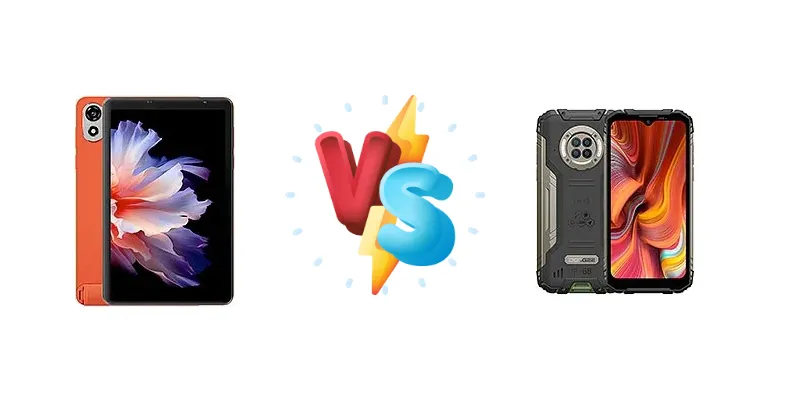
The rugged smartphone market is heating up, offering durable devices for outdoor enthusiasts and demanding work environments. The Blackview Zeno 1 and Doogee S96 Pro both aim to deliver resilience, but diverge significantly in their internal hardware. This comparison dissects their core components to determine which phone offers the best balance of power, endurance, and value.
🏆 Quick Verdict
For the average user prioritizing sustained performance and faster charging, the Doogee S96 Pro emerges as the stronger contender. Its Helio G90 chipset provides a noticeable performance uplift, and the 24W charging significantly reduces downtime. However, the Zeno 1’s exceptional battery endurance is compelling for those needing multi-day use.
| Network |
|---|
| 2G bands | GSM 850 / 900 / 1800 / 1900 | GSM 850 / 900 / 1800 / 1900 |
| 3G bands | HSDPA 900 / 2100 | HSDPA 800 / 850 / 900 / 1700(AWS) / 1900 / 2100 |
| 4G bands | 1, 3, 7, 8, 19, 20, 28, 40, 41 | 1, 2, 3, 4, 5, 7, 8, 12, 13, 17, 18, 19, 20, 25, 26, 28, 38, 40, 66 |
| Speed | HSPA, LTE | HSPA, LTE |
| Technology | GSM / HSPA / LTE | GSM / CDMA / HSPA / LTE |
| Launch |
|---|
| Announced | 2025, September | 2020, October 26. Released 2020, November |
| Status | Available. Released 2025, September | Discontinued |
| Body |
|---|
| Dimensions | 198.6 x 125.9 x 8.2 mm (7.82 x 4.96 x 0.32 in) | 167 x 81.4 x 15.5 mm (6.57 x 3.20 x 0.61 in) |
| SIM | Nano-SIM + Nano-SIM | Nano-SIM + Nano-SIM |
| Weight | 336.5 g (11.89 oz) | 310 g (10.93 oz) |
| Display |
|---|
| Protection | Mohs level 5 | Corning Gorilla Glass |
| Resolution | 800 x 1280 pixels, 16:10 ratio (~189 ppi density) | 720 x 1520 pixels, 19:9 ratio (~270 ppi density) |
| Size | 8.0 inches, 185.6 cm2 (~74.2% screen-to-body ratio) | 6.22 inches, 96.6 cm2 (~71.0% screen-to-body ratio) |
| Type | IPS LCD, 90Hz, 350 nits | IPS LCD |
| Platform |
|---|
| CPU | Octa-core (2x1.8 GHz Cortex-A75 & 6x1.6 GHz Cortex-A55) | Octa-core (2x2.0 GHz Cortex-A76 & 6x2.0 GHz Cortex-A55) |
| Chipset | Unisoc T615 (12 nm) | Mediatek MT6785 Helio G90 (12 nm) |
| GPU | Mali-G57 MP1 | Mali-G76 MC4 |
| OS | Android 15, DokeOS 4.2 | Android 10 |
| Memory |
|---|
| Card slot | microSDXC (uses shared SIM slot) | microSDXC (dedicated slot) |
| Internal | 64GB 4GB RAM, 256GB 6GB RAM | 128GB 8GB RAM |
| Main Camera |
|---|
| Features | LED flash, HDR, panorama | Quad-LED flash, HDR, panorama |
| Quad | - | 48 MP, f/1.8, (wide), PDAF
8 MP, f/2.2, 130˚, (ultrawide)
20 MP, f/2.8, (night vision), 4 infrared night vision lights
2 MP (macro) |
| Single | 8 MP, f/2.2, (wide), 1/5.0" | - |
| Video | 1080p@30fps | 1080p |
| Selfie camera |
|---|
| Features | HDR | - |
| Single | 8 MP, f/2.2, (wide), 1/5.0" | 16 MP, f/2.0, (wide) |
| Video | 1080p@30fps | 1080p |
| Sound |
|---|
| 35mm jack | Yes | Yes |
| Loudspeaker | Yes, with stereo speakers | Yes |
| Comms |
|---|
| Bluetooth | 5.2, A2DP, LE | 5.0, A2DP, LE |
| NFC | No | Yes |
| Positioning | GPS, GLONASS, GALILEO, BDS | GPS, GLONASS, BDS, GALILEO |
| Radio | FM Radio | FM radio |
| USB | USB Type-C, OTG | USB Type-C 2.0, OTG |
| WLAN | Wi-Fi 802.11 a/b/g/n/ac, dual-band | Wi-Fi 802.11 a/b/g/n/ac, dual-band |
| Features |
|---|
| Sensors | Accelerometer | Fingerprint (side-mounted), accelerometer, gyro, proximity, compass |
| Battery |
|---|
| Charging | 10W wired | 24W wired
10W wireless |
| Type | Li-Po 6000 mAh | 6350 mAh |
| Misc |
|---|
| Colors | Rock Black, Space Orange, Jungle Green | Black, Orange, Green |
| Price | - | About 280 EUR |
| EU LABEL |
|---|
| Battery | 166:39h endurance, 800 cycles | - |
| Energy | Class A | - |
| Free fall | Class C (104 falls) | - |
| Repairability | Class B | - |
Blackview Zeno 1
- Exceptional battery endurance (166:39h)
- Long battery lifespan (800 charge cycles)
- Potentially better thermal management due to efficient chipset
- Less powerful processor for demanding tasks
- Slow 10W charging
Doogee S96 Pro
- Faster and more responsive performance (Helio G90)
- Faster charging speeds (24W wired, 10W wireless)
- Potentially better image processing
- Likely shorter battery endurance compared to Zeno 1
- Potentially more heat generation under heavy load
Display Comparison
Neither device's display specifications are provided, so a direct comparison is limited. However, given the price points, we can assume both utilize IPS LCD panels. The Doogee S96 Pro, being positioned as a slightly more premium device, likely benefits from a higher peak brightness and potentially better color calibration. The Zeno 1, focusing on endurance, may prioritize power efficiency over display fidelity.
Camera Comparison
Without detailed camera specifications, a comprehensive comparison is impossible. However, the chipset difference suggests the Doogee S96 Pro has more processing power dedicated to image signal processing (ISP), potentially leading to better image quality, especially in low-light conditions. The G90’s ISP is generally more capable than the Unisoc T615’s. We can assume both phones will feature multiple rear cameras, but the quality will heavily depend on sensor size and lens aperture – details not provided.
Performance
The core difference lies in the chipsets. The Doogee S96 Pro’s MediaTek Helio G90 (12nm) boasts a more powerful CPU configuration – 2x2.0 GHz Cortex-A76 cores alongside 6x2.0 GHz Cortex-A55 cores – compared to the Blackview Zeno 1’s Unisoc T615 (12nm) with 2x1.8 GHz Cortex-A75 and 6x1.6 GHz Cortex-A55 cores. The Cortex-A76 cores in the G90 represent a significant architectural improvement over the A75, translating to faster single-core and multi-core performance. This means the S96 Pro will handle demanding tasks like gaming and video editing with greater ease. While both are 12nm chips, the G90’s superior core design and higher clock speeds provide a clear advantage. The Zeno 1’s T615 prioritizes efficiency, potentially offering better thermal management under sustained loads, but at the cost of raw power.
Battery Life
The Blackview Zeno 1 claims an impressive 166:39h endurance and 800 charge cycles, indicating a focus on long-term battery health and longevity. While the capacity isn’t specified, the endurance figure suggests a large battery optimized for extended use. The Doogee S96 Pro, however, compensates for potentially lower endurance with significantly faster charging – 24W wired and 10W wireless – compared to the Zeno 1’s 10W wired charging. This means the S96 Pro can replenish its battery much quicker, minimizing downtime. The 800 cycle claim on the Zeno 1 is a significant advantage for long-term ownership, suggesting the battery will retain capacity for a longer period.
Buying Guide
Buy the Blackview Zeno 1 if you absolutely need maximum battery life and are willing to trade off some processing power. This phone is ideal for extended trips off-grid or for users who heavily rely on their phone throughout the day without frequent access to power. Buy the Doogee S96 Pro if you prioritize smoother multitasking, gaming, and quicker charging. This is the better choice for users who demand responsive performance and don't want to be tethered to a charger for hours.
Frequently Asked Questions
❓ Will the Doogee S96 Pro’s Helio G90 overheat during prolonged gaming sessions?
While the Helio G90 is a capable processor, it can generate heat under sustained load. Doogee likely implemented thermal management solutions, but throttling is possible during extended gaming. The Zeno 1’s Unisoc T615 is less prone to overheating, but at the cost of performance.
❓ How does the 800 charge cycle claim on the Blackview Zeno 1 translate to real-world battery life over several years?
The 800 charge cycle claim suggests the Zeno 1’s battery will retain a significant portion of its original capacity after 800 full charge-discharge cycles. This means the battery will likely remain usable for a longer period compared to phones with lower cycle counts, potentially extending the phone’s lifespan.
❓ Is the 10W wireless charging on the Doogee S96 Pro significantly slower than the 24W wired charging?
Yes, 10W wireless charging is considerably slower than 24W wired charging. Expect a full charge via wireless to take several hours, while wired charging will be much faster. Wireless charging is convenient, but prioritizes convenience over speed.