
Blackview Xplore 2 vs. Samsung Galaxy XCover Pro: A Rugged Performance Showdown
| Phones Images | |||||
|---|---|---|---|---|---|
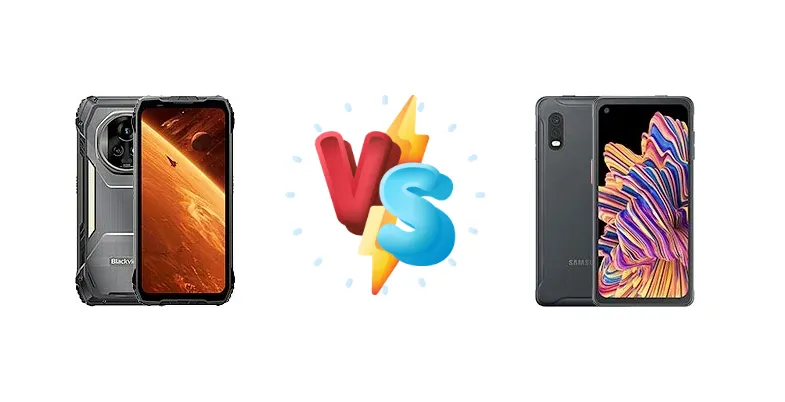
|
🏆 Quick Verdict
For most users, the Blackview Xplore 2 is the clear winner. Its Dimensity 8300 chipset delivers substantially faster performance, coupled with blazing-fast 120W charging. While the XCover Pro benefits from Samsung’s software and ecosystem, it’s significantly outmatched in raw power and charging speed.
| PHONES | ||
|---|---|---|
| Phone Names | Blackview Xplore 2 | Samsung Galaxy XCover Pro |
| Network | ||
|---|---|---|
| 2G bands | GSM 850 / 900 / 1800 / 1900 | GSM 850 / 900 / 1800 / 1900 |
| 3G bands | HSDPA 800 / 850 / 900 / 1700(AWS) / 1800 / 1900 / 2100 | HSDPA 850 / 900 / 1900 / 2100 - International |
| 4G bands | 1, 2, 3, 4, 5, 7, 8, 12, 13, 17, 18, 19, 20, 25, 26, 28, 30, 34, 38, 39, 40, 41, 66 | 1, 2, 3, 5, 7, 8, 20, 28, 38, 40, 41 - International |
| 5G bands | 1, 3, 5, 7, 8, 20, 28, 38, 40, 41, 77, 78, 79 SA/NSA | - |
| Speed | HSPA, LTE, 5G | HSPA 42.2/5.76 Mbps, LTE (3CA) Cat11 600/50 Mbps |
| Technology | GSM / CDMA / HSPA / LTE / 5G | GSM / HSPA / LTE |
| - | 1, 2, 3, 4, 5, 7, 12, 13, 14, 20, 29, 38, 40, 41, 66 - Canada | |
| Launch | ||
|---|---|---|
| Announced | 2025, September 25 | 2020, January |
| Status | Available. Released 2025, October | Available. Released 2020, January |
| Body | ||
|---|---|---|
| Dimensions | 186 x 87.8 x 29 mm (7.32 x 3.46 x 1.14 in) | 159.9 x 76.7 x 10 mm (6.30 x 3.02 x 0.39 in) |
| SIM | Nano-SIM + Nano-SIM | · Nano-SIM· Nano-SIM + Nano-SIM |
| Weight | 670 g (1.48 lb) | 218 g (7.69 oz) |
| - | IP68 dust/water resistant (up to 1.5m for 35 min) Drop-to-concrete resistance from up to 1.5m MIL-STD-810G compliant* *does not guarantee ruggedness or use in extreme conditions | |
| Display | ||
|---|---|---|
| Protection | Corning Gorilla Glass 5, Mohs level 5 | Corning Gorilla Glass 5 |
| Resolution | 1440 x 3200 pixels, 20:9 ratio (~521 ppi density) | 1080 x 2340 pixels, 19.5:9 ratio (~409 ppi density) |
| Size | 6.73 inches, 109.4 cm2 (~67.0% screen-to-body ratio) | 6.3 inches, 97.4 cm2 (~79.4% screen-to-body ratio) |
| Type | LTPO AMOLED, 68B colors, 120Hz, HDR, 500 nits (typ), 1300 nits (HBM), 2600 nits (peak) | IPS LCD |
| Platform | ||
|---|---|---|
| CPU | Octa-core (1x3.35 GHz Cortex-A715 & 3x3.20 GHz Cortex-A715 & 4x2.20 GHz Cortex-A510) | Octa-core (4x2.3 GHz Cortex-A73 & 4x1.7 GHz Cortex-A53) |
| Chipset | Mediatek Dimensity 8300 (4 nm) | Exynos 9611 (10 nm) |
| GPU | Mali G615-MC6 | Mali-G72 MP3 |
| OS | Android 15, up to 3 major Android upgrades, DokeOS 4.2 | Android 10, upgradable to Android 13, One UI 5 |
| Memory | ||
|---|---|---|
| Card slot | microSDXC (uses shared SIM slot) | microSDXC (dedicated slot) |
| Internal | 256GB 12GB RAM, 1TB 16GB RAM | 64GB 4GB RAM |
| Main Camera | ||
|---|---|---|
| Dual | 50 MP, f/1.9, (wide), 1/1.57", PDAF, OIS 20 MP, f/1.8, (night vision), 1/2.8", 2 infrared night vision lights | 25 MP, f/1.7, 26mm (wide), PDAF 8 MP, f/2.2, 123˚ (ultrawide), 1/4.0", 1.12µm |
| Features | LED flash, HDR, panorama | Dual-LED flash, HDR, panorama |
| Video | 4K@30/60fps, HDR10+ | 1080p@30fps |
| Selfie camera | ||
|---|---|---|
| Features | - | HDR |
| Single | 50 MP, f/2.5, (wide), 1/2.76" | 13 MP, f/2.0, (wide), 1/3.1", 1.12µm |
| Video | 4K@30/60fps, HDR10+ | 1080p@30fps |
| Sound | ||
|---|---|---|
| 3.5mm jack | - | Yes |
| 35mm jack | No | Yes |
| Loudspeaker | Yes, with stereo speakers | Yes |
| Comms | ||
|---|---|---|
| Bluetooth | 5.4, A2DP, LE | 5.0, A2DP, LE |
| Infrared port | Yes | - |
| NFC | Yes | Yes |
| Positioning | GPS (L1+L5), GLONASS, GALILEO, BDS, QZSS | GPS, GLONASS, GALILEO, BDS |
| Radio | FM radio | FM radio (market/region dependent) |
| USB | USB Type-C, OTG | USB Type-C 2.0 |
| WLAN | Wi-Fi 802.11 a/b/g/n/ac/6e, tri-band | Wi-Fi 802.11 a/b/g/n/ac/k/v/r, dual-band, Wi-Fi Direct |
| Features | ||
|---|---|---|
| Sensors | Fingerprint (side-mounted), accelerometer, gyro, proximity, compass, barometer | Fingerprint (side-mounted), accelerometer, gyro, proximity, compass |
| - | ANT+ | |
| Battery | ||
|---|---|---|
| Charging | 120W wired 10W reverse wired | 15W wired |
| Type | 20000 mAh | Li-Po 4050 mAh, removable |
| Misc | ||
|---|---|---|
| Colors | Black | Black |
| Models | - | SM-G715FN/DS, SM-G715FN, SM-G715F, SM-G715W, SM-G715U, SM-G715U1 |
| Price | € 569.99 / $ 348.93 / £ 424.99 | About 120 EUR |
| SAR EU | - | 0.47 W/kg (head) 1.23 W/kg (body) |
| EU LABEL | ||
|---|---|---|
| Battery | 188:00h endurance, 800 cycles | - |
| Energy | Class F | - |
| Free fall | Class A (270 falls) | - |
| Repairability | Class B | - |
Blackview Xplore 2
- Significantly faster processor (Dimensity 8300)
- Ultra-fast 120W charging
- Long battery life (188h endurance)
- Potentially more advanced camera ISP
- Brand recognition is lower than Samsung
- Software update commitment is unknown
Samsung Galaxy XCover Pro
- Samsung’s established ecosystem and software support
- Familiar user interface
- Rugged design and durability
- Wide availability of accessories
- Outdated processor (Exynos 9611)
- Slow 15W charging
- Lower overall performance
- Limited long-term software support
Display Comparison
Display specifications are not provided for either device. However, given the XCover Pro’s age, it likely features a standard 60Hz panel. The Xplore 2, being a newer device, may incorporate a higher refresh rate display, improving smoothness. The Xplore 2’s potential for a more modern panel technology could translate to better color accuracy and viewing angles, crucial for map reading or detailed image analysis in the field.
Camera Comparison
Camera details are limited. However, the Xplore 2’s chipset likely supports more advanced image signal processing (ISP) capabilities, potentially leading to better low-light performance and dynamic range. The XCover Pro’s Exynos 9611, while capable, is limited by its age. Without specific sensor details, it’s difficult to make a definitive judgment, but the Xplore 2’s modern chipset gives it a clear advantage in computational photography.
Performance
The performance gap is substantial. The Blackview Xplore 2’s Mediatek Dimensity 8300 (4nm) is a modern, high-performance chipset featuring an octa-core configuration with a prime Cortex-A715 core clocked at 3.35 GHz. This contrasts sharply with the Samsung Galaxy XCover Pro’s Exynos 9611 (10nm), utilizing older Cortex-A73 cores peaking at 2.3 GHz. The Dimensity 8300’s 4nm process node offers superior power efficiency and thermal management, meaning sustained performance under load will be significantly better on the Xplore 2. This translates to faster app loading times, smoother multitasking, and a more responsive user experience, particularly beneficial for professionals using demanding applications.
Battery Life
The Blackview Xplore 2 boasts an impressive 188-hour endurance rating and supports 120W wired charging, allowing for incredibly fast top-ups. The Samsung Galaxy XCover Pro is limited to 15W charging. While battery capacity isn’t specified for either device, the Xplore 2’s 120W charging dramatically reduces downtime. The 800 charge cycles rating for the Xplore 2 also suggests a longer lifespan for the battery itself, a critical factor for long-term reliability in rugged use cases.
Buying Guide
Buy the Blackview Xplore 2 if you prioritize performance, fast charging, and a modern chipset for demanding tasks like mobile gaming or running complex field applications. Buy the Samsung Galaxy XCover Pro if you are deeply embedded in the Samsung ecosystem, value guaranteed software updates, and require a more familiar user experience, accepting a performance compromise.