
Blackview Xplore 2 vs BV9900E: A Deep Dive into Performance and Ruggedness
| Phones Images | |||||
|---|---|---|---|---|---|
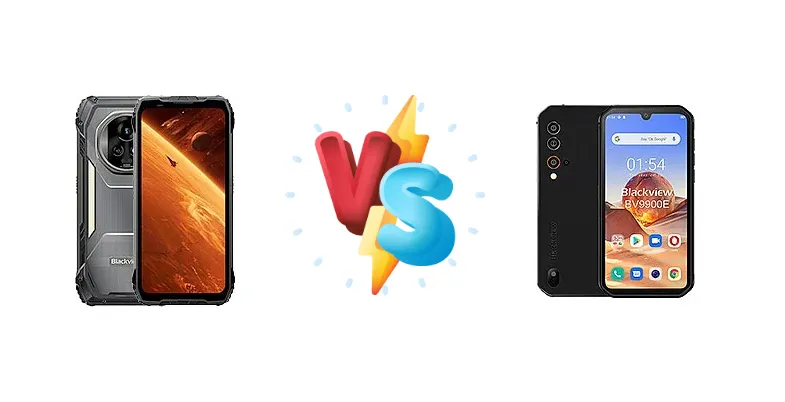
|
🏆 Quick Verdict
For the average user seeking a future-proofed, high-performance rugged phone, the Blackview Xplore 2 is the clear winner. Its Dimensity 8300 chipset delivers substantially faster processing and graphics, coupled with blazing-fast 120W charging. While the BV9900E offers a more affordable entry into the rugged space, its older Helio P90 struggles to keep pace.
| PHONES | ||
|---|---|---|
| Phone Names | Blackview Xplore 2 | Blackview BV9900E |
| Network | ||
|---|---|---|
| 2G bands | GSM 850 / 900 / 1800 / 1900 | GSM 850 / 900 / 1800 / 1900 |
| 3G bands | HSDPA 800 / 850 / 900 / 1700(AWS) / 1800 / 1900 / 2100 | HSDPA 800 / 850 / 900 / 1700(AWS) / 1900 / 2100 |
| 4G bands | 1, 2, 3, 4, 5, 7, 8, 12, 13, 17, 18, 19, 20, 25, 26, 28, 30, 34, 38, 39, 40, 41, 66 | 1, 2, 3, 4, 5, 7, 8, 12, 13, 17, 18, 19, 20, 25, 26, 28, 34, 38, 39, 40, 41, 66 |
| 5G bands | 1, 3, 5, 7, 8, 20, 28, 38, 40, 41, 77, 78, 79 SA/NSA | - |
| Speed | HSPA, LTE, 5G | HSPA, LTE |
| Technology | GSM / CDMA / HSPA / LTE / 5G | GSM / CDMA / HSPA / CDMA2000 / LTE |
| Launch | ||
|---|---|---|
| Announced | 2025, September 25 | 2020, September 10. Released 2020, September |
| Status | Available. Released 2025, October | Discontinued |
| Body | ||
|---|---|---|
| Dimensions | 186 x 87.8 x 29 mm (7.32 x 3.46 x 1.14 in) | 156.5 x 78.3 x 14.2 mm (6.16 x 3.08 x 0.56 in) |
| SIM | Nano-SIM + Nano-SIM | Nano-SIM + Nano-SIM |
| Weight | 670 g (1.48 lb) | 273 g (9.63 oz) |
| Display | ||
|---|---|---|
| Protection | Corning Gorilla Glass 5, Mohs level 5 | Corning Gorilla Glass 5 |
| Resolution | 1440 x 3200 pixels, 20:9 ratio (~521 ppi density) | 1080 x 2280 pixels, 19:9 ratio (~432 ppi density) |
| Size | 6.73 inches, 109.4 cm2 (~67.0% screen-to-body ratio) | 5.84 inches, 85.1 cm2 (~69.5% screen-to-body ratio) |
| Type | LTPO AMOLED, 68B colors, 120Hz, HDR, 500 nits (typ), 1300 nits (HBM), 2600 nits (peak) | IPS LCD |
| Platform | ||
|---|---|---|
| CPU | Octa-core (1x3.35 GHz Cortex-A715 & 3x3.20 GHz Cortex-A715 & 4x2.20 GHz Cortex-A510) | Octa-core (2x2.2 GHz Cortex-A75 & 6x2.0 GHz Cortex-A55) |
| Chipset | Mediatek Dimensity 8300 (4 nm) | Mediatek MT6779V/CE Helio P90 (12 nm) |
| GPU | Mali G615-MC6 | PowerVR GM9446 |
| OS | Android 15, up to 3 major Android upgrades, DokeOS 4.2 | Android 10 |
| Memory | ||
|---|---|---|
| Card slot | microSDXC (uses shared SIM slot) | microSDXC |
| Internal | 256GB 12GB RAM, 1TB 16GB RAM | 128GB 6GB RAM |
| Main Camera | ||
|---|---|---|
| Dual | 50 MP, f/1.9, (wide), 1/1.57", PDAF, OIS 20 MP, f/1.8, (night vision), 1/2.8", 2 infrared night vision lights | - |
| Features | LED flash, HDR, panorama | LED flash, HDR, panorama |
| Quad | - | 48 MP, f/1.8, (wide), PDAF 16 MP, 120˚ (ultrawide) 2 MP (macro) Auxiliary lens |
| Video | 4K@30/60fps, HDR10+ | 4K@30fps, 1080p@60fps |
| Selfie camera | ||
|---|---|---|
| Single | 50 MP, f/2.5, (wide), 1/2.76" | 16 MP, f/2.0, (wide) |
| Video | 4K@30/60fps, HDR10+ | 1080p@30fps |
| Sound | ||
|---|---|---|
| 35mm jack | No | No |
| Loudspeaker | Yes, with stereo speakers | Yes |
| Comms | ||
|---|---|---|
| Bluetooth | 5.4, A2DP, LE | 5.0, A2DP, LE |
| Infrared port | Yes | - |
| NFC | Yes | Yes |
| Positioning | GPS (L1+L5), GLONASS, GALILEO, BDS, QZSS | GPS, GLONASS, GALILEO, BDS |
| Radio | FM radio | FM radio |
| USB | USB Type-C, OTG | USB Type-C 2.0, OTG |
| WLAN | Wi-Fi 802.11 a/b/g/n/ac/6e, tri-band | Wi-Fi 802.11 a/b/g/n/ac |
| Features | ||
|---|---|---|
| Sensors | Fingerprint (side-mounted), accelerometer, gyro, proximity, compass, barometer | Fingerprint (side-mounted), accelerometer, gyro, proximity, compass, barometer |
| Battery | ||
|---|---|---|
| Charging | 120W wired 10W reverse wired | 15W wired 18W wireless |
| Type | 20000 mAh | 4380 mAh |
| Misc | ||
|---|---|---|
| Colors | Black | Black, Silver |
| Price | € 569.99 / $ 348.93 / £ 424.99 | About 260 EUR |
| EU LABEL | ||
|---|---|---|
| Battery | 188:00h endurance, 800 cycles | - |
| Energy | Class F | - |
| Free fall | Class A (270 falls) | - |
| Repairability | Class B | - |
Blackview Xplore 2
- Significantly faster performance with the Dimensity 8300
- Ultra-fast 120W wired charging
- Longer battery life and 800 charge cycles
- Likely higher price point
- May be larger and heavier due to advanced components
Blackview BV9900E
- More affordable price
- Wireless charging support
- Proven rugged design
- Outdated Helio P90 chipset struggles with demanding tasks
- Slow charging speeds (15W wired)
- Shorter battery life compared to Xplore 2
Display Comparison
Display specifications are not provided, but given the market segment, both likely feature LCD panels optimized for outdoor visibility. The Xplore 2’s more powerful chipset *could* support higher refresh rates, leading to smoother scrolling and animations, a feature likely absent on the BV9900E. Bezels are expected to be relatively thick on both, prioritizing durability over a sleek aesthetic.
Camera Comparison
Camera details are limited, but the chipset difference implies a substantial advantage for the Xplore 2. The Dimensity 8300 includes a more advanced Image Signal Processor (ISP) capable of faster processing and improved image quality. While both phones may feature similar megapixel counts, the Xplore 2 will likely deliver better dynamic range, low-light performance, and video stabilization. The BV9900E’s older ISP will struggle to keep up, resulting in softer images and less detail.
Performance
The performance gap is the most significant differentiator. The Xplore 2’s Mediatek Dimensity 8300 (4nm) is a powerhouse, featuring a tri-cluster configuration with a high-clocked Cortex-A715 core at 3.35 GHz, alongside additional A715 cores and efficiency-focused A510 cores. This contrasts sharply with the BV9900E’s Helio P90 (12nm), utilizing older Cortex-A75 and A55 cores. The 4nm process node of the Dimensity 8300 translates to significantly improved power efficiency and thermal management, meaning sustained performance under load will be far superior. The Xplore 2 will excel in gaming, multitasking, and demanding applications, while the BV9900E will likely show signs of slowdown with heavier workloads.
Battery Life
The Xplore 2 boasts an impressive 188-hour endurance rating and 800 charge cycles, suggesting a long-lasting battery and excellent longevity. Its 120W wired charging is a game-changer, allowing for incredibly fast top-ups – likely 0-100% in under 40 minutes. The BV9900E’s 15W wired and 18W wireless charging are considerably slower, requiring significantly more time to reach a full charge. While the BV9900E offers wireless charging, the Xplore 2’s faster wired charging and superior battery endurance make it the more convenient option for most users.
Buying Guide
Buy the Blackview Xplore 2 if you need a phone capable of handling demanding tasks like gaming, video editing, or running multiple apps simultaneously, and value rapid charging. Buy the Blackview BV9900E if you prioritize a lower price point, are primarily focused on basic smartphone functions, and require a durable device for harsh environments without needing cutting-edge performance.