
Blackview Xplore 1 vs. Ulefone Armor 11 5G: A Rugged Showdown
| Phones Images | |||||
|---|---|---|---|---|---|
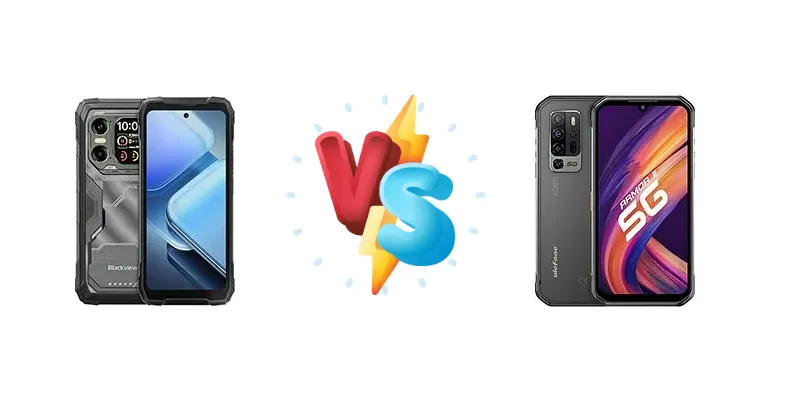
|
🏆 Quick Verdict
For most users, the Blackview Xplore 1 emerges as the stronger choice. Its more modern Dimensity 7050 chipset, built on a 6nm process, provides a performance edge and potentially better thermal management, coupled with significantly faster 55W charging. While the Ulefone offers wireless charging, the Xplore 1’s superior endurance and speed outweigh this convenience.
| PHONES | ||
|---|---|---|
| Phone Names | Blackview Xplore 1 | Ulefone Armor 11 5G |
| Network | ||
|---|---|---|
| 2G bands | GSM 850 / 900 / 1800 / 1900 | GSM 850 / 900 / 1800 / 1900 |
| 3G bands | HSDPA 800 / 850 / 900 / 1700(AWS) / 1800 / 1900 / 2100 | HSDPA 850 / 900 / 1700(AWS) / 1900 / 2100 |
| 4G bands | 1, 2, 3, 4, 5, 7, 8, 12, 13, 17, 18, 19, 20, 25, 26, 28, 30, 34, 38, 39, 40, 41, 66 | 1, 2, 3, 4, 5, 7, 8, 12, 13, 17, 18, 19, 20, 25, 26, 28, 34, 38, 39, 40, 41, 66 |
| 5G bands | 1, 3, 5, 7, 8, 20, 28, 38, 40, 41, 77, 78 SA/NSA | 1, 3, 5, 8, 20, 28, 38, 41, 77, 78, 79 SA/NSA |
| Speed | HSPA, LTE, 5G | HSPA, LTE, 5G |
| Technology | GSM / CDMA / HSPA / LTE / 5G | GSM / CDMA / HSPA / EVDO / LTE / 5G |
| - | CDMA2000 1xEV-DO | |
| Launch | ||
|---|---|---|
| Announced | 2025, August 31 | 2021, February 18 |
| Status | Available. Released 2025, September | Available. Released 2021, March 08 |
| Body | ||
|---|---|---|
| Build | - | Front glass, aluminum back with rubber, aluminum frame |
| Dimensions | 184 x 83 x 29.5 mm (7.24 x 3.27 x 1.16 in) | 163.8 x 81.6 x 14.2 mm (6.45 x 3.21 x 0.56 in) |
| SIM | Nano-SIM + Nano-SIM | Nano-SIM + Nano-SIM |
| Weight | 638 g (1.41 lb) | 295 g (10.41 oz) |
| - | IP68 dust/water resistant (up to 1.5m for 30 min) Drop-to-concrete resistance from up to 1.2m MIL-STD-810G compliant | |
| Display | ||
|---|---|---|
| Protection | Corning Gorilla Glass 5, Mohs level 7 | Oleophobic coating |
| Resolution | 1080 x 2460 pixels (~396 ppi density) | 720 x 1560 pixels, 19.5:9 ratio (~282 ppi density) |
| Size | 6.78 inches, 109.2 cm2 (~71.5% screen-to-body ratio) | 6.1 inches, 91.3 cm2 (~68.3% screen-to-body ratio) |
| Type | IPS LCD, 120Hz, 700 nits | IPS LCD |
| Platform | ||
|---|---|---|
| CPU | Octa-core (2x2.6 GHz Cortex-A78 & 6x2.0 GHz Cortex-A55) | Octa-core (4x2.0 GHz Cortex-A76 & 4x2.0 GHz Cortex-A55) |
| Chipset | Mediatek Dimensity 7050 (6 nm) | Mediatek Dimensity 800 (7 nm) |
| GPU | Mali-G68 MC4 | Mali-G57 MP4 |
| OS | Android 15, DokeOS 4.2 | Android 10, planned upgrade to Android 11 |
| Memory | ||
|---|---|---|
| Card slot | microSDXC (uses shared SIM slot) | No |
| Internal | 256GB 12GB RAM, 512GB 16GB RAM | 256GB 8GB RAM |
| - | UFS 2.1 | |
| Main Camera | ||
|---|---|---|
| Dual | 64 MP, f/1.8, (wide), 1/2.0", PDAF 20 MP, f/1.8, (night vision), 1/2.8", 2 infrared night vision lights | - |
| Features | LED flash, HDR, panorama | Dual-LED dual-tone flash, HDR, panorama |
| Penta | - | 48 MP, f/1.8, 26mm (wide), 1/2.0", 0.8µm, PDAF 13 MP, f/2.4, 125˚ (ultrawide) 20 MP, f/1.8, (night vision), 1/2.78", 1.0µm 2 MP (macro) Auxiliary lens |
| Single | - | 16 MP, f/2.0 |
| Video | 4K@30fps, 1080p@60fps | 4K@30fps, 1080p@30fps |
| Selfie camera | ||
|---|---|---|
| Features | - | HDR, panorama |
| Single | 50 MP, f/1.8, (wide), 1/2.76", PDAF | 16 MP, f/2.0 |
| Video | 4K@30fps, 1080p@60fps | 1080p@30fps |
| Sound | ||
|---|---|---|
| 3.5mm jack | - | Yes |
| 35mm jack | No | Yes |
| Loudspeaker | Yes | Yes |
| Comms | ||
|---|---|---|
| Bluetooth | 5.2, A2DP, LE | 5.0, A2DP, LE |
| Infrared port | Yes | - |
| NFC | Yes | Yes |
| Positioning | GPS (L1+L5), GLONASS, GALILEO, BDS, QZSS | GPS, GLONASS, GALILEO, BDS |
| Radio | FM radio | FM radio, RDS, recording |
| USB | USB Type-C, OTG | USB Type-C 2.0, OTG |
| WLAN | Wi-Fi 802.11 a/b/g/n/ac/6, dual-band | Wi-Fi 802.11 a/b/g/n/ac, Wi-Fi Direct |
| Features | ||
|---|---|---|
| Sensors | Fingerprint (side-mounted), accelerometer, gyro, proximity, compass | Fingerprint (side-mounted), accelerometer, gyro, proximity, compass, baroceptor |
| Battery | ||
|---|---|---|
| Charging | 55W wired 5W reverse wired | 18W wired 10W wireless |
| Type | 20000 mAh | Li-Po 5200 mAh |
| Misc | ||
|---|---|---|
| Colors | Black, Orange | Black |
| Price | € 369.99 / $ 276.61 / £ 369.99 | About 480 EUR |
| EU LABEL | ||
|---|---|---|
| Battery | 154:36h endurance, 800 cycles | - |
| Energy | Class C | - |
| Free fall | Class A (275 falls) | - |
| Repairability | Class B | - |
Blackview Xplore 1
- Faster and more efficient Dimensity 7050 chipset
- Significantly faster 55W wired charging
- Impressive 154:36h battery endurance and 800 charge cycles
- Lacks wireless charging
- Camera specifications unknown
Ulefone Armor 11 5G
- Convenient 10W wireless charging
- Established brand in the rugged phone market
- Potentially lower price point
- Older and less powerful Dimensity 800 chipset
- Slower 18W wired charging
- Battery endurance likely lower than Xplore 1
Display Comparison
Display specifications are absent from the provided data, but considering the target market, both likely feature durable, high-brightness panels. However, the Xplore 1’s newer chipset *could* support higher refresh rates or more advanced display technologies. The Armor 11 5G’s wireless charging suggests a focus on convenience, potentially at the expense of peak display brightness to manage power consumption.
Camera Comparison
Camera details are unavailable, but the rugged phone segment often prioritizes durability over cutting-edge camera technology. Both devices likely feature a main sensor, ultrawide, and potentially a depth or macro lens. Without sensor size or aperture information, it’s difficult to assess image quality. However, the Xplore 1’s more powerful ISP (Image Signal Processor) within the Dimensity 7050 could offer superior image processing capabilities, particularly in low-light conditions.
Performance
The Blackview Xplore 1’s Mediatek Dimensity 7050 (6nm) represents a significant architectural leap over the Ulefone Armor 11 5G’s Dimensity 800 (7nm). The 7050 utilizes Cortex-A78 cores clocked at 2.6 GHz, compared to the Armor 11’s A76 cores at 2.0 GHz. This translates to a noticeable performance advantage in CPU-intensive tasks. The 6nm process also contributes to improved power efficiency, potentially reducing thermal throttling during sustained workloads. While the Armor 11 5G’s Dimensity 800 is still a capable chip, the Xplore 1 offers a more future-proof platform.
Battery Life
The Blackview Xplore 1 boasts an impressive 154:36h endurance rating and a claimed 800 charge cycles, indicating a focus on long-term battery health and usability. While the Ulefone Armor 11 5G’s battery capacity is unknown, its 18W wired and 10W wireless charging are significantly slower than the Xplore 1’s 55W wired and 5W reverse wired charging. The Xplore 1 can likely achieve a full charge in under an hour, while the Armor 11 5G will take considerably longer. The 800 charge cycles on the Xplore 1 also suggest a longer lifespan before significant battery degradation.
Buying Guide
Buy the Blackview Xplore 1 if you prioritize raw performance for demanding tasks like gaming or video editing, and value faster charging speeds to minimize downtime. Buy the Ulefone Armor 11 5G if wireless charging is a must-have feature, and you prefer a slightly more established brand within the rugged phone space, accepting a performance trade-off.