
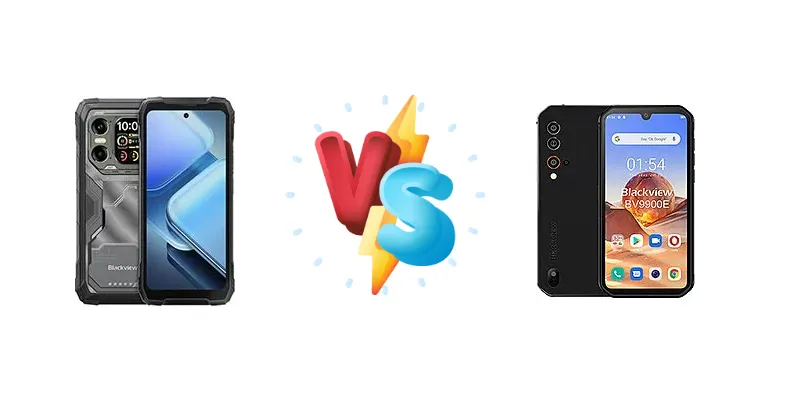
Blackview Xplore 1 vs BV9900E: A Deep Dive into Rugged Smartphone Performance
| Phones Images | |||||
|---|---|---|---|---|---|
|
🏆 Quick Verdict
For most users, the Blackview Xplore 1 is the superior choice. Its Dimensity 7050 chipset offers significantly improved CPU and GPU performance, coupled with a remarkable 154:36h battery endurance. While the BV9900E offers wireless charging, the Xplore 1’s faster wired charging and overall efficiency make it the more practical option.
| PHONES | ||
|---|---|---|
| Phone Names | Blackview Xplore 1 | Blackview BV9900E |
| Network | ||
|---|---|---|
| 2G bands | GSM 850 / 900 / 1800 / 1900 | GSM 850 / 900 / 1800 / 1900 |
| 3G bands | HSDPA 800 / 850 / 900 / 1700(AWS) / 1800 / 1900 / 2100 | HSDPA 800 / 850 / 900 / 1700(AWS) / 1900 / 2100 |
| 4G bands | 1, 2, 3, 4, 5, 7, 8, 12, 13, 17, 18, 19, 20, 25, 26, 28, 30, 34, 38, 39, 40, 41, 66 | 1, 2, 3, 4, 5, 7, 8, 12, 13, 17, 18, 19, 20, 25, 26, 28, 34, 38, 39, 40, 41, 66 |
| 5G bands | 1, 3, 5, 7, 8, 20, 28, 38, 40, 41, 77, 78 SA/NSA | - |
| Speed | HSPA, LTE, 5G | HSPA, LTE |
| Technology | GSM / CDMA / HSPA / LTE / 5G | GSM / CDMA / HSPA / CDMA2000 / LTE |
| Launch | ||
|---|---|---|
| Announced | 2025, August 31 | 2020, September 10. Released 2020, September |
| Status | Available. Released 2025, September | Discontinued |
| Body | ||
|---|---|---|
| Dimensions | 184 x 83 x 29.5 mm (7.24 x 3.27 x 1.16 in) | 156.5 x 78.3 x 14.2 mm (6.16 x 3.08 x 0.56 in) |
| SIM | Nano-SIM + Nano-SIM | Nano-SIM + Nano-SIM |
| Weight | 638 g (1.41 lb) | 273 g (9.63 oz) |
| Display | ||
|---|---|---|
| Protection | Corning Gorilla Glass 5, Mohs level 7 | Corning Gorilla Glass 5 |
| Resolution | 1080 x 2460 pixels (~396 ppi density) | 1080 x 2280 pixels, 19:9 ratio (~432 ppi density) |
| Size | 6.78 inches, 109.2 cm2 (~71.5% screen-to-body ratio) | 5.84 inches, 85.1 cm2 (~69.5% screen-to-body ratio) |
| Type | IPS LCD, 120Hz, 700 nits | IPS LCD |
| Platform | ||
|---|---|---|
| CPU | Octa-core (2x2.6 GHz Cortex-A78 & 6x2.0 GHz Cortex-A55) | Octa-core (2x2.2 GHz Cortex-A75 & 6x2.0 GHz Cortex-A55) |
| Chipset | Mediatek Dimensity 7050 (6 nm) | Mediatek MT6779V/CE Helio P90 (12 nm) |
| GPU | Mali-G68 MC4 | PowerVR GM9446 |
| OS | Android 15, DokeOS 4.2 | Android 10 |
| Memory | ||
|---|---|---|
| Card slot | microSDXC (uses shared SIM slot) | microSDXC |
| Internal | 256GB 12GB RAM, 512GB 16GB RAM | 128GB 6GB RAM |
| Main Camera | ||
|---|---|---|
| Dual | 64 MP, f/1.8, (wide), 1/2.0", PDAF 20 MP, f/1.8, (night vision), 1/2.8", 2 infrared night vision lights | - |
| Features | LED flash, HDR, panorama | LED flash, HDR, panorama |
| Quad | - | 48 MP, f/1.8, (wide), PDAF 16 MP, 120˚ (ultrawide) 2 MP (macro) Auxiliary lens |
| Video | 4K@30fps, 1080p@60fps | 4K@30fps, 1080p@60fps |
| Selfie camera | ||
|---|---|---|
| Single | 50 MP, f/1.8, (wide), 1/2.76", PDAF | 16 MP, f/2.0, (wide) |
| Video | 4K@30fps, 1080p@60fps | 1080p@30fps |
| Sound | ||
|---|---|---|
| 35mm jack | No | No |
| Loudspeaker | Yes | Yes |
| Comms | ||
|---|---|---|
| Bluetooth | 5.2, A2DP, LE | 5.0, A2DP, LE |
| Infrared port | Yes | - |
| NFC | Yes | Yes |
| Positioning | GPS (L1+L5), GLONASS, GALILEO, BDS, QZSS | GPS, GLONASS, GALILEO, BDS |
| Radio | FM radio | FM radio |
| USB | USB Type-C, OTG | USB Type-C 2.0, OTG |
| WLAN | Wi-Fi 802.11 a/b/g/n/ac/6, dual-band | Wi-Fi 802.11 a/b/g/n/ac |
| Features | ||
|---|---|---|
| Sensors | Fingerprint (side-mounted), accelerometer, gyro, proximity, compass | Fingerprint (side-mounted), accelerometer, gyro, proximity, compass, barometer |
| Battery | ||
|---|---|---|
| Charging | 55W wired 5W reverse wired | 15W wired 18W wireless |
| Type | 20000 mAh | 4380 mAh |
| Misc | ||
|---|---|---|
| Colors | Black, Orange | Black, Silver |
| Price | € 369.99 / $ 276.61 / £ 369.99 | About 260 EUR |
| EU LABEL | ||
|---|---|---|
| Battery | 154:36h endurance, 800 cycles | - |
| Energy | Class C | - |
| Free fall | Class A (275 falls) | - |
| Repairability | Class B | - |
Blackview Xplore 1
- Significantly faster processor (Dimensity 7050)
- Exceptional battery life (154:36h endurance)
- Faster wired charging (55W)
- More efficient 6nm process
- No wireless charging
- Rugged design may be bulky
Blackview BV9900E
- Wireless charging support (18W)
- Potentially lower price point
- Rugged design
- Established reputation in the rugged phone market
- Slower processor (Helio P90)
- Shorter battery life
- Slower charging speeds (15W wired)
- Less efficient 12nm process
Display Comparison
Display specifications are not provided, but given the market segment, both likely feature durable, if not cutting-edge, LCD panels. The focus here is on ruggedness, not pixel density. However, the Xplore 1’s newer chipset *could* support higher refresh rates if Blackview chose to implement them, a feature likely absent on the BV9900E. Bezels are expected to be substantial on both devices, prioritizing drop protection over a modern, edge-to-edge design.
Camera Comparison
Camera details are absent beyond the presence of sensors. However, the Xplore 1’s more powerful ISP (Image Signal Processor) within the Dimensity 7050 chipset will likely result in better image processing, particularly in low-light conditions. The BV9900E’s Helio P90 ISP is older and less capable. Expect the Xplore 1 to offer superior dynamic range and noise reduction. The presence of a 2MP macro lens on either device is likely a marketing gimmick and shouldn’t heavily influence purchasing decisions.
Performance
The core difference lies in the chipsets. The Xplore 1’s Mediatek Dimensity 7050 (6nm) is a substantial upgrade over the BV9900E’s Helio P90 (12nm). The Dimensity 7050’s Cortex-A78 cores, clocked at 2.6 GHz, provide a significant performance boost over the P90’s 2.2 GHz Cortex-A75 cores. The 6nm process node also translates to improved power efficiency, contributing to the Xplore 1’s impressive battery life. The P90, while capable, will struggle with demanding games and multitasking compared to the Xplore 1.
Battery Life
The Xplore 1 dominates in battery endurance with a reported 154:36h runtime. This is likely due to the efficient 6nm Dimensity 7050 chipset and optimized power management. The BV9900E’s battery capacity is not specified, but its older, less efficient chipset will result in significantly shorter usage times. While the BV9900E offers 18W wireless charging, the Xplore 1’s 55W wired charging is considerably faster, allowing for a full charge in a fraction of the time. The 5W reverse wired charging on the Xplore 1 is a useful addition for topping up accessories.
Buying Guide
Buy the Blackview Xplore 1 if you prioritize performance for gaming, multitasking, or demanding applications, and require exceptional battery life. Its modern chipset ensures future-proofing and a smoother user experience. Buy the Blackview BV9900E if wireless charging is a non-negotiable feature and your usage is primarily focused on basic tasks like calls, messaging, and light social media. Be prepared for slower performance and shorter battery life compared to the Xplore 1.