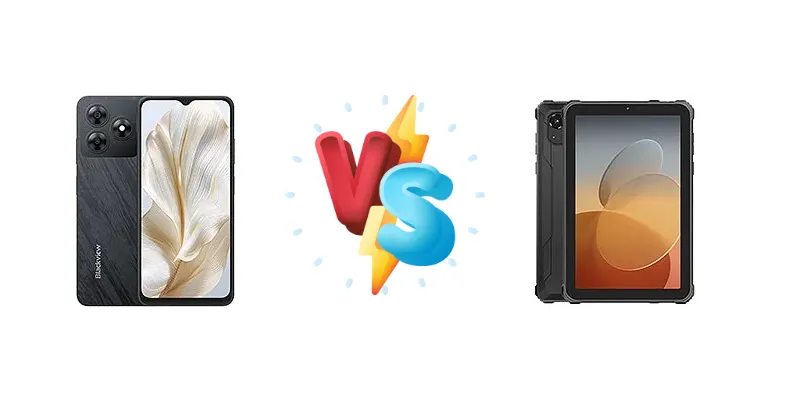
The rugged smartphone market is booming, offering durable devices for outdoor enthusiasts and demanding jobs. The Blackview Wave 8C and Oukitel RT3 Pro represent compelling options in the budget segment, but cater to different priorities. The Wave 8C emphasizes extreme battery longevity, while the RT3 Pro prioritizes processing power and faster charging. This comparison dissects their key specifications to determine which device best suits your needs.
🏆 Quick Verdict
For users prioritizing absolute battery life above all else, the Oukitel RT3 Pro is the clear winner with its nearly double endurance. However, the Blackview Wave 8C offers a respectable runtime and a more efficient chipset, making it a viable choice for lighter users who value cost savings.
| Network |
|---|
| 2G bands | GSM 850 / 900 / 1800 / 1900 | GSM 850 / 900 / 1800 / 1900 |
| 3G bands | HSDPA 900 / 2100 - International | HSDPA 850 / 900 / 1700(AWS) / 1900 / 2100 |
| 4G bands | 1, 3, 7, 8, 19, 20, 38, 40, 41 - International | 1, 2, 3, 4, 5, 7, 8, 12, 17, 18, 19, 20, 25, 26, 28, 38, 39, 40, 41, 66 |
| Speed | HSPA, LTE | HSPA, LTE |
| Technology | GSM / HSPA / LTE | GSM / HSPA / LTE |
| Launch |
|---|
| Announced | 2024, November | 2024, October |
| Status | Available. Released 2024, November | Available. Released 2024, October |
| Body |
|---|
| Dimensions | 163.2 x 75.2 x 8.8 mm (6.43 x 2.96 x 0.35 in) | 207 x 134 x 13.9 mm (8.15 x 5.28 x 0.55 in) |
| SIM | Nano-SIM + Nano-SIM | Nano-SIM + Nano-SIM |
| Weight | 193 g (6.81 oz) | 538 g (1.19 lb) |
| Display |
|---|
| Protection | Mohs level 5 | Corning Gorilla Glass 5, Mohs level 4 |
| Resolution | 720 x 1612 pixels, 20:9 ratio (~269 ppi density) | 800 x 1280 pixels, 16:10 ratio (~189 ppi density) |
| Size | 6.56 inches, 103.4 cm2 (~84.2% screen-to-body ratio) | 8.0 inches, 185.6 cm2 (~66.9% screen-to-body ratio) |
| Type | IPS LCD, 450 nits | IPS LCD, 600 nits |
| Platform |
|---|
| CPU | Octa-core (4x1.6 GHz Cortex-A55 & 4x1.2 GHz Cortex-A55) | Octa-core (2x2.0 GHz Cortex-A75 & 6x1.7 GHz Cortex-A55) |
| Chipset | Unisoc SC9863A (28 nm) | Mediatek Helio G81 (12 nm) |
| GPU | IMG8322 | Mali-G52 MC2 |
| OS | Android 14 (Go edition), DokeOS 4.0 | Android 14 |
| Memory |
|---|
| Card slot | microSDXC (dedicated slot) | microSDXC (uses shared SIM slot) |
| Internal | 64GB 2GB RAM | 128GB 4GB RAM |
| Main Camera |
|---|
| Dual | - | 16 MP, f/2.0, (wide), 1/3.06", PDAF
Auxiliary lens |
| Features | LED flash, HDR, panorama | LED flash |
| Single | 13 MP, (wide) | - |
| Video | 1080p@30fps | 1080p@30fps |
| Selfie camera |
|---|
| Single | 8 MP, (wide) | 8 MP, f/2.0, (wide), 1/4.0" |
| Video | 1080p@30fps | 720p@30fps |
| Sound |
|---|
| 35mm jack | Yes | No |
| Loudspeaker | Yes | Yes, with stereo speakers |
| Comms |
|---|
| Bluetooth | 4.2, A2DP | 5.0, A2DP, LE |
| NFC | No | Yes |
| Positioning | GPS, GLONASS, GALILEO | GPS, GLONASS, GALILEO, BDS |
| Radio | FM radio, RDS, recording | FM radio |
| USB | USB Type-C, OTG | USB Type-C 2.0, OTG |
| WLAN | Wi-Fi 802.11 b/g/n | Wi-Fi 802.11 a/b/g/n/ac, dual-band |
| Features |
|---|
| Sensors | Accelerometer, proximity | Accelerometer, compass |
| Battery |
|---|
| Charging | 5W wired | 10W wired |
| Type | 5000 mAh | Li-Po 5150 mAh |
| Misc |
|---|
| Colors | Sunset Purple, Dawn Blue, Dusk Black | Black, Orange, Green |
| Price | - | About 180 EUR |
| EU LABEL |
|---|
| Battery | 71:45h endurance, 1100 cycles | 138:44h endurance, 1000 cycles |
| Energy | Class A | Class B |
| Free fall | Class A (270 falls) | Class A (208 falls) |
| Repairability | Class B | Class B |
Blackview Wave 8C
- Exceptional battery endurance (71:45h)
- More power-efficient chipset (Unisoc SC9863A)
- Potentially lower price point
- Slower processor performance
- Slower charging speed (5W)
Oukitel RT3 Pro
- Superior processing power (Helio G81)
- Faster charging (10W)
- Long battery endurance (138:44h)
- Less battery endurance than Wave 8C
- Potentially higher price point
Display Comparison
Neither device provides display specifications, but given their price points, we can assume both utilize LCD panels. The focus here isn't on visual fidelity. The real difference lies in power consumption, which is indirectly impacted by the chipset. The RT3 Pro's more powerful Helio G81 will likely drive a slightly brighter display, but at the cost of increased battery drain.
Camera Comparison
Without detailed camera specs, a direct comparison is difficult. However, given the market segment, we can expect both phones to feature basic camera setups. The focus will likely be on usability rather than image quality. The RT3 Pro’s more powerful ISP (Image Signal Processor) within the Helio G81 chipset *could* offer slightly better image processing, but this is speculative. The presence of a 2MP macro lens on either device is largely a marketing gimmick and shouldn't be a deciding factor.
Performance
The Oukitel RT3 Pro’s Mediatek Helio G81, fabricated on a 12nm process, represents a significant performance leap over the Blackview Wave 8C’s Unisoc SC9863A (28nm). The G81’s octa-core configuration, featuring 2x2.0 GHz Cortex-A75 and 6x1.7 GHz Cortex-A55 cores, delivers substantially faster processing speeds compared to the Wave 8C’s 4x1.6 GHz Cortex-A55 & 4x1.2 GHz Cortex-A55. This translates to smoother multitasking, quicker app launches, and a more enjoyable gaming experience on the RT3 Pro. The 28nm process of the SC9863A is less efficient, meaning more power is consumed for the same tasks, impacting battery life despite the Wave 8C's larger battery capacity.
Battery Life
The Oukitel RT3 Pro boasts a remarkable 138:44h endurance, significantly exceeding the Blackview Wave 8C’s 71:45h. While the Wave 8C has a larger battery capacity (unspecified), the RT3 Pro’s more efficient chipset and optimized power management contribute to its superior longevity. The RT3 Pro also benefits from 10W wired charging, a step up from the Wave 8C’s 5W, reducing charging times. This means the RT3 Pro can replenish its battery faster, minimizing downtime.
Buying Guide
Buy the Blackview Wave 8C if you need a phone that can genuinely last for days on a single charge, even with moderate use, and are comfortable with slower performance and charging speeds. This is ideal for extended trips off-grid or for users who simply dislike frequent charging. Buy the Oukitel RT3 Pro if you prefer a more responsive user experience, faster app loading times, and quicker charging, even if it means sacrificing some ultimate battery endurance. This phone is better suited for users who multitask, play mobile games, or rely on their phone for work.
Frequently Asked Questions
❓ Does the Unisoc SC9863A chipset struggle with demanding apps like social media or video streaming?
The Unisoc SC9863A is a basic chipset designed for efficiency, not high performance. While it can handle basic tasks like calls, texts, and light browsing, you may experience noticeable lag or slowdowns when running multiple apps simultaneously or streaming high-resolution video. The Oukitel RT3 Pro's Helio G81 is significantly better equipped for these tasks.
❓ How does the 5W charging on the Blackview Wave 8C impact its usability? Will it take all day to charge?
5W charging is quite slow by modern standards. Expect a full charge to take several hours, potentially 5-7 hours from 0%. This is a trade-off for the extended battery life; the Wave 8C is designed to be charged infrequently, rather than quickly. The RT3 Pro's 10W charging offers a noticeable improvement, reducing charge times considerably.
❓ Is the difference in battery cycle counts (1100 for Wave 8C vs 1000 for RT3 Pro) a significant factor?
While 100 cycles difference sounds substantial, it's unlikely to be a major concern for most users. Battery degradation occurs over time regardless of cycle count. Both phones will experience reduced battery capacity after several years of use. The RT3 Pro's superior overall battery endurance likely outweighs the slightly lower cycle count.