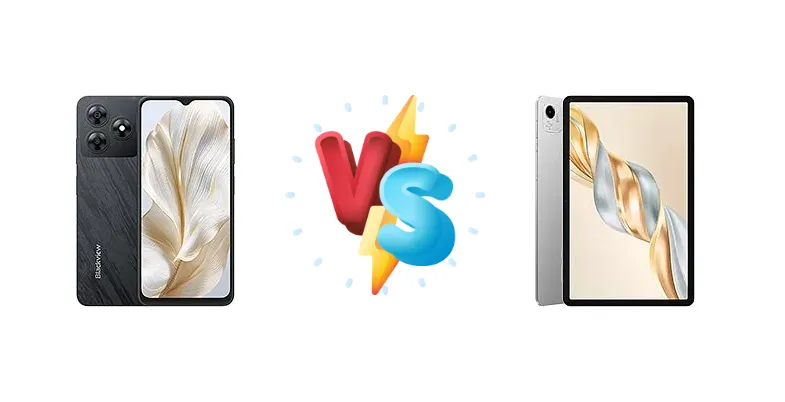
The tablet market offers a wide range of options, but finding the right balance between price, performance, and battery life can be challenging. We pit the Blackview Wave 8C, known for its impressive battery endurance, against the Honor Pad X9a, which prioritizes a more efficient chipset and faster charging, to determine which tablet reigns supreme.
🏆 Quick Verdict
For users prioritizing all-day (and then some) battery life, the Blackview Wave 8C is the clear winner, offering 71:45h of endurance. However, the Honor Pad X9a counters with a significantly faster Snapdragon 685 chipset and 35W charging, making it the better choice for those who demand quicker performance and less downtime.
| Network |
|---|
| 2G bands | GSM 850 / 900 / 1800 / 1900 | N/A |
| 3G bands | HSDPA 900 / 2100 - International | N/A |
| 4G bands | 1, 3, 7, 8, 19, 20, 38, 40, 41 - International | N/A |
| EDGE | - | No |
| GPRS | - | No |
| Speed | HSPA, LTE | - |
| Technology | GSM / HSPA / LTE | No cellular connectivity |
| Launch |
|---|
| Announced | 2024, November | 2025, March 21 |
| Status | Available. Released 2024, November | Available. Released 2025, March 26 |
| Body |
|---|
| Build | - | Glass front, aluminum frame, aluminum back |
| Dimensions | 163.2 x 75.2 x 8.8 mm (6.43 x 2.96 x 0.35 in) | 267.3 x 167.4 x 6.8 mm (10.52 x 6.59 x 0.27 in) |
| SIM | Nano-SIM + Nano-SIM | No |
| Weight | 193 g (6.81 oz) | 475 g (1.05 lb) |
| Display |
|---|
| Protection | Mohs level 5 | Mohs level 4 |
| Resolution | 720 x 1612 pixels, 20:9 ratio (~269 ppi density) | 1504 x 2508 pixels, 5:3 ratio (~254 ppi density) |
| Size | 6.56 inches, 103.4 cm2 (~84.2% screen-to-body ratio) | 11.5 inches, 376.3 cm2 (~84.1% screen-to-body ratio) |
| Type | IPS LCD, 450 nits | TFT LCD, 120Hz, 400 nits (peak) |
| Platform |
|---|
| CPU | Octa-core (4x1.6 GHz Cortex-A55 & 4x1.2 GHz Cortex-A55) | Octa-core (4x2.8 GHz Cortex-A73 & 4x1.9 GHz Cortex-A53) |
| Chipset | Unisoc SC9863A (28 nm) | Qualcomm SM6225 Snapdragon 685 (6 nm) |
| GPU | IMG8322 | Adreno 610 |
| OS | Android 14 (Go edition), DokeOS 4.0 | Android 15, MagicOS 9 |
| Memory |
|---|
| Card slot | microSDXC (dedicated slot) | No |
| Internal | 64GB 2GB RAM | 128GB 6GB RAM, 128GB 8GB RAM |
| Main Camera |
|---|
| Features | LED flash, HDR, panorama | - |
| Single | 13 MP, (wide) | 8 MP, f/2.0, (wide), 1/5.0" |
| Video | 1080p@30fps | 1080p@30fps |
| Selfie camera |
|---|
| Single | 8 MP, (wide) | 5 MP, f/2.2 |
| Video | 1080p@30fps | 1080p@30fps |
| Sound |
|---|
| 35mm jack | Yes | No |
| Loudspeaker | Yes | Yes, with stereo speakers (4 speakers) |
| Comms |
|---|
| Bluetooth | 4.2, A2DP | 5.1, A2DP, LE |
| NFC | No | No |
| Positioning | GPS, GLONASS, GALILEO | No |
| Radio | FM radio, RDS, recording | No |
| USB | USB Type-C, OTG | USB Type-C |
| WLAN | Wi-Fi 802.11 b/g/n | Wi-Fi 802.11 a/b/g/n/ac, dual-band |
| Features |
|---|
| Sensors | Accelerometer, proximity | Accelerometer |
| Battery |
|---|
| Charging | 5W wired | 35W wired |
| Type | 5000 mAh | Li-Ion 8300 mAh |
| Misc |
|---|
| Colors | Sunset Purple, Dawn Blue, Dusk Black | Gray |
| Models | - | ELN2-W29 |
| Price | - | About 210 EUR |
| EU LABEL |
|---|
| Battery | 71:45h endurance, 1100 cycles | 92:29h endurance, 1200 cycles |
| Energy | Class A | Class F |
| Free fall | Class A (270 falls) | Class E (10 falls) |
| Repairability | Class B | Class C |
Blackview Wave 8C
- Exceptional battery endurance (71:45h)
- High battery cycle count (1100 cycles)
- Potentially lower price point
- Slow processor (Unisoc SC9863A)
- Slow charging speed (5W)
- Less efficient chipset (28nm)
Honor Pad X9a
- Faster and more efficient processor (Snapdragon 685)
- Significantly faster charging (35W)
- Long battery life (92:29h)
- Potentially higher price point
- Slightly lower battery cycle count (1200 cycles)
Display Comparison
Neither device's display specifications are provided, so a direct comparison is limited. However, given the price points, we can assume both utilize IPS LCD panels. The Honor Pad X9a, benefiting from a more modern chipset, likely has better image processing capabilities, potentially resulting in slightly more accurate colors. The absence of details like resolution or refresh rate makes a definitive statement impossible, but the X9a's chipset suggests a more refined visual experience.
Camera Comparison
Without specific camera sensor details, a detailed comparison is difficult. However, it's reasonable to assume both tablets feature modest camera setups geared towards casual use. The absence of information suggests neither device will excel in photography. The focus should be on the chipset's image signal processor (ISP); the Snapdragon 685 in the Honor Pad X9a likely offers superior image processing capabilities, resulting in better dynamic range and noise reduction compared to the Unisoc SC9863A in the Blackview Wave 8C.
Performance
The Honor Pad X9a’s Qualcomm Snapdragon 685, built on a 6nm process, represents a substantial leap in efficiency and performance over the Blackview Wave 8C’s Unisoc SC9863A (28nm). The Snapdragon 685 features Cortex-A73 cores clocked at 2.8 GHz, significantly outperforming the Wave 8C’s Cortex-A55 cores at 1.6 GHz. This translates to faster app launches, smoother multitasking, and a more responsive overall user experience. The 6nm fabrication process also contributes to lower heat generation, potentially reducing throttling during sustained workloads. The Wave 8C will handle basic tasks, but the X9a is demonstrably more capable.
Battery Life
The Honor Pad X9a boasts a significant advantage in battery endurance with 92:29h compared to the Blackview Wave 8C’s 71:45h. While the Wave 8C offers a respectable 1100 charge cycles, the X9a’s superior efficiency, thanks to the 6nm Snapdragon 685, allows it to extract more usage from its battery. Furthermore, the X9a’s 35W wired charging is a game-changer, drastically reducing recharge times compared to the Wave 8C’s slow 5W charging. This means less time tethered to an outlet and more time enjoying the tablet.
Buying Guide
Buy the Blackview Wave 8C if you need a tablet primarily for extended media consumption, reading, or basic tasks where battery life is paramount and you don't mind slower processing speeds. Buy the Honor Pad X9a if you prefer a more responsive user experience, faster app loading times, and the convenience of rapid charging, even if it means sacrificing some overall endurance.
Frequently Asked Questions
❓ Will the Unisoc SC9863A in the Blackview Wave 8C struggle with demanding apps like video editors or graphically intensive games?
Yes, the Unisoc SC9863A is a low-end chipset. While it can handle basic tasks like web browsing and video playback, it will likely exhibit significant lag and slowdowns when running resource-intensive applications. The Honor Pad X9a’s Snapdragon 685 is far better suited for these workloads.
❓ How long will it realistically take to fully charge the Blackview Wave 8C with its 5W charging?
With a 5W charging rate, a full charge from 0% on the Blackview Wave 8C will likely take upwards of 6-8 hours, potentially even longer depending on usage during charging. This is a significant drawback compared to the Honor Pad X9a’s 35W fast charging, which can achieve a full charge in well under 2 hours.
❓ Is the difference in battery cycle counts (1100 vs 1200) between the Wave 8C and X9a significant in real-world usage?
While 100 cycles represent a difference, it's unlikely to be noticeable for the average user. Battery degradation occurs over time regardless of cycle count, and usage patterns (charging habits, temperature) have a greater impact. Both tablets offer a respectable number of cycles.
❓ Does the Snapdragon 685 in the Honor Pad X9a support any gaming optimizations or features?
The Snapdragon 685 includes Qualcomm’s Snapdragon Elite Gaming features, which offer optimizations for popular mobile games. While it’s not a gaming powerhouse, it provides a smoother and more enjoyable gaming experience compared to the Blackview Wave 8C’s Unisoc chipset.