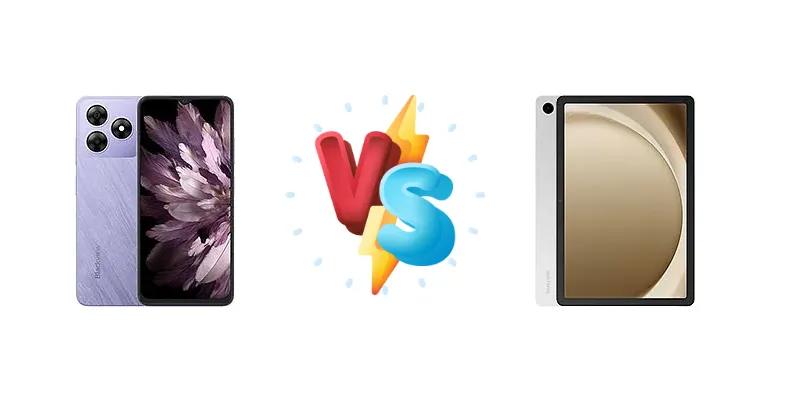
The tablet market offers a wide spectrum of choices, but finding the right balance between performance and endurance can be tricky. We pit the Blackview Wave 8, known for its exceptional battery life, against the Samsung Galaxy Tab A9+, which prioritizes a more modern chipset and 5G connectivity. This comparison aims to determine which tablet best suits your needs, whether you prioritize all-day usage or a smoother, more responsive experience.
🏆 Quick Verdict
For users prioritizing maximum battery life and long-term durability, the Blackview Wave 8 is the clear winner. Its 71-hour endurance and 1100 charge cycles significantly outperform the Tab A9+. However, the Samsung Galaxy Tab A9+ offers a more efficient chipset and faster charging, making it a better choice for those who demand quicker performance and 5G connectivity.
| Network |
|---|
| 2G bands | GSM 850 / 900 / 1800 / 1900 | GSM 850 / 900 / 1800 / 1900 |
| 3G bands | HSDPA 900 / 2100 - International | HSDPA 850 / 900 / 1700(AWS) / 1900 / 2100 |
| 4G bands | 1, 3, 7, 8, 19, 20, 38, 40, 41 - International | 1, 2, 3, 4, 5, 7, 8, 12, 13, 17, 20, 26, 28, 38, 40, 41, 66 |
| 5G bands | - | 1, 3, 5, 7, 8, 20, 28, 38, 40, 41, 66, 77, 78 SA/NSA/Sub6 |
| Speed | HSPA, LTE | HSPA, LTE, 5G - cellular model only |
| Technology | GSM / HSPA / LTE | GSM / HSPA / LTE / 5G |
| Launch |
|---|
| Announced | 2024, November | 2023, October 05 |
| Status | Available. Released 2024, November | Available. Released 2023, October 17 |
| Body |
|---|
| Dimensions | 163.2 x 75.2 x 8.8 mm (6.43 x 2.96 x 0.35 in) | 257.1 x 168.7 x 6.9 mm (10.12 x 6.64 x 0.27 in) |
| SIM | Nano-SIM + Nano-SIM | Nano-SIM + eSIM (cellular model only) |
| Weight | 192 g (6.77 oz) | 480 g or 492 g (1.06 lb) |
| Display |
|---|
| Protection | Mohs level 5 | - |
| Resolution | 720 x 1612 pixels, 20:9 ratio (~269 ppi density) | 1200 x 1920 pixels, 16:10 ratio (~206 ppi density) |
| Size | 6.56 inches, 103.4 cm2 (~84.2% screen-to-body ratio) | 11.0 inches, 350.9 cm2 (~80.9% screen-to-body ratio) |
| Type | IPS LCD, 450 nits | TFT LCD, 90Hz |
| Platform |
|---|
| CPU | Octa-core (2x1.6 GHz Cortex-A75 & 6x1.6 GHz Cortex-A55) | Octa-core (2x2.2 GHz Kryo 660 Gold & 6x1.8 GHz Kryo 660 Silver) |
| Chipset | Unisoc T606 (12 nm) | Qualcomm SM6375 Snapdragon 695 5G (6 nm) |
| GPU | Mali-G57 MP1 | Adreno 619 |
| OS | Android 14, DokeOS 4.0 | Android 13, upgradable to Android 15, One UI 7 |
| Memory |
|---|
| Card slot | microSDXC (uses shared SIM slot) | microSDXC (dedicated slot) |
| Internal | 256GB 4GB RAM | 64GB 4GB RAM, 128GB 4GB RAM, 128GB 8GB RAM, 256GB 8GB RAM |
| Main Camera |
|---|
| Features | LED flash, HDR, panorama | - |
| Single | 13 MP, (wide) | 8 MP, AF |
| Video | 1080p@30fps | 1080p@30fps |
| Selfie camera |
|---|
| Single | 8 MP, (wide) | 5 MP |
| Video | 1080p@30fps | 1080p@30fps |
| Sound |
|---|
| 35mm jack | Yes | Yes |
| Loudspeaker | Yes | Yes, with stereo speakers (4 speakers) |
| Comms |
|---|
| Bluetooth | 5.2, A2DP, LE | 5.1, A2DP, LE |
| NFC | No | No |
| Positioning | GPS, GLONASS, GALILEO, BDS | GPS, GLONASS, GALILEO, BDS, QZSS - cellular model only |
| Radio | FM radio | No |
| USB | USB Type-C, OTG | USB Type-C 2.0 |
| WLAN | Wi-Fi 802.11 a/b/g/n/ac, dual-band | Wi-Fi 802.11 a/b/g/n/ac, dual-band, Wi-Fi Direct |
| Features |
|---|
| Sensors | Fingerprint (side-mounted), accelerometer, proximity | Accelerometer, gyro, proximity (accessories only), compass |
| Battery |
|---|
| Charging | 10W wired | 15W wired |
| Type | 5000 mAh | Li-Po 7040 mAh |
| Misc |
|---|
| Colors | Sunset Purple, Dawn Blue, Dusk Black | Graphite, Silver, Navy |
| Models | - | SM-X210, SM-X215, SM-X216B |
| Price | - | $ 199.99 |
| SAR | 0.70 W/kg (head) 1.40 W/kg (body) | 0.42 W/kg (body) |
| SAR EU | - | 1.19 W/kg (body) |
| EU LABEL |
|---|
| Battery | 71:07h endurance, 1100 cycles | - |
| Energy | Class A | - |
| Free fall | Class A (270 falls) | - |
| Repairability | Class B | - |
Blackview Wave 8
- Exceptional battery life (71+ hours)
- High battery cycle count (1100 cycles)
- Excellent value for money
- Slower charging speed (10W)
- Less powerful processor
Samsung Galaxy Tab A9+
- Faster and more efficient Snapdragon 695 chipset
- 5G connectivity for faster data speeds
- Faster charging (15W)
- Significantly shorter battery life
- Potentially higher price point
Display Comparison
While display specifications aren't provided, the Samsung Galaxy Tab A9+ likely benefits from Samsung's display expertise, potentially offering better color accuracy and viewing angles. The Blackview Wave 8, positioned as a value-oriented device, may utilize a more basic panel. However, without specific data on resolution, brightness, and panel type, it's difficult to definitively declare a winner. The Tab A9+'s brand reputation suggests a more refined visual experience.
Camera Comparison
Without detailed camera specifications, a direct comparison is limited. However, given Samsung’s history, the Tab A9+ likely features a more sophisticated camera system with better image processing algorithms. The Blackview Wave 8, focusing on core functionality, likely employs a more basic camera setup. The absence of information regarding sensor size and aperture makes a precise assessment impossible, but Samsung’s brand reputation suggests a superior photographic experience.
Performance
The Samsung Galaxy Tab A9+’s Qualcomm Snapdragon 695 (6nm) represents a significant architectural advantage over the Blackview Wave 8’s Unisoc T606 (12nm). The 6nm process node allows for greater transistor density and improved power efficiency, translating to better sustained performance and less heat generation. The Snapdragon 695’s Kryo 660 Gold cores, clocked at 2.2 GHz, also outperform the Cortex-A75 cores in the Unisoc T606 (1.6 GHz). This means the Tab A9+ will handle multitasking, demanding apps, and gaming with greater ease. The 5G capability of the Snapdragon 695 is also a key differentiator, offering faster data speeds where available.
Battery Life
The Blackview Wave 8’s standout feature is its exceptional battery endurance – a remarkable 71:07 hours. This is coupled with an impressive 1100 charge cycles, indicating long-term battery health. While the Samsung Galaxy Tab A9+ offers faster 15W charging compared to the Wave 8’s 10W, it cannot match the Wave 8’s overall longevity. The slower charging speed on the Wave 8 is a trade-off for the significantly extended runtime. The Unisoc T606’s power efficiency, combined with a potentially larger battery capacity (not specified), contributes to the Wave 8’s dominance in this category.
Buying Guide
Buy the Blackview Wave 8 if you need a tablet that can reliably last through multi-day trips, extended work sessions, or frequent use by children without constant charging. It’s ideal for media consumption, reading, and basic productivity tasks where raw processing power isn’t critical. Buy the Samsung Galaxy Tab A9+ if you prefer a more responsive user experience, benefit from 5G connectivity for on-the-go access, and appreciate the faster charging speeds, even if it means sacrificing some battery endurance.
Frequently Asked Questions
❓ Is the Unisoc T606 chipset in the Blackview Wave 8 sufficient for everyday tasks like browsing, email, and video streaming?
Yes, the Unisoc T606 is perfectly capable of handling everyday tasks. While it won't deliver flagship-level performance, it provides a smooth and responsive experience for common applications. The focus of the Wave 8 is endurance, not raw power.
❓ How much faster is the charging on the Samsung Galaxy Tab A9+ compared to the Blackview Wave 8, and does this offset the shorter battery life?
The Tab A9+ charges at 15W, while the Wave 8 charges at 10W. This means the Tab A9+ will reach a full charge approximately 35% faster. However, the Wave 8’s significantly longer battery life means you’ll need to charge it far less frequently, making the slower charging speed a less significant drawback for most users.
❓ Does the 5G connectivity on the Samsung Galaxy Tab A9+ significantly impact battery life?
Yes, utilizing 5G connectivity will noticeably reduce battery life on the Tab A9+. 5G requires more power than Wi-Fi, so frequent use of 5G will contribute to faster battery drain. However, the faster data speeds may be worth the trade-off for users who require constant connectivity on the go.