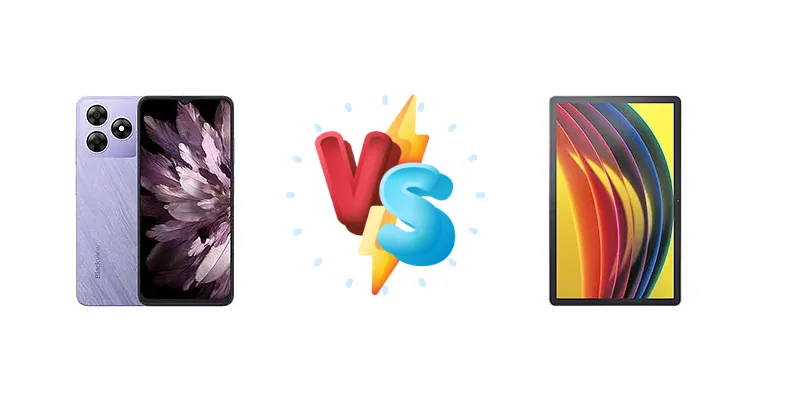
The tablet market offers a wide spectrum of choices, but often forces compromises. The Blackview Wave 8 and Lenovo Tab P11 Plus represent two distinct approaches: prioritizing exceptional battery endurance versus delivering more robust performance for gaming and multitasking. This comparison dissects their core specifications to determine which tablet best suits your needs.
🏆 Quick Verdict
For users prioritizing all-day (and multi-day) battery life, the Blackview Wave 8 is the clear winner, boasting a remarkable 71:07h endurance. However, the Lenovo Tab P11 Plus, powered by the Helio G90T, offers a significantly faster processor and 20W charging, making it ideal for users who demand more from their tablet.
| Network |
|---|
| 2G bands | GSM 850 / 900 / 1800 / 1900 | GSM 850 / 900 / 1800 / 1900 |
| 3G bands | HSDPA 900 / 2100 - International | HSDPA 850 / 900 / 1900 / 2100 |
| 4G bands | 1, 3, 7, 8, 19, 20, 38, 40, 41 - International | 1, 2, 3, 4, 5, 7, 8, 20, 28, 38, 40, 41 |
| Speed | HSPA, LTE | HSPA, LTE - cellular model only |
| Technology | GSM / HSPA / LTE | GSM / HSPA / LTE |
| Launch |
|---|
| Announced | 2024, November | 2021, June 28 |
| Status | Available. Released 2024, November | Available. Released 2021, July 29 |
| Body |
|---|
| Dimensions | 163.2 x 75.2 x 8.8 mm (6.43 x 2.96 x 0.35 in) | 258.4 x 163 x 7.5 mm (10.17 x 6.42 x 0.30 in) |
| SIM | Nano-SIM + Nano-SIM | Nano-SIM (cellular model only) |
| Weight | 192 g (6.77 oz) | 490 g (1.08 lb) |
| | - | Stylus support |
| Display |
|---|
| Protection | Mohs level 5 | - |
| Resolution | 720 x 1612 pixels, 20:9 ratio (~269 ppi density) | 1200 x 2000 pixels, 5:3 ratio (~212 ppi density) |
| Size | 6.56 inches, 103.4 cm2 (~84.2% screen-to-body ratio) | 11.0 inches, 344.4 cm2 (~81.8% screen-to-body ratio) |
| Type | IPS LCD, 450 nits | IPS LCD, 400 nits (typ) |
| Platform |
|---|
| CPU | Octa-core (2x1.6 GHz Cortex-A75 & 6x1.6 GHz Cortex-A55) | Octa-core (2x2.05 GHz Cortex-A76 & 6x2.0 GHz Cortex-A55) |
| Chipset | Unisoc T606 (12 nm) | Mediatek MT6785 Helio G90T (12 nm) |
| GPU | Mali-G57 MP1 | Mali-G76 MC4 |
| OS | Android 14, DokeOS 4.0 | Android 11 |
| Memory |
|---|
| Card slot | microSDXC (uses shared SIM slot) | microSDXC (dedicated slot) |
| Internal | 256GB 4GB RAM | 64GB 4GB RAM, 128GB 4GB RAM, 128GB 6GB RAM |
| Main Camera |
|---|
| Features | LED flash, HDR, panorama | LED flash |
| Single | 13 MP, (wide) | 13 MP, (wide), AF |
| Video | 1080p@30fps | 1080p@30fps |
| Selfie camera |
|---|
| Single | 8 MP, (wide) | 8 MP, (wide) |
| Video | 1080p@30fps | 1080p@30fps |
| Sound |
|---|
| 3.5mm jack | - | No |
| 35mm jack | Yes | No |
| Loudspeaker | Yes | Yes, with stereo speakers (4 speakers) |
| Comms |
|---|
| Bluetooth | 5.2, A2DP, LE | 5.1, A2DP, LE |
| NFC | No | No |
| Positioning | GPS, GLONASS, GALILEO, BDS | GPS, GLONASS, BDS - cellular model only |
| Radio | FM radio | FM radio |
| USB | USB Type-C, OTG | USB Type-C 2.0 |
| WLAN | Wi-Fi 802.11 a/b/g/n/ac, dual-band | Wi-Fi 802.11 a/b/g/n/ac, dual-band, Wi-Fi Direct |
| Features |
|---|
| Sensors | Fingerprint (side-mounted), accelerometer, proximity | Accelerometer, gyro, proximity |
| Battery |
|---|
| Charging | 10W wired | 20W wired |
| Type | 5000 mAh | Li-Po 7700 mAh |
| Misc |
|---|
| Colors | Sunset Purple, Dawn Blue, Dusk Black | Slate Grey, Platinum Grey, Modernist teal |
| Models | - | ZA940124SE |
| Price | - | About 300 EUR |
| SAR | 0.70 W/kg (head) 1.40 W/kg (body) | - |
| EU LABEL |
|---|
| Battery | 71:07h endurance, 1100 cycles | - |
| Energy | Class A | - |
| Free fall | Class A (270 falls) | - |
| Repairability | Class B | - |
Blackview Wave 8
- Exceptional battery life (71:07h endurance)
- High battery cycle count (1100 cycles)
- Power-efficient Unisoc T606 chipset
- Slow 10W charging
- Less powerful processor for demanding tasks
- Limited performance for gaming
Lenovo Tab P11 Plus
- Faster MediaTek Helio G90T processor
- 20W fast charging
- Better performance for gaming and multitasking
- Shorter battery life compared to Wave 8
- Potentially more thermal throttling under heavy load
- Likely fewer battery charge cycles
Display Comparison
Neither device's display specifications are provided, so a direct comparison is limited. However, given the price points, both likely utilize IPS LCD panels. The Lenovo Tab P11 Plus, being positioned as a slightly more premium offering, may benefit from a higher resolution or slightly improved color accuracy. The absence of details like peak brightness or refresh rate suggests neither is targeting display-centric users.
Camera Comparison
Without detailed camera specifications, a meaningful comparison is difficult. Both tablets likely feature modest camera setups geared towards casual use. The absence of information regarding sensor size or optical image stabilization suggests neither is a strong contender for photography enthusiasts. It's reasonable to assume the Lenovo Tab P11 Plus might offer slightly better image processing capabilities due to its more powerful chipset.
Performance
The Lenovo Tab P11 Plus holds a clear advantage in processing power. Its MediaTek Helio G90T chipset, featuring a dual-core Cortex-A76 configuration clocked at 2.05 GHz, significantly outperforms the Blackview Wave 8’s Unisoc T606. The T606’s Cortex-A75 cores, clocked at 1.6 GHz, are less efficient and offer lower peak performance. This translates to smoother multitasking, faster app loading times, and a more enjoyable gaming experience on the Lenovo. While both are 12nm chips, the architectural improvements in the G90T are substantial.
Battery Life
The Blackview Wave 8 dominates in battery endurance, achieving an astonishing 71:07 hours of use. This is a direct result of the power-efficient Unisoc T606 chipset and likely a larger battery capacity (though not specified). The Lenovo Tab P11 Plus, while offering faster 20W wired charging, will require more frequent charging due to the more power-hungry Helio G90T. The Wave 8’s 10W charging is slow, but the exceptional battery life mitigates this drawback. The Wave 8's 1100 charge cycles also suggest a longer lifespan before battery degradation.
Buying Guide
Buy the Blackview Wave 8 if you need a tablet primarily for media consumption, reading, or light productivity tasks, and value extended battery life above all else. Its 1100 charge cycles also suggest long-term reliability. Buy the Lenovo Tab P11 Plus if you prefer a tablet capable of handling demanding games, video editing, or multitasking, and appreciate faster charging speeds to minimize downtime.
Frequently Asked Questions
❓ Will the Unisoc T606 in the Blackview Wave 8 struggle with graphically intensive games like Genshin Impact?
Yes, the Unisoc T606 is a mid-range chipset and will likely struggle to run demanding games like Genshin Impact at high settings. Expect lower frame rates and potential stuttering. The Wave 8 is better suited for less demanding games and media consumption.
❓ How long does it realistically take to fully charge the Lenovo Tab P11 Plus from 0% with the 20W charger?
While 20W charging is faster than the Wave 8's 10W, the actual 0-100% charge time will depend on usage during charging. Expect approximately 2-3 hours for a full charge, but it will be significantly faster to reach 50-80%.
❓ Does the Blackview Wave 8's slow charging speed make it impractical for quick top-ups?
The 10W charging is indeed slow. However, the exceptional battery life means you'll likely only need to charge it every few days, minimizing the impact of the slow charging speed. It's designed for infrequent, overnight charging rather than quick top-ups.