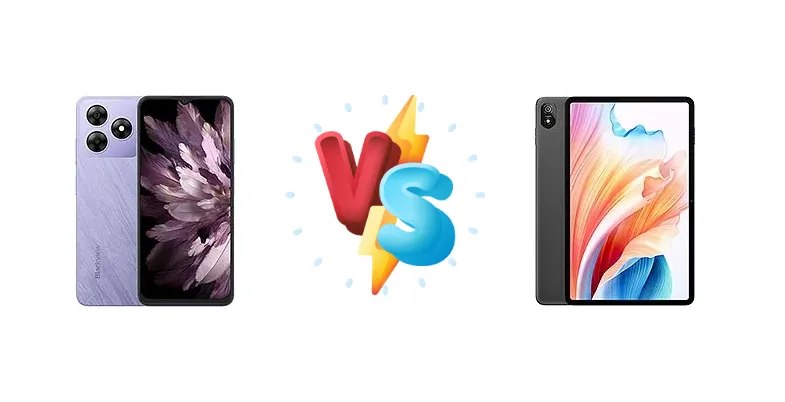
Blackview’s tablet lineup offers compelling options in the budget space, but the Wave 8 and Tab 18 represent distinct priorities. The Wave 8 focuses on maximizing battery life, while the Tab 18 prioritizes processing power with a more modern chipset. This comparison dissects these differences to determine which tablet delivers the best value for your needs.
🏆 Quick Verdict
For users prioritizing all-day battery life and extended usability, the Blackview Wave 8 is the clear winner, boasting an impressive 71-hour endurance. However, the Blackview Tab 18’s Helio G99 chipset offers a significant performance boost, making it the better choice for demanding tasks and gaming.
| Network |
|---|
| 2G bands | GSM 850 / 900 / 1800 / 1900 | GSM 850 / 900 / 1800 / 1900 |
| 3G bands | HSDPA 900 / 2100 - International | HSDPA 900 / 2100 |
| 4G bands | 1, 3, 7, 8, 19, 20, 38, 40, 41 - International | 1, 3, 7, 8, 20, 40 |
| Speed | HSPA, LTE | HSPA, LTE |
| Technology | GSM / HSPA / LTE | GSM / HSPA / LTE |
| Launch |
|---|
| Announced | 2024, November | 2023, November |
| Status | Available. Released 2024, November | Available. Released 2023, November |
| Body |
|---|
| Dimensions | 163.2 x 75.2 x 8.8 mm (6.43 x 2.96 x 0.35 in) | 277.6 x 173.2 x 7.9 mm (10.93 x 6.82 x 0.31 in) |
| SIM | Nano-SIM + Nano-SIM | Nano-SIM + Nano-SIM |
| Weight | 192 g (6.77 oz) | 632 g (1.39 lb) |
| Display |
|---|
| Protection | Mohs level 5 | - |
| Resolution | 720 x 1612 pixels, 20:9 ratio (~269 ppi density) | 1200 x 2000 pixels, 5:3 ratio (~194 ppi density) |
| Size | 6.56 inches, 103.4 cm2 (~84.2% screen-to-body ratio) | 12.0 inches, 409.9 cm2 (~85.2% screen-to-body ratio) |
| Type | IPS LCD, 450 nits | IPS LCD, 350 nits |
| Platform |
|---|
| CPU | Octa-core (2x1.6 GHz Cortex-A75 & 6x1.6 GHz Cortex-A55) | Octa-core (2x2.2 GHz Cortex-A76 & 6x2.0 GHz Cortex-A55) |
| Chipset | Unisoc T606 (12 nm) | Mediatek Helio G99 (6 nm) |
| GPU | Mali-G57 MP1 | Mali-G57 MC2 |
| OS | Android 14, DokeOS 4.0 | Android 13, Doke OS_P 4.0 |
| Memory |
|---|
| Card slot | microSDXC (uses shared SIM slot) | microSDXC (uses shared SIM slot) |
| Internal | 256GB 4GB RAM | 256GB 12GB RAM |
| Main Camera |
|---|
| Features | LED flash, HDR, panorama | LED flash |
| Single | 13 MP, (wide) | 16 MP |
| Video | 1080p@30fps | 1080p@30fps |
| Selfie camera |
|---|
| Single | 8 MP, (wide) | 8 MP |
| Video | 1080p@30fps | Yes |
| Sound |
|---|
| 35mm jack | Yes | No |
| Loudspeaker | Yes | Yes, with stereo speakers (4 speakers) |
| Comms |
|---|
| Bluetooth | 5.2, A2DP, LE | 5.1, A2DP, LE |
| NFC | No | No |
| Positioning | GPS, GLONASS, GALILEO, BDS | GPS, GLONASS, GALILEO, BDS |
| Radio | FM radio | FM Radio |
| USB | USB Type-C, OTG | USB Type-C, OTG |
| WLAN | Wi-Fi 802.11 a/b/g/n/ac, dual-band | Wi-Fi 802.11 a/b/g/n/ac, dual-band |
| Features |
|---|
| Sensors | Fingerprint (side-mounted), accelerometer, proximity | Fingerprint (side-mounted), accelerometer, gyro, proximity, compass |
| Battery |
|---|
| Charging | 10W wired | 33W wired |
| Type | 5000 mAh | 8800 mAh |
| Misc |
|---|
| Colors | Sunset Purple, Dawn Blue, Dusk Black | Turquoise Green, Glacier Blue, Space Grey |
| SAR | 0.70 W/kg (head) 1.40 W/kg (body) | - |
| EU LABEL |
|---|
| Battery | 71:07h endurance, 1100 cycles | - |
| Energy | Class A | - |
| Free fall | Class A (270 falls) | - |
| Repairability | Class B | - |
Blackview Wave 8
- Exceptional battery life (71 hours)
- High battery cycle count (1100 cycles)
- Potentially lower price point
- Less powerful processor
- Slow 10W charging
- May struggle with demanding apps
Blackview Tab 18
- Faster and more efficient Helio G99 chipset
- 33W fast charging
- Improved multitasking and gaming performance
- Likely shorter battery life
- Potentially higher price
- May experience more heat under load
Display Comparison
Display specifications are not provided, so a direct comparison is limited. However, given the price points, both tablets likely utilize IPS LCD panels. The Tab 18’s focus on performance suggests a potentially higher resolution or refresh rate, though this is speculative. Bezels are likely similar on both devices, reflecting their budget positioning. Color accuracy will likely be standard for this segment, prioritizing viewing angles over professional-grade color reproduction.
Camera Comparison
Camera details are absent, making a detailed comparison impossible. However, given the market segment, both tablets likely feature modest camera setups. It’s reasonable to assume the Tab 18, benefiting from its more powerful processor, may have slightly better image processing capabilities. The presence or absence of features like phase detection autofocus (PDAF) or optical image stabilization (OIS) is unknown, but unlikely in this price range. Focusing on the processor's ability to handle image processing is more relevant than sensor size speculation.
Performance
The core difference lies in the chipsets. The Blackview Tab 18’s Mediatek Helio G99, fabricated on a 6nm process, represents a substantial leap in efficiency and performance over the Wave 8’s Unisoc T606 (12nm). The G99’s Cortex-A76 cores, clocked at 2.2 GHz, outperform the Wave 8’s Cortex-A75 cores (1.6 GHz) in both single-core and multi-core tasks. This translates to snappier app launches, smoother multitasking, and a more enjoyable gaming experience. The 6nm process also contributes to better thermal management, potentially reducing throttling during sustained workloads. The Wave 8’s T606 is adequate for basic tasks, but will struggle with demanding applications.
Battery Life
The Blackview Wave 8’s standout feature is its exceptional 71-hour endurance and 1100 charge cycles. This suggests a large battery capacity optimized for longevity. While the Tab 18’s battery capacity is unknown, its more powerful Helio G99 chipset will consume more power. The Tab 18 compensates with 33W wired charging, a significant advantage over the Wave 8’s slow 10W charging. This means the Tab 18 can replenish its battery much faster, minimizing downtime, even if its overall endurance is lower. The Wave 8 prioritizes minimizing power draw, while the Tab 18 prioritizes quick top-ups.
Buying Guide
Buy the Blackview Wave 8 if you need a tablet primarily for media consumption, reading, or light productivity tasks where extended battery life is paramount. It’s ideal for travelers or users away from power outlets for long periods. Buy the Blackview Tab 18 if you prefer a tablet capable of handling more intensive applications, gaming, or multitasking, and you value faster performance over ultimate battery endurance. The 33W charging also significantly reduces downtime.
Frequently Asked Questions
❓ Will the Helio G99 in the Tab 18 overheat during prolonged gaming sessions?
The Mediatek Helio G99 is designed with thermal efficiency in mind, utilizing a 6nm process. While it will generate more heat than the Unisoc T606, it’s less prone to severe throttling than older, less efficient chipsets. However, sustained gaming at maximum settings may still lead to some heat buildup, potentially impacting performance slightly over extended periods.
❓ How long will it take to fully charge the Blackview Tab 18 from 0% with the 33W charger?
While a precise figure requires testing, a 33W charger should fully charge the Blackview Tab 18 in approximately 2-3 hours, depending on the battery capacity. This is a significant improvement over the Wave 8’s 10W charging, which would likely take 6+ hours for a full charge.
❓ Is the 1100 charge cycle rating of the Wave 8 a significant advantage?
Yes, the 1100 charge cycle rating indicates the Wave 8’s battery is designed to maintain a high capacity even after numerous charge-discharge cycles. This suggests a longer overall battery lifespan compared to tablets with lower cycle ratings, making it a worthwhile investment for long-term use.