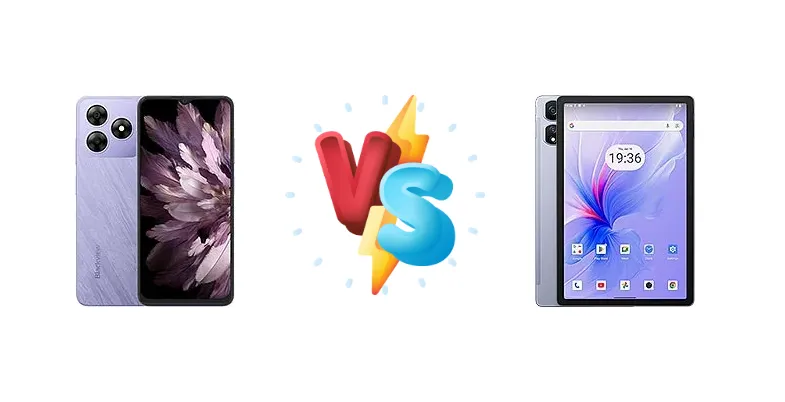
Blackview has carved a niche for itself in the budget-friendly tablet and rugged phone space. The Wave 8 and Tab 16 Pro represent two distinct approaches: a more compact, potentially portable experience versus a larger-screened device prioritizing extended battery life. This comparison dissects the core differences between these two devices, focusing on performance, endurance, and charging capabilities to help you determine which best suits your needs.
🏆 Quick Verdict
For the average user prioritizing all-day (and beyond) battery life, the Blackview Tab 16 Pro is the clear winner. Its significantly longer 97:36h endurance and faster 18W charging outweigh the Wave 8’s slightly more compact form factor and marginally lower price. However, users needing a more portable device will find the Wave 8 a viable option.
| Network |
|---|
| 2G bands | GSM 850 / 900 / 1800 / 1900 | GSM 850 / 900 / 1800 / 1900 |
| 3G bands | HSDPA 900 / 2100 - International | HSDPA 900 / 2100 |
| 4G bands | 1, 3, 7, 8, 19, 20, 38, 40, 41 - International | 1, 3, 7, 8, 19, 20, 40, 41 |
| Speed | HSPA, LTE | HSPA, LTE |
| Technology | GSM / HSPA / LTE | GSM / HSPA / LTE |
| Launch |
|---|
| Announced | 2024, November | 2024, May |
| Status | Available. Released 2024, November | Available. Released 2024, May |
| Body |
|---|
| Dimensions | 163.2 x 75.2 x 8.8 mm (6.43 x 2.96 x 0.35 in) | 256.8 x 167 x 7.5 mm (10.11 x 6.57 x 0.30 in) |
| SIM | Nano-SIM + Nano-SIM | Nano-SIM + Nano-SIM |
| Weight | 192 g (6.77 oz) | 503 g (1.11 lb) |
| Display |
|---|
| Protection | Mohs level 5 | Mohs level 5 |
| Resolution | 720 x 1612 pixels, 20:9 ratio (~269 ppi density) | 1200 x 1920 pixels, 16:10 ratio (~206 ppi density) |
| Size | 6.56 inches, 103.4 cm2 (~84.2% screen-to-body ratio) | 11.0 inches, 350.9 cm2 (~81.8% screen-to-body ratio) |
| Type | IPS LCD, 450 nits | IPS LCD |
| Platform |
|---|
| CPU | Octa-core (2x1.6 GHz Cortex-A75 & 6x1.6 GHz Cortex-A55) | Octa-core (2x2.0 GHz Cortex-A75 & 6x1.8 GHz Cortex-A55) |
| Chipset | Unisoc T606 (12 nm) | Unisoc Tiger T616 (12 nm) |
| GPU | Mali-G57 MP1 | Mali-G57 MP1 |
| OS | Android 14, DokeOS 4.0 | Android 14 |
| Memory |
|---|
| Card slot | microSDXC (uses shared SIM slot) | microSDXC (uses shared SIM slot) |
| Internal | 256GB 4GB RAM | 256GB 8GB RAM |
| Main Camera |
|---|
| Dual | - | 13 MP
2 MP |
| Features | LED flash, HDR, panorama | LED flash |
| Single | 13 MP, (wide) | - |
| Video | 1080p@30fps | 1080p@30fps |
| Selfie camera |
|---|
| Single | 8 MP, (wide) | 8 MP |
| Video | 1080p@30fps | Yes |
| Sound |
|---|
| 35mm jack | Yes | No |
| Loudspeaker | Yes | Yes, with stereo speakers |
| Comms |
|---|
| Bluetooth | 5.2, A2DP, LE | 5.0, A2DP |
| NFC | No | No |
| Positioning | GPS, GLONASS, GALILEO, BDS | GPS, GLONASS, GALILEO, BDS |
| Radio | FM radio | Unspecified |
| USB | USB Type-C, OTG | USB Type-C, OTG |
| WLAN | Wi-Fi 802.11 a/b/g/n/ac, dual-band | Wi-Fi 802.11 a/b/g/n/ac, dual-band |
| Features |
|---|
| Sensors | Fingerprint (side-mounted), accelerometer, proximity | Accelerometer |
| Battery |
|---|
| Charging | 10W wired | 18W wired |
| Type | 5000 mAh | 7700 mAh |
| Misc |
|---|
| Colors | Sunset Purple, Dawn Blue, Dusk Black | Gray, Blue, Violet |
| SAR | 0.70 W/kg (head) 1.40 W/kg (body) | - |
| EU LABEL |
|---|
| Battery | 71:07h endurance, 1100 cycles | 97:36h endurance, 1200 cycles |
| Energy | Class A | Class E |
| Free fall | Class A (270 falls) | Class B (156 falls) |
| Repairability | Class B | Class B |
Blackview Wave 8
- More portable and compact design.
- Potentially lower price point.
- Slightly easier to handle for one-handed use.
- Significantly shorter battery life (71:07h).
- Slower charging speed (10W).
- Less powerful chipset (Unisoc T606).
Blackview Tab 16 Pro
- Exceptional battery life (97:36h).
- Faster charging (18W).
- More powerful chipset (Unisoc Tiger T616).
- Larger and less portable form factor.
- Potentially higher price.
- May be less comfortable for one-handed use.
Display Comparison
While display specifications aren't provided, the Tab 16 Pro's larger form factor suggests a larger screen, likely benefiting media consumption. The Wave 8, being more compact, will likely have a higher pixel density for a sharper image at a smaller scale. Both devices utilize 12nm chipsets, suggesting similar power draw from the display panel. Without knowing panel technology (IPS, AMOLED) or resolution, it's difficult to assess color accuracy or brightness, but the larger screen of the Tab 16 Pro will likely offer a more immersive viewing experience.
Camera Comparison
Camera specifications are absent, making a direct comparison impossible. However, given the budget nature of both devices, it’s reasonable to expect similar camera performance. Image processing will likely be the key differentiator, with Blackview’s software algorithms playing a significant role in final image quality. Without sensor size or aperture information, it’s difficult to assess low-light performance or dynamic range. We can assume both devices will offer adequate cameras for casual photography, but shouldn’t be considered replacements for dedicated cameras.
Performance
The Blackview Tab 16 Pro boasts the Unisoc Tiger T616 chipset, featuring a slightly faster CPU clock speed (2.0 GHz Cortex-A75) compared to the Wave 8’s Unisoc T606 (1.6 GHz Cortex-A75). This, coupled with the slightly faster Cortex-A55 cores (1.8 GHz vs 1.6 GHz), translates to a noticeable performance advantage for the Tab 16 Pro in demanding tasks like gaming and multitasking. While both chipsets are built on a 12nm process, the T616’s architectural refinements provide a tangible boost. The impact of RAM speed (LPDDR4X is likely on both) isn't specified, but the chipset difference is the primary performance differentiator.
Battery Life
The battery is where the Tab 16 Pro truly shines. Its 97:36h endurance, powered by a larger battery (size unspecified), is a significant leap over the Wave 8’s 71:07h. This translates to potentially days of use on a single charge, making it ideal for users who are frequently away from power outlets. Furthermore, the Tab 16 Pro supports 18W wired charging, significantly faster than the Wave 8’s 10W, reducing recharge times. The Tab 16 Pro also boasts 1200 charge cycles compared to the Wave 8's 1100, suggesting a longer lifespan before battery degradation becomes noticeable.
Buying Guide
Buy the Blackview Wave 8 if you need a more easily manageable device for on-the-go use, prioritizing portability over extreme battery longevity. It’s ideal for light tasks like reading, browsing, and occasional video streaming. Buy the Blackview Tab 16 Pro if you prefer a larger display for immersive media consumption, extended productivity sessions, or simply want a device that can last through multiple days of moderate use without needing a charger. It’s the better choice for students or travelers.
Frequently Asked Questions
❓ How much faster is the charging on the Blackview Tab 16 Pro compared to the Wave 8?
The Tab 16 Pro’s 18W charging is significantly faster than the Wave 8’s 10W. While exact 0-100% times aren’t available, the Tab 16 Pro will likely recharge in considerably less time, offering a more convenient charging experience.
❓ Will the Unisoc Tiger T616 in the Tab 16 Pro handle demanding games like PUBG or Genshin Impact?
The Unisoc Tiger T616 is capable of running PUBG and Genshin Impact, but you’ll likely need to lower graphics settings to achieve a smooth frame rate. It’s not a gaming powerhouse, but it provides a playable experience for casual gaming.
❓ What does the '1200 charge cycles' specification on the Tab 16 Pro mean for long-term battery health?
The 1200 charge cycles specification indicates that the Tab 16 Pro’s battery is designed to retain a significant portion of its original capacity after being fully charged and discharged 1200 times. This suggests a longer lifespan and reduced battery degradation compared to devices with lower cycle counts.
❓ Is the difference in battery endurance between the Wave 8 and Tab 16 Pro noticeable in everyday use?
Absolutely. The 26+ hour difference in endurance is substantial. The Tab 16 Pro can realistically last multiple days on a single charge with moderate use, while the Wave 8 will likely require daily charging. This makes the Tab 16 Pro ideal for travelers or users who dislike frequent charging.