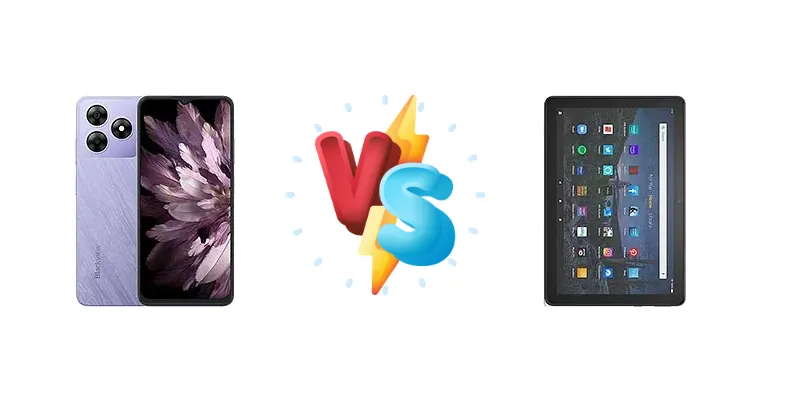
The tablet market offers a spectrum of choices, from fully-featured Android experiences to Amazon’s content-focused Fire OS. We’re pitting the Blackview Wave 8, a device prioritizing battery endurance, against the Amazon Fire HD 10 Plus (2021), a popular option deeply integrated with Amazon’s ecosystem. This comparison will dissect their core components to determine which tablet best suits your needs.
🏆 Quick Verdict
For users prioritizing longevity and a more open Android experience, the Blackview Wave 8 is the clear winner. Its exceptional 71:07h battery endurance and 1100 charge cycles significantly outperform the Fire HD 10 Plus. However, Amazon’s ecosystem integration and wireless charging are compelling advantages for dedicated Amazon users.
| Network |
|---|
| 2G bands | GSM 850 / 900 / 1800 / 1900 | N/A |
| 3G bands | HSDPA 900 / 2100 - International | - |
| 4G bands | 1, 3, 7, 8, 19, 20, 38, 40, 41 - International | - |
| EDGE | - | No |
| GPRS | - | No |
| Speed | HSPA, LTE | - |
| Technology | GSM / HSPA / LTE | No cellular connectivity |
| Launch |
|---|
| Announced | 2024, November | 2021, April 27. Released 2021, May 26 |
| Status | Available. Released 2024, November | Discontinued |
| Body |
|---|
| Dimensions | 163.2 x 75.2 x 8.8 mm (6.43 x 2.96 x 0.35 in) | 247 x 166 x 9.2 mm (9.72 x 6.54 x 0.36 in) |
| SIM | Nano-SIM + Nano-SIM | No |
| Weight | 192 g (6.77 oz) | 468 g (1.03 lb) |
| Display |
|---|
| Protection | Mohs level 5 | Aluminosilicate glass |
| Resolution | 720 x 1612 pixels, 20:9 ratio (~269 ppi density) | 1920 x 1200 pixels, 16:10 ratio (~224 ppi density) |
| Size | 6.56 inches, 103.4 cm2 (~84.2% screen-to-body ratio) | 10.1 inches, 295.8 cm2 (~72.1% screen-to-body ratio) |
| Type | IPS LCD, 450 nits | IPS LCD |
| Platform |
|---|
| CPU | Octa-core (2x1.6 GHz Cortex-A75 & 6x1.6 GHz Cortex-A55) | Octa-core (4x2.0 GHz Cortex-A73 & 4x2.0 GHz Cortex-A53) |
| Chipset | Unisoc T606 (12 nm) | Mediatek MT8183 Helio P60T (12 nm) |
| GPU | Mali-G57 MP1 | Mali-G72 MP3 |
| OS | Android 14, DokeOS 4.0 | Android 9.0 (Pie), Fire OS 7 |
| Memory |
|---|
| Card slot | microSDXC (uses shared SIM slot) | microSDXC (dedicated slot) |
| Internal | 256GB 4GB RAM | 32GB 4GB RAM, 64GB 4GB RAM |
| | - | eMMC 5.1 |
| Main Camera |
|---|
| Features | LED flash, HDR, panorama | - |
| Single | 13 MP, (wide) | 5 MP |
| Video | 1080p@30fps | 720p |
| Selfie camera |
|---|
| Single | 8 MP, (wide) | 2 MP |
| Video | 1080p@30fps | 720p |
| Sound |
|---|
| 3.5mm jack | - | Yes |
| 35mm jack | Yes | Yes |
| Loudspeaker | Yes | Yes, with stereo speakers |
| Comms |
|---|
| Bluetooth | 5.2, A2DP, LE | 5.0, A2DP, LE |
| NFC | No | No |
| Positioning | GPS, GLONASS, GALILEO, BDS | No |
| Radio | FM radio | No |
| USB | USB Type-C, OTG | USB Type-C 2.0, OTG |
| WLAN | Wi-Fi 802.11 a/b/g/n/ac, dual-band | Wi-Fi 802.11 a/b/g/n/ac, dual-band |
| Features |
|---|
| Sensors | Fingerprint (side-mounted), accelerometer, proximity | Accelerometer |
| | - | Text-to-Speech English-language content reader |
| Battery |
|---|
| Charging | 10W wired | Wireless |
| Type | 5000 mAh | Li-Ion |
| Misc |
|---|
| Colors | Sunset Purple, Dawn Blue, Dusk Black | Slate |
| Models | - | T76N2P |
| Price | - | About 150 EUR |
| SAR | 0.70 W/kg (head) 1.40 W/kg (body) | - |
| EU LABEL |
|---|
| Battery | 71:07h endurance, 1100 cycles | - |
| Energy | Class A | - |
| Free fall | Class A (270 falls) | - |
| Repairability | Class B | - |
Blackview Wave 8
- Exceptional battery life (71:07h endurance)
- Long-term battery health (1100 charge cycles)
- More open Android experience
- Slower 10W wired charging
- Potentially less optimized software
Amazon Fire HD 10 Plus (2021)
- Wireless charging convenience
- Deep Amazon ecosystem integration
- Slightly better single-core performance
- Shorter battery life
- Fire OS limitations and app compatibility issues
Display Comparison
Neither device boasts a cutting-edge display. Both utilize 12nm chipsets, suggesting neither is pushing display boundaries. While specific display specs (resolution, brightness) are missing for the Blackview Wave 8, the Fire HD 10 Plus’s 10.1-inch screen is adequate for media consumption. The lack of LTPO or high refresh rates on either device indicates a focus on cost-effectiveness rather than visual fidelity. Bezels are likely comparable, typical of tablets in this price bracket.
Camera Comparison
Camera performance is unlikely to be a deciding factor for either tablet. Given the market segment, both devices likely feature modest camera setups. Without specific sensor details for the Blackview Wave 8, it’s safe to assume the Fire HD 10 Plus’s camera is comparable, focusing on basic photo and video capture for casual use. The presence of a 2MP macro camera on the Fire HD 10 Plus is largely a marketing gimmick, offering minimal practical benefit.
Performance
The core performance difference lies in the chipset architecture. The Amazon Fire HD 10 Plus’s MediaTek Helio P60T features four Cortex-A73 cores clocked at 2.0 GHz, offering a performance edge in single-core tasks compared to the Blackview Wave 8’s Unisoc T606. However, the Wave 8 counters with a more efficient core configuration – two Cortex-A75 cores at 1.6 GHz and six Cortex-A55 cores at 1.6 GHz. This suggests better multi-core performance and sustained workloads. While both are 12nm chips, the Cortex-A75 architecture in the Wave 8 is generally more efficient than the A73 in the Fire HD 10 Plus. The Fire HD 10 Plus’s GPU is also likely to offer slightly better graphical performance, but neither tablet is geared towards demanding gaming.
Battery Life
This is where the Blackview Wave 8 truly shines. Its reported 71:07h endurance is exceptional, dwarfing the expected battery life of the Fire HD 10 Plus. The Wave 8’s 1100 charge cycles also indicate superior long-term battery health. While the Fire HD 10 Plus offers the convenience of wireless charging, the Wave 8’s significantly longer runtime and battery lifespan outweigh this benefit for many users. The Wave 8’s 10W wired charging is slower, but the extended battery life mitigates the need for frequent top-ups.
Buying Guide
Buy the Blackview Wave 8 if you need a tablet that can last for days on a single charge, prefer a standard Android experience without ecosystem lock-in, and value long-term battery health. Buy the Amazon Fire HD 10 Plus (2021) if you are heavily invested in Amazon’s services (Prime Video, Kindle, Music), prioritize wireless charging convenience, and don’t mind a customized, app-limited operating system.
Frequently Asked Questions
❓ Does the Unisoc T606 in the Blackview Wave 8 struggle with multitasking compared to the Helio P60T?
While the Helio P60T has a slight edge in single-core performance, the Unisoc T606’s core configuration (2x A75 + 6x A55) is optimized for sustained multi-tasking. The Wave 8 should handle typical tablet workloads – browsing, video streaming, light gaming – without significant issues. The difference will be most noticeable in demanding applications.
❓ How restrictive is Fire OS on the Amazon Fire HD 10 Plus, and can I easily sideload apps?
Fire OS is heavily customized and lacks full Google Play Store access. While you can sideload apps, it requires technical knowledge and isn’t a seamless experience. Many popular apps may not be fully compatible or optimized for Fire OS. This is a significant drawback for users accustomed to the standard Android ecosystem.
❓ Is the wireless charging on the Fire HD 10 Plus worth sacrificing battery life for?
Wireless charging is a convenience feature, but the Blackview Wave 8’s dramatically longer battery life offers a more substantial benefit for most users. If you frequently use wireless chargers and prioritize convenience over runtime, the Fire HD 10 Plus’s wireless charging might be appealing. However, the Wave 8’s endurance minimizes the need for frequent charging.