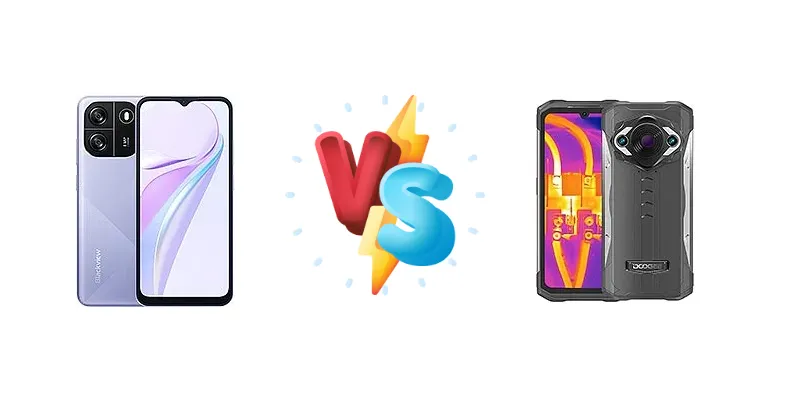
The rugged phone market is booming, but finding a balance between durability and performance at a reasonable price is challenging. We pit the Blackview Wave 6C, a value-focused option, against the Doogee S98 Pro, which aims for a more premium experience within the budget segment, to determine which offers the best overall package for outdoor enthusiasts and demanding users.
🏆 Quick Verdict
For the average user prioritizing responsiveness and future-proofing, the Doogee S98 Pro is the clear winner. Its Mediatek Helio G96 chipset delivers significantly better performance than the Blackview Wave 6C’s Unisoc SC9863A, justifying the price difference. However, the Wave 6C remains a viable option for basic tasks and users on a very tight budget.
| Network |
|---|
| 2G bands | GSM 850 / 900 / 1800 / 1900 | GSM 850 / 900 / 1800 / 1900 |
| 3G bands | HSDPA 900 / 2100 | HSDPA 800 / 850 / 900 / 1700(AWS) / 1900 / 2100 |
| 4G bands | 1, 3, 7, 8, 19, 20, 40 | 1, 2, 3, 4, 5, 7, 8, 12, 13, 17, 18, 19, 20, 25, 26, 28, 34, 38, 39, 40, 41, 66 |
| Speed | HSPA, LTE | HSPA, LTE |
| Technology | GSM / HSPA / LTE | GSM / CDMA / HSPA / LTE |
| Launch |
|---|
| Announced | 2023, December | 2022, May 27 |
| Status | Available. Released 2023, December | Available. Released 2022, June 06 |
| Body |
|---|
| Dimensions | 164.7 x 76.5 x 9.7 mm (6.48 x 3.01 x 0.38 in) | 172 x 82 x 15.5 mm (6.77 x 3.23 x 0.61 in) |
| SIM | Nano-SIM + Nano-SIM | Nano-SIM + Nano-SIM |
| Weight | 191 g (6.74 oz) | 320 g (11.29 oz) |
| Display |
|---|
| Protection | - | Corning Gorilla Glass |
| Resolution | 720 x 1600 pixels, 20:9 ratio (~270 ppi density) | 1080 x 2340 pixels, 19.5:9 ratio (~409 ppi density) |
| Size | 6.5 inches, 102.0 cm2 (~81.0% screen-to-body ratio) | 6.3 inches, 97.4 cm2 (~69.1% screen-to-body ratio) |
| Type | IPS LCD, 380 nits | IPS LCD, 500 nits (peak) |
| Platform |
|---|
| CPU | Octa-core (4x1.6 GHz Cortex-A55 & 4x1.2 GHz Cortex-A55) | Octa-core (2x2.05 GHz Cortex-A76 & 6x2.0 GHz Cortex-A55) |
| Chipset | Unisoc SC9863A (28 nm) | Mediatek MT6781 Helio G96 (12 nm) |
| GPU | IMG8322 | Mali-G57 MC2 |
| OS | Android 13 (Go edition), Doke OS 4.0 Go | Android 12 |
| Memory |
|---|
| Card slot | microSDXC (uses shared SIM slot) | microSDXC (dedicated slot) |
| Internal | 32GB 2GB RAM | 256GB 8GB RAM |
| Main Camera |
|---|
| Features | LED flash, HDR, panorama | Dual-LED flash, HDR, panorama |
| Single | 8 MP, (wide) | - |
| Triple | - | 48 MP, f/1.8, (wide), PDAF
20 MP, f/1.8, (night vision), 2 infrared night vision lights
Thermal imaging camera |
| Video | 1080p@30fps | 1440p, 1080p |
| Selfie camera |
|---|
| Single | 5 MP, (wide) | 16 MP, f/2.0, (wide) |
| Video | Yes | 1080p |
| Sound |
|---|
| 35mm jack | Yes | Unspecified |
| Loudspeaker | Yes | Yes |
| Comms |
|---|
| Bluetooth | 4.2, A2DP | 5.1, A2DP, LE |
| NFC | No | Yes |
| Positioning | GPS, GLONASS, GALILEO, BDS | GPS, GLONASS, BDS, GALILEO |
| Radio | FM radio | FM radio |
| USB | USB Type-C 2.0, OTG | USB Type-C 2.0, OTG |
| WLAN | Wi-Fi 802.11 b/g/n | Wi-Fi 802.11 a/b/g/n/ac, dual-band |
| Features |
|---|
| Sensors | Fingerprint (side-mounted), accelerometer, proximity | Fingerprint (side-mounted), accelerometer, gyro, proximity, compass |
| Battery |
|---|
| Charging | - | 33W wired
15W wireless |
| Type | 5100 mAh | 6000 mAh |
| Misc |
|---|
| Colors | Lilac Purple, Mint Blue, Midnight Black | Black |
| Price | - | About 470 EUR |
Blackview Wave 6C
- Extremely affordable price point
- Rugged design for durability
- Potentially longer battery life due to less powerful processor
- Significantly slower performance
- Outdated chipset technology
- Limited features compared to the S98 Pro
Doogee S98 Pro
- Faster and more responsive performance
- 33W wired and 15W wireless charging
- More versatile chipset for gaming and multitasking
- Higher price tag
- Potentially shorter battery life under heavy load
- Rugged design may add bulk
Display Comparison
Neither device boasts a standout display. Both likely utilize IPS LCD panels, common in this price bracket. The key difference lies under the hood. While specific display specs for the Wave 6C are unavailable, the S98 Pro’s focus on multimedia consumption suggests a potentially brighter panel. The lack of high refresh rates on either device indicates a focus on battery conservation rather than visual fluidity. Bezels are expected to be noticeable on both, typical of rugged designs prioritizing drop protection.
Camera Comparison
Camera performance is likely to be a mixed bag on both devices. Without detailed sensor information for the Wave 6C, it’s difficult to make a direct comparison. The S98 Pro likely features a more capable main sensor, benefiting from Mediatek’s image signal processor (ISP). While both phones may include multiple lenses, the quality of secondary sensors (like macro lenses) is often limited. Image processing will play a crucial role, and Doogee’s software optimizations could provide a slight edge in terms of dynamic range and color accuracy. Expect acceptable results in good lighting conditions, but performance will degrade in low-light scenarios.
Performance
The performance gap between these two is substantial. The Doogee S98 Pro’s Mediatek Helio G96, built on a 12nm process, is a significant upgrade over the Blackview Wave 6C’s Unisoc SC9863A (28nm). The G96’s octa-core configuration, featuring two Cortex-A76 cores clocked at 2.05 GHz, provides a noticeable boost in CPU performance for tasks like app loading and multitasking. The Wave 6C’s Cortex-A55 cores, while efficient, are considerably less powerful. This translates to a smoother experience on the S98 Pro, especially when running demanding applications or games. The 12nm process also contributes to better thermal efficiency, reducing the likelihood of throttling under sustained load.
Battery Life
The Doogee S98 Pro offers a more versatile charging experience with its 33W wired and 15W wireless charging capabilities. While the Wave 6C’s battery capacity is unknown, the S98 Pro’s faster charging will significantly reduce downtime. The Helio G96’s improved efficiency, combined with a likely optimized battery management system, should translate to competitive battery life despite the processor’s increased performance. Wireless charging is a convenience feature absent on the Wave 6C, appealing to users who prefer cable-free charging.
Buying Guide
Buy the Blackview Wave 6C if you need a highly affordable, extremely durable phone primarily for calls, texts, and light social media use. It’s ideal for those who prioritize longevity and don’t require demanding app performance. Buy the Doogee S98 Pro if you prefer a smoother user experience, enjoy mobile gaming, or frequently use resource-intensive applications. The faster processor and added features like wireless charging make it a more versatile device.
Frequently Asked Questions
❓ Will the Doogee S98 Pro overheat during extended gaming sessions?
The Mediatek Helio G96 is designed with thermal efficiency in mind, and the S98 Pro’s rugged chassis likely provides adequate heat dissipation. While some warming is expected during prolonged gaming, it shouldn’t reach critical levels that cause significant performance throttling. However, sustained use of graphically demanding games will naturally generate heat.
❓ Is the Unisoc SC9863A in the Blackview Wave 6C sufficient for running popular social media apps like Facebook and Instagram?
Yes, the Unisoc SC9863A is capable of running basic social media applications like Facebook and Instagram. However, expect slower loading times and occasional lag, especially when multitasking. The processor is best suited for light usage and isn’t ideal for demanding apps or games.
❓ Does the Doogee S98 Pro support NFC for contactless payments?
While not explicitly stated in the provided specs, Doogee often includes NFC in their Pro models. Checking the official product page or user reviews is recommended to confirm NFC functionality before purchase.
❓ How durable is the Blackview Wave 6C compared to other rugged phones?
The Wave 6C is designed to be rugged, but its level of protection is likely less comprehensive than more expensive models. It should withstand drops and exposure to dust and water, but specific IP ratings are unavailable. It's a good entry-level rugged phone, but don't expect the same level of resilience as higher-end devices.