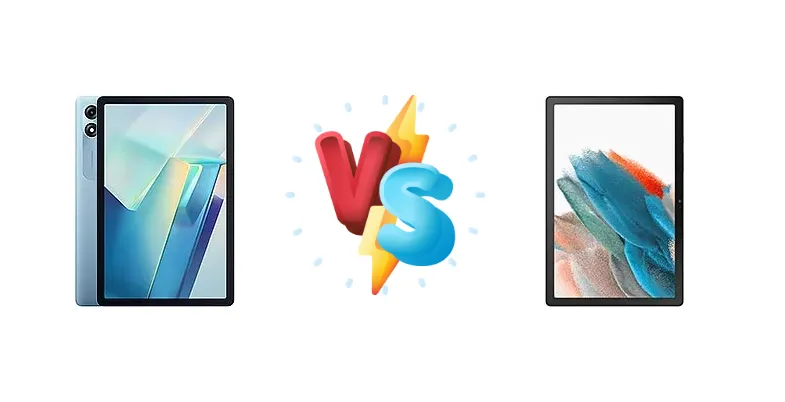
The budget tablet market is fiercely competitive, and the Blackview Tab9WiFi and Samsung Galaxy Tab A8 10.5 (2021) represent compelling options for users seeking affordable entertainment and productivity. While both tablets utilize Unisoc chipsets, subtle differences in CPU clock speeds, charging capabilities, and reported battery endurance create distinct user experiences. This comparison dives deep into these nuances to determine which tablet delivers the best value.
🏆 Quick Verdict
For users prioritizing extended battery life and maximizing usage between charges, the Blackview Tab9WiFi emerges as the winner. Its impressive 137:41h endurance significantly surpasses what's expected in this price bracket. However, the Samsung Galaxy Tab A8 offers slightly faster charging and a more established brand reputation.
| Network |
|---|
| 2G bands | N/A | GSM 850 / 900 / 1800 / 1900 |
| 3G bands | N/A | HSDPA 850 / 900 / 1700(AWS) / 1900 / 2100 |
| 4G bands | N/A | 1, 2, 3, 4, 5, 7, 8, 12, 17, 20, 28, 38, 40, 41, 66 |
| EDGE | No | - |
| GPRS | No | - |
| Speed | - | HSPA, LTE - cellular model only |
| Technology | No cellular connectivity | GSM / HSPA / LTE |
| Launch |
|---|
| Announced | 2024, June | 2021, December 15 |
| Status | Available. Released 2024, June | Available. Released 2022, January 17 |
| Body |
|---|
| Dimensions | 246.8 x 161.8 x 9.1 mm (9.72 x 6.37 x 0.36 in) | 246.8 x 161.9 x 6.9 mm (9.72 x 6.37 x 0.27 in) |
| SIM | No | Nano-SIM (cellular model only) |
| Weight | 540 g (1.19 lb) | 508 g (1.12 lb) |
| Display |
|---|
| Protection | Mohs level 5 | - |
| Resolution | 1200 x 1920 pixels, 16:10 ratio (~206 ppi density) | 1200 x 1920 pixels, 16:10 ratio (~216 ppi density) |
| Size | 11.0 inches, 350.9 cm2 (~87.9% screen-to-body ratio) | 10.5 inches, 319.7 cm2 (~80.0% screen-to-body ratio) |
| Type | IPS LCD | TFT LCD |
| Platform |
|---|
| CPU | Octa-core (2x1.6 GHz Cortex-A75 & 6x1.6 GHz Cortex-A55) | Octa-core (2x2.0 GHz Cortex-A75 & 6x2.0 GHz Cortex-A55) |
| Chipset | Unisoc T606 (12 nm) | Unisoc Tiger T618 (12 nm) |
| GPU | Mali-G57 MP1 | Mali G52 MP2 |
| OS | Android 14, DokeOS_P 4.0 | Android 11, upgradable to Android 14, One UI 6 |
| Memory |
|---|
| Card slot | microSDXC (dedicated slot) | microSDXC (dedicated slot) |
| Internal | 256GB 6GB RAM | 32GB 2GB RAM, 32GB 3GB RAM, 64GB 2GB RAM, 64GB 3GB RAM, 64GB 4GB RAM, 128GB 3GB RAM, 128GB 4GB RAM |
| Main Camera |
|---|
| Features | LED flash | - |
| Single | 13 MP | 8 MP, AF |
| Video | 1080p@30fps | 1080p@30fps |
| Selfie camera |
|---|
| Single | 8 MP | 5 MP |
| Video | Yes | 1080p@30fps |
| Sound |
|---|
| 3.5mm jack | - | Yes |
| 35mm jack | Yes | Yes |
| Loudspeaker | Yes, with stereo speakers | Yes, with stereo speakers (4 speakers) |
| Comms |
|---|
| Bluetooth | 5.0, A2DP | 5.0, A2DP, LE |
| NFC | No | No |
| Positioning | No | GPS, GLONASS, BDS, GALILEO, QZSS - cellular model only |
| Radio | No | No |
| USB | USB Type-C 2.0, OTG | USB Type-C 2.0 |
| WLAN | Wi-Fi 802.11 a/b/g/n/ac, dual-band | Wi-Fi 802.11 a/b/g/n/ac, dual-band, Wi-Fi Direct |
| Features |
|---|
| Sensors | Accelerometer | Accelerometer, gyro, proximity, compass |
| Battery |
|---|
| Charging | 10W wired | 15W wired |
| Type | 8200 mAh | Li-Po 7040 mAh |
| Misc |
|---|
| Colors | Ink Grey, Frost Blue, Blush Pink | Gray, Silver, Pink Gold |
| Models | - | SM-X200, SM-X205 |
| Price | - | About 230 EUR |
| SAR EU | - | 0.92 W/kg (body) |
| EU LABEL |
|---|
| Battery | 137:41h endurance, 800 cycles | - |
| Energy | Class D | - |
| Free fall | Class C (104 falls) | - |
| Repairability | Class B | - |
Blackview Tab9WiFi
- Exceptional battery life (137:41h endurance)
- High battery cycle count (800 cycles)
- Competitive price point
- Slower 10W charging
- Less established brand reputation
Samsung Galaxy Tab A8 10.5 (2021)
- Faster 15W charging
- More recognizable Samsung brand
- Slightly faster CPU clock speeds
- Lower battery endurance (estimated)
- Potentially shorter battery lifespan
Display Comparison
Neither device boasts a particularly standout display. Both are likely to utilize IPS LCD panels, common in this price segment. Detailed specs like resolution and peak brightness are missing, but the focus here is on internal components. Bezels are expected to be relatively substantial on both, contributing to a larger overall device footprint. Color accuracy is likely to be standard for budget tablets, suitable for casual viewing but not professional color work.
Camera Comparison
Camera performance is unlikely to be a deciding factor for either tablet. Details regarding sensor size and image processing are absent. Given the market segment, both tablets likely feature basic camera setups primarily intended for video calls and occasional snapshots. Focusing on megapixel counts would be misleading; image quality will be heavily influenced by software optimization, which is difficult to predict without testing.
Performance
The Samsung Galaxy Tab A8 10.5 (2021) holds a slight edge in raw CPU performance thanks to its Unisoc Tiger T618 chipset, featuring 2x2.0 GHz Cortex-A75 cores compared to the Blackview Tab9WiFi’s 2x1.6 GHz Cortex-A75 cores. While both utilize the same Cortex-A55 efficiency cores (6x1.6 GHz vs 6x2.0 GHz), the higher clock speed on the A8 translates to snappier responsiveness in demanding applications. However, the real-world difference will likely be minimal for typical tablet tasks like web browsing, video streaming, and social media. Both chipsets are fabricated on a 12nm process, suggesting similar thermal characteristics.
Battery Life
The Blackview Tab9WiFi’s standout feature is its exceptional battery endurance, rated at 137:41h. This is a significant advantage over the Galaxy Tab A8, which lacks a published endurance figure but is expected to offer considerably less runtime. The Tab9WiFi’s 10W charging is slower than the Tab A8’s 15W charging, meaning a full charge will take longer. However, the extended battery life mitigates the slower charging speed, as users will need to charge less frequently. The Tab9WiFi also boasts an impressive 800 charge cycles, suggesting long-term battery health.
Buying Guide
Buy the Blackview Tab9WiFi if you need a tablet primarily for extended media consumption, reading, or light productivity tasks where battery life is paramount. Its 800-cycle battery longevity also suggests a longer usable lifespan. Buy the Samsung Galaxy Tab A8 10.5 (2021) if you prefer a more recognizable brand with slightly faster 15W charging, and are willing to trade some battery endurance for that convenience and potentially better software support in the long run.
Frequently Asked Questions
❓ Will the Unisoc T606 in the Blackview Tab9WiFi struggle with multitasking?
While not a flagship chipset, the Unisoc T606 is capable of handling moderate multitasking. The 8 cores provide sufficient processing power for switching between apps like web browsers, email, and streaming services. However, demanding tasks like video editing or running multiple resource-intensive apps simultaneously may experience some slowdown.
❓ How long will it realistically take to fully charge the Blackview Tab9WiFi with its 10W charger?
Given the larger battery capacity required to achieve 137:41h endurance, a full charge with the 10W charger will likely take between 4-6 hours. While slower than the Tab A8’s 15W charging, the extended battery life minimizes the need for frequent top-ups.
❓ Does the Samsung Galaxy Tab A8 support any form of fast charging beyond 15W?
No, the Samsung Galaxy Tab A8 10.5 (2021) is officially rated for 15W charging. While it might technically accept a higher wattage charger, it will not charge any faster than its maximum supported rate.
❓ What type of storage does the Blackview Tab9WiFi use, and is it expandable?
Unfortunately, the storage type and expandability options for the Blackview Tab9WiFi are not specified in the provided data. However, many budget tablets in this category utilize eMMC storage and include a microSD card slot for expandable storage. Checking the official product listing is recommended for confirmation.