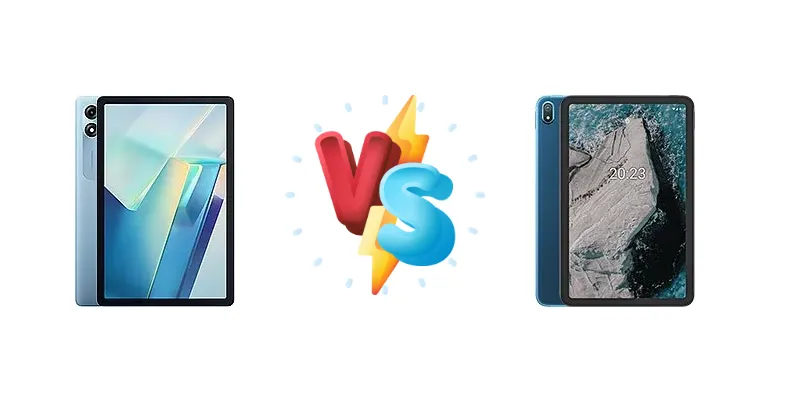
The budget tablet market is fiercely competitive, and the Blackview Tab9WiFi and Nokia T20 represent compelling options for users seeking affordability without sacrificing essential features. This comparison focuses on the core differences – the Tab9WiFi’s exceptional battery endurance versus the T20’s brighter, more viewable display – to determine which tablet delivers the best overall experience.
🏆 Quick Verdict
For users prioritizing all-day battery life and extended usability, the Blackview Tab9WiFi is the clear winner. Its 137:41h endurance significantly outpaces the Nokia T20. However, if a brighter, more vibrant display is paramount, the Nokia T20 offers a superior viewing experience.
| Network |
|---|
| 2G bands | N/A | GSM 850 / 900 / 1800 / 1900 |
| 3G bands | N/A | HSDPA 850 / 900 / 1700(AWS) / 1900 / 2100 - US, LATAM |
| 4G bands | N/A | 1, 2, 3, 4, 5, 7, 8, 12, 13, 17, 20, 28, 40, 66 - US, LATAM |
| EDGE | No | - |
| GPRS | No | - |
| Speed | - | HSPA, LTE Cat4 150/50 Mbps - cellular model only |
| Technology | No cellular connectivity | GSM / HSPA / LTE |
| | - | 1, 3, 5, 7, 8, 20, 28, 38, 40, 41 - International |
| Launch |
|---|
| Announced | 2024, June | 2021, October 06 |
| Status | Available. Released 2024, June | Available. Released 2021, November 02 |
| Body |
|---|
| Build | - | Glass front, aluminum back |
| Dimensions | 246.8 x 161.8 x 9.1 mm (9.72 x 6.37 x 0.36 in) | 247.6 x 157.5 x 7.8 mm (9.75 x 6.20 x 0.31 in) |
| SIM | No | Nano-SIM (cellular model only) |
| Weight | 540 g (1.19 lb) | 465 g (Wi-Fi), 470 g (LTE) (1.03 lb) |
| | - | Splash resistant |
| Display |
|---|
| Protection | Mohs level 5 | Scratch-resistant glass |
| Resolution | 1200 x 1920 pixels, 16:10 ratio (~206 ppi density) | 1200 x 2000 pixels, 5:3 ratio (~224 ppi density) |
| Size | 11.0 inches, 350.9 cm2 (~87.9% screen-to-body ratio) | 10.4 inches, 307.9 cm2 (~78.9% screen-to-body ratio) |
| Type | IPS LCD | IPS LCD, 400 nits (typ) |
| Platform |
|---|
| CPU | Octa-core (2x1.6 GHz Cortex-A75 & 6x1.6 GHz Cortex-A55) | Octa-core (2x1.8 GHz Cortex-A75 & 6x1.8 GHz Cortex-A55) |
| Chipset | Unisoc T606 (12 nm) | Unisoc T610 (12 nm) |
| GPU | Mali-G57 MP1 | Mali-G52 MP2 |
| OS | Android 14, DokeOS_P 4.0 | Android 11, upgradable to Android 13 |
| Memory |
|---|
| Card slot | microSDXC (dedicated slot) | microSDXC (dedicated slot) |
| Internal | 256GB 6GB RAM | 32GB 3GB RAM, 64GB 4GB RAM |
| | - | eMMC 5.1 |
| Main Camera |
|---|
| Features | LED flash | LED flash |
| Single | 13 MP | 8 MP, AF |
| Video | 1080p@30fps | 1080p@30fps |
| Selfie camera |
|---|
| Single | 8 MP | 5 MP |
| Video | Yes | Yes |
| Sound |
|---|
| 3.5mm jack | - | Yes |
| 35mm jack | Yes | Yes |
| Loudspeaker | Yes, with stereo speakers | Yes, with stereo speakers |
| Comms |
|---|
| Bluetooth | 5.0, A2DP | 5.0, A2DP, LE |
| NFC | No | No |
| Positioning | No | GPS - cellular model only |
| Radio | No | FM radio |
| USB | USB Type-C 2.0, OTG | USB Type-C 2.0 |
| WLAN | Wi-Fi 802.11 a/b/g/n/ac, dual-band | Wi-Fi 802.11 a/b/g/n/ac, dual-band |
| Features |
|---|
| Sensors | Accelerometer | Accelerometer |
| Battery |
|---|
| Charging | 10W wired | 15W wired |
| Type | 8200 mAh | Li-Po 8200 mAh |
| Misc |
|---|
| Colors | Ink Grey, Frost Blue, Blush Pink | Deep Ocean |
| Models | - | TA-1397, TA-1394, TA-1392 |
| Price | - | About 200 EUR |
| SAR | - | 1.34 W/kg (body) |
| SAR EU | - | 1.35 W/kg (body) |
| EU LABEL |
|---|
| Battery | 137:41h endurance, 800 cycles | - |
| Energy | Class D | - |
| Free fall | Class C (104 falls) | - |
| Repairability | Class B | - |
Blackview Tab9WiFi
- Exceptional battery life (137:41h endurance)
- Long battery lifespan (800 charge cycles)
- Potentially lower price point
- Display specifications are unknown, likely lower quality
- Slower processor compared to Nokia T20
Nokia T20
- Brighter display (422 nits)
- Higher contrast ratio (1786:1)
- Slightly faster processor (Unisoc T610)
- Shorter battery life
- Slower charging speed (15W)
Display Comparison
The Nokia T20 distinguishes itself with a measured peak brightness of 422 nits and a 1786:1 contrast ratio, providing a significantly more vibrant and visible image, especially outdoors or in well-lit rooms. While the Blackview Tab9WiFi’s display specifications are not provided, the Nokia T20’s superior contrast ratio suggests deeper blacks and more dynamic colors. This makes the T20 a better choice for watching videos and viewing photos. The lack of display details for the Tab9WiFi suggests a more basic panel focused on cost savings.
Camera Comparison
Neither tablet is positioned as a photography powerhouse, and detailed camera specifications are absent. Given the market segment, image quality is likely similar, focusing on basic functionality for video calls and casual snapshots. Without sensor size or aperture information, it’s difficult to assess a clear advantage. We can assume both rely on software processing to enhance image quality, but don't expect flagship-level performance.
Performance
Both tablets utilize Unisoc chipsets, but the Nokia T20 features the slightly more powerful Unisoc T610 with a 2x1.8 GHz Cortex-A75 core configuration, compared to the Blackview Tab9WiFi’s T606 with 2x1.6 GHz Cortex-A75 cores. This 200MHz clock speed difference, while seemingly small, can translate to marginally faster application loading times and smoother multitasking on the Nokia T20. Both chipsets employ the same Cortex-A55 efficiency cores, suggesting similar performance in less demanding tasks. The 12nm process node is shared, indicating comparable power efficiency between the two.
Battery Life
The Blackview Tab9WiFi’s standout feature is its exceptional battery endurance, rated at 137:41 hours. This is likely achieved through a combination of a larger battery capacity (not specified) and optimized power management. The Nokia T20, while offering a respectable experience, is hampered by its 15W wired charging, which will take longer to fully replenish the battery compared to the Tab9WiFi’s 10W charging, despite the potential for a smaller battery capacity. The Tab9WiFi also boasts 800 charge cycles, suggesting a longer lifespan before significant battery degradation.
Buying Guide
Buy the Blackview Tab9WiFi if you need a tablet for extended reading sessions, travel, or situations where access to power is limited. Its exceptional battery life makes it ideal for digital nomads and students. Buy the Nokia T20 if you prefer a tablet for media consumption in brightly lit environments, video calls, or tasks where screen clarity is crucial. The higher brightness and contrast ratio enhance the visual experience.
Frequently Asked Questions
❓ How much faster is the Nokia T20's processor in real-world use?
The 200MHz clock speed difference between the Unisoc T610 in the Nokia T20 and the T606 in the Blackview Tab9WiFi translates to a noticeable, but not dramatic, improvement in performance. Expect slightly faster app loading and smoother multitasking, but both tablets will handle everyday tasks like browsing and video streaming adequately.
❓ Is the 10W charging on the Blackview Tab9WiFi a significant drawback?
While 10W charging is slower than the Nokia T20’s 15W, the Blackview Tab9WiFi’s exceptional battery life mitigates this concern. You’ll likely charge the Tab9WiFi less frequently, reducing the impact of the slower charging speed. The 800 charge cycle rating also suggests the battery will maintain capacity for longer.
❓ Will the Nokia T20's display be easily visible outdoors?
Yes, the Nokia T20’s 422 nits peak brightness is sufficient for comfortable viewing in most outdoor conditions, especially when shaded. This is a significant advantage over the Blackview Tab9WiFi, where display brightness is unknown but likely lower.