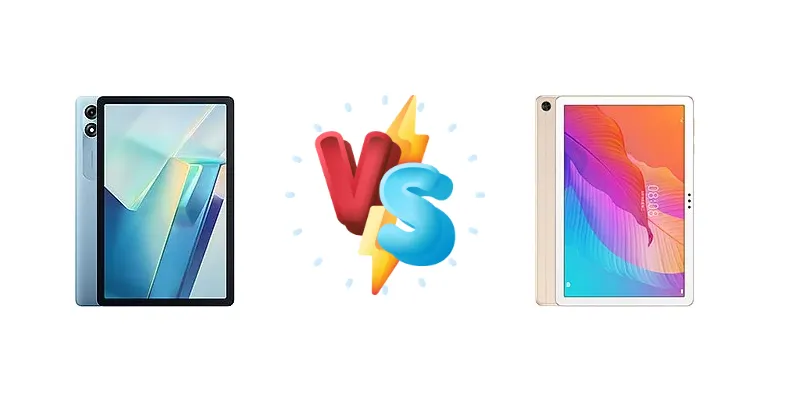
The budget tablet market is fiercely competitive, and the Blackview Tab9WiFi and Huawei MatePad T 10s represent compelling options for users seeking affordable entertainment and productivity. This comparison dives deep into their specifications, focusing on how the differing chipsets and battery endurance impact real-world performance and usability.
🏆 Quick Verdict
For the average user prioritizing long battery life and sustained performance, the Blackview Tab9WiFi emerges as the better choice. Its Unisoc T606 chipset, coupled with exceptional 137:41h endurance, outweighs the Kirin 710A's slightly faster CPU cores, especially considering both tablets share the same slow 10W charging.
| Network |
|---|
| 2G bands | N/A | GSM 850 / 900 / 1800 / 1900 |
| 3G bands | N/A | HSDPA 850 / 900 / 1700(AWS) / 1900 / 2100 |
| 4G bands | N/A | 1, 3, 5, 7, 8, 18, 19, 20, 26, 28, 38, 40, 41 |
| EDGE | No | - |
| GPRS | No | - |
| Speed | - | HSPA, LTE - cellular model only |
| Technology | No cellular connectivity | GSM / HSPA / LTE |
| Launch |
|---|
| Announced | 2024, June | 2020, September 09. Released 2020, September 09 |
| Status | Available. Released 2024, June | Discontinued |
| Body |
|---|
| Dimensions | 246.8 x 161.8 x 9.1 mm (9.72 x 6.37 x 0.36 in) | 240.2 x 159 x 7.9 mm (9.46 x 6.26 x 0.31 in) |
| SIM | No | Nano-SIM (cellular model only) |
| Weight | 540 g (1.19 lb) | 450 g (0.99 lb) |
| | - | Stylus support |
| Display |
|---|
| Protection | Mohs level 5 | - |
| Resolution | 1200 x 1920 pixels, 16:10 ratio (~206 ppi density) | 1200 x 1920 pixels, 16:10 ratio (~224 ppi density) |
| Size | 11.0 inches, 350.9 cm2 (~87.9% screen-to-body ratio) | 10.1 inches, 295.8 cm2 (~77.4% screen-to-body ratio) |
| Type | IPS LCD | IPS LCD |
| Platform |
|---|
| CPU | Octa-core (2x1.6 GHz Cortex-A75 & 6x1.6 GHz Cortex-A55) | Octa-core (4x2.0 GHz Cortex-A73 & 4x1.7 GHz Cortex-A53) |
| Chipset | Unisoc T606 (12 nm) | Kirin 710A (14 nm) |
| GPU | Mali-G57 MP1 | Mali-G51 MP4 |
| OS | Android 14, DokeOS_P 4.0 | Android 10, EMUI 10.1, no Google Play Services |
| Memory |
|---|
| Card slot | microSDXC (dedicated slot) | microSDXC |
| Internal | 256GB 6GB RAM | 16GB 2GB RAM, 32GB 2GB RAM, 64GB 3GB RAM, 64GB 4GB RAM, 128GB 4GB RAM |
| | - | eMMC 5.1 |
| Main Camera |
|---|
| Features | LED flash | HDR, panorama |
| Single | 13 MP | 5 MP, f/2.2, PDAF |
| Video | 1080p@30fps | 1080p@30fps |
| Selfie camera |
|---|
| Single | 8 MP | 2 MP, f/2.4 |
| Video | Yes | - |
| Sound |
|---|
| 3.5mm jack | - | Yes |
| 35mm jack | Yes | Yes |
| Loudspeaker | Yes, with stereo speakers | Yes, with stereo speakers |
| | - | Tuned by Harman Kardon |
| Comms |
|---|
| Bluetooth | 5.0, A2DP | 5.0, A2DP, LE |
| NFC | No | No |
| Positioning | No | GPS, GLONASS, BDS - cellular model only |
| Radio | No | No |
| USB | USB Type-C 2.0, OTG | USB Type-C 2.0, OTG |
| WLAN | Wi-Fi 802.11 a/b/g/n/ac, dual-band | Wi-Fi 802.11 a/b/g/n/ac, dual-band, Wi-Fi Direct |
| Features |
|---|
| Sensors | Accelerometer | Accelerometer, proximity |
| Battery |
|---|
| Charging | 10W wired | 10W wired |
| Type | 8200 mAh | Li-Po 5100 mAh |
| Misc |
|---|
| Colors | Ink Grey, Frost Blue, Blush Pink | Gold, Deepsea Blue |
| Models | - | AGS3-L09, AGS3-W09, AGS3K-W09 |
| Price | - | About 200 EUR |
| EU LABEL |
|---|
| Battery | 137:41h endurance, 800 cycles | - |
| Energy | Class D | - |
| Free fall | Class C (104 falls) | - |
| Repairability | Class B | - |
Blackview Tab9WiFi
- Exceptional battery life (137:41h endurance)
- More modern chipset architecture (Unisoc T606)
- Potentially better sustained performance due to 12nm process
- Slow 10W charging
- Likely basic camera performance
Huawei MatePad T 10s
- Slightly faster CPU clock speeds (Kirin 710A)
- Established brand reputation (Huawei)
- Potentially better software optimization (region dependent)
- Lower battery endurance compared to Blackview
- Less efficient 14nm chipset
Display Comparison
Neither device boasts a standout display. Both are likely to feature IPS LCD panels, common in this price bracket. Without specific resolution or brightness data, it's difficult to definitively declare a winner. However, the focus should be on practical usability – both will suffice for video streaming and web browsing. Bezels are likely to be substantial on both, reflecting their budget positioning.
Camera Comparison
Camera performance is unlikely to be a deciding factor for either tablet. Given the target market, both will likely feature basic camera setups. Without specific sensor details, it’s safe to assume image quality will be adequate for casual snapshots but not competitive with smartphones. Focusing on the chipset’s image signal processor (ISP) capabilities is less relevant given the likely low-resolution sensors used.
Performance
The core difference lies in the chipsets. The Blackview Tab9WiFi utilizes the Unisoc T606, a 12nm process chip with an octa-core configuration featuring two Cortex-A75 cores clocked at 1.6 GHz and six Cortex-A55 cores, also at 1.6 GHz. The Huawei MatePad T 10s employs the Kirin 710A, a 14nm chip with four Cortex-A73 cores at 2.0 GHz and four Cortex-A53 cores at 1.7 GHz. While the Kirin 710A’s A73 cores have a higher clock speed, the T606’s newer architecture and more efficient process node suggest better sustained performance and thermal management. The T606’s architecture is more modern, potentially leading to better multi-tasking capabilities despite the clock speed difference. The 14nm process of the Kirin 710A will likely result in higher power consumption under load.
Battery Life
The Blackview Tab9WiFi’s 137:41h endurance is a significant advantage. This translates to exceptional battery life, allowing for extended use without frequent charging. The Huawei MatePad T 10s, while likely possessing a comparable battery capacity, is hampered by the less efficient Kirin 710A chipset. Both tablets are limited to 10W wired charging, meaning a full charge will take a considerable amount of time regardless of which device you choose. The Blackview’s longer endurance mitigates the slow charging speed more effectively.
Buying Guide
Buy the Blackview Tab9WiFi if you need a tablet that can reliably last through long commutes, travel, or extended reading sessions without constantly searching for an outlet. Its superior battery endurance is ideal for media consumption and light productivity. Buy the Huawei MatePad T 10s if you prioritize slightly quicker app loading times and responsiveness for basic tasks, and are comfortable with more frequent charging, potentially benefiting from Huawei’s established software ecosystem (though this is dependent on region and services).
Frequently Asked Questions
❓ Will the Unisoc T606 in the Blackview Tab9WiFi struggle with demanding games?
While the T606 isn't a gaming powerhouse, it's capable of handling less intensive mobile games at medium settings. Demanding titles will likely require reduced graphics settings and may experience occasional frame drops. The focus of this tablet is media consumption and light productivity, not hardcore gaming.
❓ Does the Huawei MatePad T 10s support Google Mobile Services (GMS)?
This is a crucial consideration. Due to ongoing restrictions, Huawei tablets often ship without full GMS support. The MatePad T 10s may rely on Huawei’s AppGallery and HMS (Huawei Mobile Services) instead. This means access to popular apps like Google Maps and YouTube may require workarounds or may not be available.
❓ How long will it take to fully charge either tablet with the 10W charger?
Expect a full charge to take approximately 4-5 hours for both tablets. The 10W charging standard is quite slow, so patience is required. The Blackview Tab9WiFi’s superior battery endurance means you’ll need to charge it less frequently, mitigating the impact of the slow charging speed.