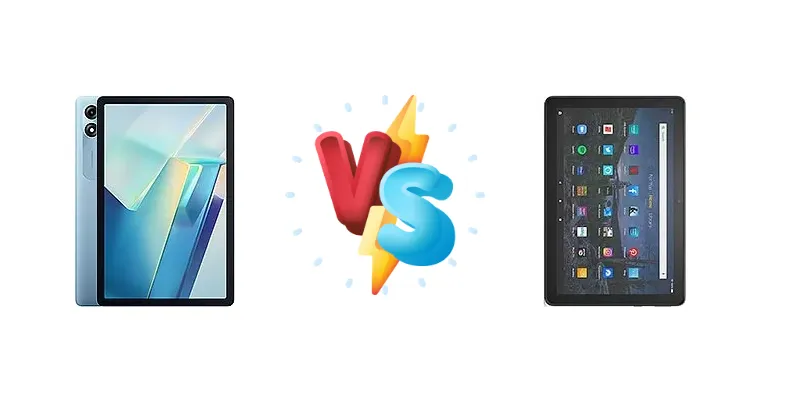
The budget tablet market is fiercely competitive, offering a range of options for media consumption, light productivity, and entertainment. We pit the Blackview Tab9WiFi, a device focused on extended battery life, against the Amazon Fire HD 10 Plus (2021), which leverages Amazon’s ecosystem and offers wireless charging. This comparison will dissect their core components to determine which tablet delivers the best value for your needs.
🏆 Quick Verdict
For users prioritizing battery life and a more open Android experience, the Blackview Tab9WiFi is the clear winner. Its impressive 137:41h endurance significantly outlasts the Fire HD 10 Plus, despite the latter’s wireless charging convenience. However, Amazon’s ecosystem integration makes the Fire HD 10 Plus appealing for existing Prime subscribers.
| Network |
|---|
| 2G bands | N/A | N/A |
| 3G bands | N/A | - |
| 4G bands | N/A | - |
| EDGE | No | No |
| GPRS | No | No |
| Technology | No cellular connectivity | No cellular connectivity |
| Launch |
|---|
| Announced | 2024, June | 2021, April 27. Released 2021, May 26 |
| Status | Available. Released 2024, June | Discontinued |
| Body |
|---|
| Dimensions | 246.8 x 161.8 x 9.1 mm (9.72 x 6.37 x 0.36 in) | 247 x 166 x 9.2 mm (9.72 x 6.54 x 0.36 in) |
| SIM | No | No |
| Weight | 540 g (1.19 lb) | 468 g (1.03 lb) |
| Display |
|---|
| Protection | Mohs level 5 | Aluminosilicate glass |
| Resolution | 1200 x 1920 pixels, 16:10 ratio (~206 ppi density) | 1920 x 1200 pixels, 16:10 ratio (~224 ppi density) |
| Size | 11.0 inches, 350.9 cm2 (~87.9% screen-to-body ratio) | 10.1 inches, 295.8 cm2 (~72.1% screen-to-body ratio) |
| Type | IPS LCD | IPS LCD |
| Platform |
|---|
| CPU | Octa-core (2x1.6 GHz Cortex-A75 & 6x1.6 GHz Cortex-A55) | Octa-core (4x2.0 GHz Cortex-A73 & 4x2.0 GHz Cortex-A53) |
| Chipset | Unisoc T606 (12 nm) | Mediatek MT8183 Helio P60T (12 nm) |
| GPU | Mali-G57 MP1 | Mali-G72 MP3 |
| OS | Android 14, DokeOS_P 4.0 | Android 9.0 (Pie), Fire OS 7 |
| Memory |
|---|
| Card slot | microSDXC (dedicated slot) | microSDXC (dedicated slot) |
| Internal | 256GB 6GB RAM | 32GB 4GB RAM, 64GB 4GB RAM |
| | - | eMMC 5.1 |
| Main Camera |
|---|
| Features | LED flash | - |
| Single | 13 MP | 5 MP |
| Video | 1080p@30fps | 720p |
| Selfie camera |
|---|
| Single | 8 MP | 2 MP |
| Video | Yes | 720p |
| Sound |
|---|
| 3.5mm jack | - | Yes |
| 35mm jack | Yes | Yes |
| Loudspeaker | Yes, with stereo speakers | Yes, with stereo speakers |
| Comms |
|---|
| Bluetooth | 5.0, A2DP | 5.0, A2DP, LE |
| NFC | No | No |
| Positioning | No | No |
| Radio | No | No |
| USB | USB Type-C 2.0, OTG | USB Type-C 2.0, OTG |
| WLAN | Wi-Fi 802.11 a/b/g/n/ac, dual-band | Wi-Fi 802.11 a/b/g/n/ac, dual-band |
| Features |
|---|
| Sensors | Accelerometer | Accelerometer |
| | - | Text-to-Speech English-language content reader |
| Battery |
|---|
| Charging | 10W wired | Wireless |
| Type | 8200 mAh | Li-Ion |
| Misc |
|---|
| Colors | Ink Grey, Frost Blue, Blush Pink | Slate |
| Models | - | T76N2P |
| Price | - | About 150 EUR |
| EU LABEL |
|---|
| Battery | 137:41h endurance, 800 cycles | - |
| Energy | Class D | - |
| Free fall | Class C (104 falls) | - |
| Repairability | Class B | - |
Blackview Tab9WiFi
- Exceptional battery life (137:41h endurance)
- Open Android experience, avoiding ecosystem lock-in
- Long battery lifespan (800 charge cycles)
- Slower 10W wired charging
- Potentially less powerful GPU for gaming
Amazon Fire HD 10 Plus (2021)
- Wireless charging convenience
- Tight integration with Amazon’s ecosystem (Prime Video, Kindle)
- Potentially stronger GPU performance
- Shorter battery life compared to Blackview Tab9WiFi
- Amazon’s Fire OS is a heavily customized Android experience
Display Comparison
Neither device boasts a cutting-edge display. Both utilize 12nm chipsets, suggesting similar display controller capabilities. While specific display specs (resolution, brightness) are missing for the Blackview Tab9WiFi, the Fire HD 10 Plus’s 10.1-inch IPS LCD is adequate for media consumption. The lack of high refresh rates or advanced panel technologies like LTPO on either device indicates a focus on cost-effectiveness rather than visual fidelity. Bezels are likely comparable, typical of this price segment.
Camera Comparison
Camera performance is unlikely to be a deciding factor for either tablet. Given the target market, both devices likely feature basic camera setups. Without specific details, it’s safe to assume image quality will be sufficient for casual snapshots but not competitive with smartphones. Focusing on the chipsets, the image signal processors (ISPs) within the Helio P60T and T606 are likely comparable in capability, meaning image processing will be similar.
Performance
The core performance difference lies in the chipset architecture. The Amazon Fire HD 10 Plus’s MediaTek Helio P60T features four Cortex-A73 cores clocked at 2.0 GHz, offering a performance advantage in multi-threaded tasks compared to the Blackview Tab9WiFi’s Unisoc T606. The T606 utilizes two Cortex-A75 cores at 1.6 GHz and six Cortex-A55 cores, also at 1.6 GHz. While the A73 cores are faster individually, the T606’s more efficient core configuration and 12nm process could lead to better sustained performance under load. The Fire HD 10 Plus’s GPU is also likely more powerful, potentially offering a smoother gaming experience, but thermal management is a key unknown. Both devices likely feature similar RAM configurations, impacting multitasking capabilities.
Battery Life
The Blackview Tab9WiFi’s standout feature is its exceptional battery endurance – a claimed 137:41 hours. This is significantly higher than what’s typically seen in tablets with similar battery capacities. The Unisoc T606’s efficiency and optimized software likely contribute to this longevity. The Amazon Fire HD 10 Plus, while offering the convenience of wireless charging, doesn’t boast comparable endurance. The 10W wired charging on the Blackview Tab9WiFi is slower than the Fire HD 10 Plus’s charging capabilities, but the extended battery life mitigates this drawback. The 800 charge cycles rating for the Blackview Tab9WiFi also suggests a longer lifespan for the battery itself.
Buying Guide
Buy the Blackview Tab9WiFi if you need a tablet that can reliably last through long flights, extended reading sessions, or as a dedicated media player without constant charging. It’s ideal for users who prefer a standard Android experience and want to avoid ecosystem lock-in. Buy the Amazon Fire HD 10 Plus (2021) if you are deeply invested in the Amazon ecosystem – Prime Video, Kindle, and Alexa – and value the convenience of wireless charging and a tightly integrated experience, accepting the trade-off of a less versatile operating system.
Frequently Asked Questions
❓ Does the Unisoc T606 chipset in the Blackview Tab9WiFi struggle with demanding games?
While the Unisoc T606 isn't a high-end gaming chip, it's capable of running many popular mobile games at medium settings. The focus of this tablet is endurance, not peak performance. The Helio P60T in the Fire HD 10 Plus likely offers a slight edge in GPU performance, but thermal throttling could limit sustained gaming on both devices.
❓ How much does Amazon’s Fire OS restrict customization compared to the standard Android experience on the Blackview Tab9WiFi?
Fire OS is a heavily customized version of Android. It prioritizes Amazon’s services and lacks the Google Play Store by default, requiring sideloading for many apps. The Blackview Tab9WiFi offers a more standard Android experience with full access to the Google Play Store and greater customization options.
❓ Is the wireless charging on the Fire HD 10 Plus a significant advantage considering the Blackview Tab9WiFi’s vastly superior battery life?
Wireless charging is convenient, but its benefit is diminished when the device requires charging less frequently. The Blackview Tab9WiFi’s exceptional battery life means you’ll likely be plugging it in far less often, reducing the need for the convenience of wireless charging.