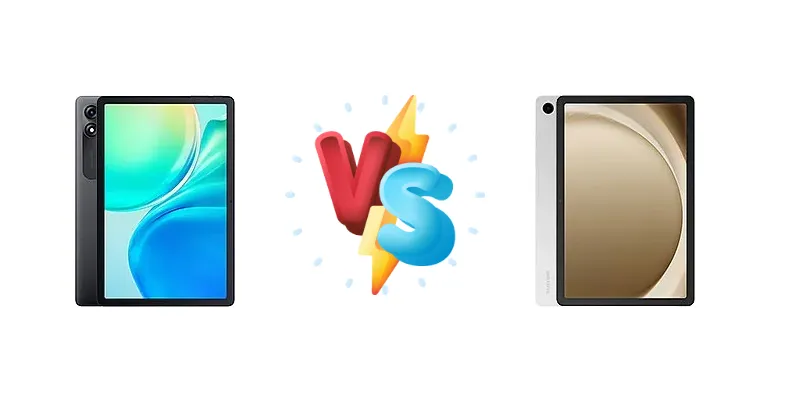
The budget tablet market is heating up, with options like the Blackview Tab90WiFi and Samsung Galaxy Tab A9+ vying for your attention. Both aim to deliver a capable Android experience without breaking the bank, but they take different approaches. The Blackview prioritizes endurance, while the Samsung focuses on a more modern chipset and faster charging. This comparison dives deep into the specs to determine which tablet offers the best value.
🏆 Quick Verdict
For the average user prioritizing long-lasting battery life and a lower price point, the Blackview Tab90WiFi is the better choice. However, the Samsung Galaxy Tab A9+ offers a performance edge thanks to its Snapdragon 695 chipset, making it more suitable for demanding tasks and future-proofing.
| Network |
|---|
| 2G bands | N/A | GSM 850 / 900 / 1800 / 1900 |
| 3G bands | N/A | HSDPA 850 / 900 / 1700(AWS) / 1900 / 2100 |
| 4G bands | N/A | 1, 2, 3, 4, 5, 7, 8, 12, 13, 17, 20, 26, 28, 38, 40, 41, 66 |
| 5G bands | - | 1, 3, 5, 7, 8, 20, 28, 38, 40, 41, 66, 77, 78 SA/NSA/Sub6 |
| EDGE | No | - |
| GPRS | No | - |
| Speed | - | HSPA, LTE, 5G - cellular model only |
| Technology | No cellular connectivity | GSM / HSPA / LTE / 5G |
| Launch |
|---|
| Announced | 2024, June | 2023, October 05 |
| Status | Available. Released 2024, June | Available. Released 2023, October 17 |
| Body |
|---|
| Dimensions | 256.9 x 168.5 x 9.5 mm (10.11 x 6.63 x 0.37 in) | 257.1 x 168.7 x 6.9 mm (10.12 x 6.64 x 0.27 in) |
| SIM | No | Nano-SIM + eSIM (cellular model only) |
| Weight | 540 g (1.19 lb) | 480 g or 492 g (1.06 lb) |
| Display |
|---|
| Protection | Mohs level 7 | - |
| Resolution | 800 x 1280 pixels, 16:10 ratio (~138 ppi density) | 1200 x 1920 pixels, 16:10 ratio (~206 ppi density) |
| Size | 10.92 inches, 345.8 cm2 (~79.9% screen-to-body ratio) | 11.0 inches, 350.9 cm2 (~80.9% screen-to-body ratio) |
| Type | IPS LCD | TFT LCD, 90Hz |
| Platform |
|---|
| CPU | Octa-core (2x1.6 GHz Cortex-A75 & 6x1.6 GHz Cortex-A55) | Octa-core (2x2.2 GHz Kryo 660 Gold & 6x1.8 GHz Kryo 660 Silver) |
| Chipset | Unisoc T606 (12 nm) | Qualcomm SM6375 Snapdragon 695 5G (6 nm) |
| GPU | Mali-G57 MP1 | Adreno 619 |
| OS | Android 14, DokeOS_P 4.0 | Android 13, upgradable to Android 15, One UI 7 |
| Memory |
|---|
| Card slot | microSDXC (dedicated slot) | microSDXC (dedicated slot) |
| Internal | 128GB 4GB RAM | 64GB 4GB RAM, 128GB 4GB RAM, 128GB 8GB RAM, 256GB 8GB RAM |
| Main Camera |
|---|
| Features | LED flash | - |
| Single | 13 MP | 8 MP, AF |
| Video | 1080p@30fps | 1080p@30fps |
| Selfie camera |
|---|
| Single | 8 MP | 5 MP |
| Video | Yes | 1080p@30fps |
| Sound |
|---|
| 35mm jack | Yes | Yes |
| Loudspeaker | Yes, with stereo speakers | Yes, with stereo speakers (4 speakers) |
| Comms |
|---|
| Bluetooth | 5.0, A2DP | 5.1, A2DP, LE |
| NFC | No | No |
| Positioning | No | GPS, GLONASS, GALILEO, BDS, QZSS - cellular model only |
| Radio | No | No |
| USB | USB Type-C 2.0, OTG | USB Type-C 2.0 |
| WLAN | Wi-Fi 802.11 a/b/g/n/ac, dual-band | Wi-Fi 802.11 a/b/g/n/ac, dual-band, Wi-Fi Direct |
| Features |
|---|
| Sensors | Accelerometer | Accelerometer, gyro, proximity (accessories only), compass |
| Battery |
|---|
| Charging | 10W wired | 15W wired |
| Type | 8200 mAh | Li-Po 7040 mAh |
| Misc |
|---|
| Colors | Ink Grey, Frost Blue, Blush Pink | Graphite, Silver, Navy |
| Models | - | SM-X210, SM-X215, SM-X216B |
| Price | - | $ 199.99 |
| SAR | - | 0.42 W/kg (body) |
| SAR EU | - | 1.19 W/kg (body) |
| EU LABEL |
|---|
| Battery | 128:54h endurance, 800 cycles | - |
| Energy | Class D | - |
| Free fall | Class C (136 falls) | - |
| Repairability | Class B | - |
Blackview Tab90WiFi
- Exceptional battery life (128:54h endurance)
- Long battery lifespan (800 charge cycles)
- More affordable price point
- Less powerful processor (Unisoc T606)
- Slower charging speed (10W)
Samsung Galaxy Tab A9+
- More powerful processor (Snapdragon 695)
- Faster charging speed (15W)
- Potentially better display quality
- Shorter battery life compared to Blackview
- Higher price point
Display Comparison
Neither device's display specifications are provided, so we must infer. Given the price points, both likely utilize IPS LCD panels. However, the Samsung Galaxy Tab A9+ benefits from Samsung's display expertise, potentially offering slightly better color accuracy and viewing angles. The Blackview Tab90WiFi, while likely adequate, may exhibit more noticeable color shifting at extreme angles. Bezels are expected to be similar on both, reflecting their budget positioning.
Camera Comparison
Camera details are absent for both devices, but given their market segment, expectations should be tempered. It's safe to assume both feature basic camera setups primarily intended for video calls and casual snapshots. Without specific sensor sizes or aperture information, it’s difficult to make a definitive judgment. However, Samsung’s image processing algorithms are generally more refined, potentially yielding slightly better image quality in favorable lighting conditions.
Performance
The core difference lies in the chipsets. The Samsung Galaxy Tab A9+’s Qualcomm Snapdragon 695 (6nm) is a significant step up from the Blackview Tab90WiFi’s Unisoc T606 (12nm). The 6nm process node inherently provides better power efficiency and thermal performance, allowing the Snapdragon 695 to sustain higher clock speeds for longer periods. The A9+'s CPU, with 2x2.2 GHz Kryo 660 Gold cores, outperforms the Tab90WiFi’s 2x1.6 GHz Cortex-A75 cores in single-core tasks. This translates to snappier app launches and smoother multitasking. While both are octa-core, the architectural advantages of the Snapdragon 695 are clear.
Battery Life
The Blackview Tab90WiFi boasts an impressive 128:54h endurance rating, a clear advantage over what we’d expect from the Samsung Galaxy Tab A9+. While the A9+ has a faster 15W charging speed compared to the Tab90WiFi’s 10W, the Blackview’s superior endurance means you’ll likely need to charge it less frequently. The 800 charge cycles rating for the Blackview suggests a longer lifespan for the battery itself, offering sustained performance over years of use. The faster charging on the Samsung is beneficial, but it’s less impactful if you’re not constantly needing to top up.
Buying Guide
Buy the Blackview Tab90WiFi if you need a tablet primarily for media consumption, reading, and light productivity, and battery life is paramount. Its impressive 128:54h endurance will keep you going for days. Buy the Samsung Galaxy Tab A9+ if you prefer a more responsive experience for multitasking, occasional gaming, and appreciate the benefits of a newer, more efficient chipset, even if it means slightly shorter battery life.
Frequently Asked Questions
❓ Will the Unisoc T606 in the Blackview Tab90WiFi struggle with demanding games?
Yes, the Unisoc T606 is a budget-focused chipset. While it can handle casual gaming, graphically intensive titles will likely require reduced settings and may experience occasional frame drops. The Samsung Galaxy Tab A9+ with its Snapdragon 695 will provide a smoother gaming experience.
❓ How long will it realistically take to fully charge the Blackview Tab90WiFi with its 10W charging?
With a 10W charger, a full charge from 0% will likely take around 4-5 hours, depending on usage during charging. While slower than the Samsung’s 15W charging, the Blackview’s exceptional battery life means you won’t need to charge it as often.
❓ Does the Samsung Galaxy Tab A9+ support 5G connectivity, and is it a significant advantage?
The chipset (Snapdragon 695) *implies* 5G support, but this is not explicitly stated in the provided data. If 5G is available, it offers faster data speeds when connected to a 5G network, but requires a compatible SIM card and plan. The Blackview Tab90WiFi is WiFi only.
❓ Is the 800 charge cycle rating on the Blackview Tab90WiFi a meaningful metric?
Yes, it is. A higher charge cycle rating indicates that the battery is designed to maintain a significant portion of its capacity after being charged and discharged 800 times. This suggests the Blackview Tab90WiFi will experience less battery degradation over its lifespan compared to tablets with lower cycle ratings.