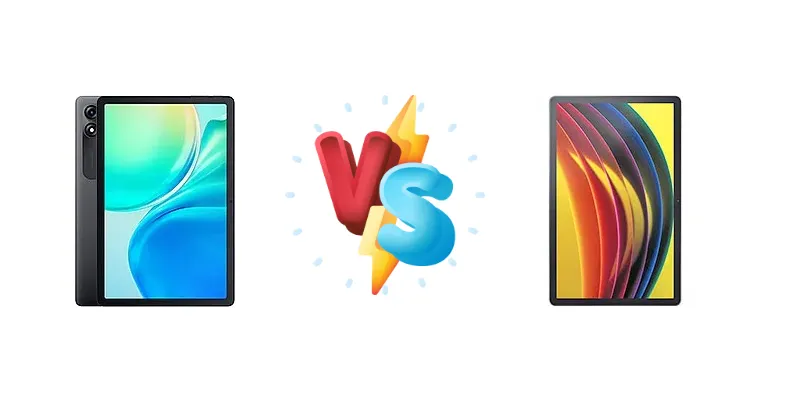
The budget tablet market is fiercely competitive, and the Blackview Tab90WiFi and Lenovo Tab P11 Plus represent compelling options for users seeking affordable entertainment and productivity. This comparison dives deep into their core specifications, focusing on performance differences stemming from their respective chipsets and the impact of varying charging capabilities on daily usability.
🏆 Quick Verdict
For most users, the Lenovo Tab P11 Plus emerges as the better choice. Its Helio G90T chipset delivers noticeably superior CPU and GPU performance compared to the Blackview Tab90WiFi’s Unisoc T606, making it more suitable for gaming and demanding applications. While the Blackview boasts impressive battery endurance, the P11 Plus’s faster 20W charging mitigates the impact of a potentially smaller battery.
| Network |
|---|
| 2G bands | N/A | GSM 850 / 900 / 1800 / 1900 |
| 3G bands | N/A | HSDPA 850 / 900 / 1900 / 2100 |
| 4G bands | N/A | 1, 2, 3, 4, 5, 7, 8, 20, 28, 38, 40, 41 |
| EDGE | No | - |
| GPRS | No | - |
| Speed | - | HSPA, LTE - cellular model only |
| Technology | No cellular connectivity | GSM / HSPA / LTE |
| Launch |
|---|
| Announced | 2024, June | 2021, June 28 |
| Status | Available. Released 2024, June | Available. Released 2021, July 29 |
| Body |
|---|
| Dimensions | 256.9 x 168.5 x 9.5 mm (10.11 x 6.63 x 0.37 in) | 258.4 x 163 x 7.5 mm (10.17 x 6.42 x 0.30 in) |
| SIM | No | Nano-SIM (cellular model only) |
| Weight | 540 g (1.19 lb) | 490 g (1.08 lb) |
| | - | Stylus support |
| Display |
|---|
| Protection | Mohs level 7 | - |
| Resolution | 800 x 1280 pixels, 16:10 ratio (~138 ppi density) | 1200 x 2000 pixels, 5:3 ratio (~212 ppi density) |
| Size | 10.92 inches, 345.8 cm2 (~79.9% screen-to-body ratio) | 11.0 inches, 344.4 cm2 (~81.8% screen-to-body ratio) |
| Type | IPS LCD | IPS LCD, 400 nits (typ) |
| Platform |
|---|
| CPU | Octa-core (2x1.6 GHz Cortex-A75 & 6x1.6 GHz Cortex-A55) | Octa-core (2x2.05 GHz Cortex-A76 & 6x2.0 GHz Cortex-A55) |
| Chipset | Unisoc T606 (12 nm) | Mediatek MT6785 Helio G90T (12 nm) |
| GPU | Mali-G57 MP1 | Mali-G76 MC4 |
| OS | Android 14, DokeOS_P 4.0 | Android 11 |
| Memory |
|---|
| Card slot | microSDXC (dedicated slot) | microSDXC (dedicated slot) |
| Internal | 128GB 4GB RAM | 64GB 4GB RAM, 128GB 4GB RAM, 128GB 6GB RAM |
| Main Camera |
|---|
| Features | LED flash | LED flash |
| Single | 13 MP | 13 MP, (wide), AF |
| Video | 1080p@30fps | 1080p@30fps |
| Selfie camera |
|---|
| Single | 8 MP | 8 MP, (wide) |
| Video | Yes | 1080p@30fps |
| Sound |
|---|
| 3.5mm jack | - | No |
| 35mm jack | Yes | No |
| Loudspeaker | Yes, with stereo speakers | Yes, with stereo speakers (4 speakers) |
| Comms |
|---|
| Bluetooth | 5.0, A2DP | 5.1, A2DP, LE |
| NFC | No | No |
| Positioning | No | GPS, GLONASS, BDS - cellular model only |
| Radio | No | FM radio |
| USB | USB Type-C 2.0, OTG | USB Type-C 2.0 |
| WLAN | Wi-Fi 802.11 a/b/g/n/ac, dual-band | Wi-Fi 802.11 a/b/g/n/ac, dual-band, Wi-Fi Direct |
| Features |
|---|
| Sensors | Accelerometer | Accelerometer, gyro, proximity |
| Battery |
|---|
| Charging | 10W wired | 20W wired |
| Type | 8200 mAh | Li-Po 7700 mAh |
| Misc |
|---|
| Colors | Ink Grey, Frost Blue, Blush Pink | Slate Grey, Platinum Grey, Modernist teal |
| Models | - | ZA940124SE |
| Price | - | About 300 EUR |
| EU LABEL |
|---|
| Battery | 128:54h endurance, 800 cycles | - |
| Energy | Class D | - |
| Free fall | Class C (136 falls) | - |
| Repairability | Class B | - |
Blackview Tab90WiFi
- Exceptional battery endurance (128:54h)
- Long battery lifespan (800 charge cycles)
- Potentially lower price point
- Slower processor (Unisoc T606)
- Slow charging speed (10W)
- Likely less responsive user experience
Lenovo Tab P11 Plus
- Faster processor (Helio G90T)
- Faster charging speed (20W)
- Smoother multitasking and gaming
- Potentially shorter battery life
- May be more expensive
- Battery may degrade faster (fewer charge cycles - not specified)
Display Comparison
Neither device’s display specifications are provided, so a direct comparison is limited. However, given the price points, both likely utilize IPS LCD panels. The Lenovo Tab P11 Plus, being a slightly more established model, may benefit from better color calibration out of the box. Bezels are likely comparable, and the absence of high refresh rate support is expected in this segment. Display quality will likely be a minor differentiator.
Camera Comparison
Without detailed camera specifications, a meaningful comparison is difficult. Both tablets likely feature basic camera setups geared towards video calls and casual snapshots. The absence of information regarding sensor size or aperture suggests neither device will excel in low-light photography. It’s safe to assume image quality will be adequate for basic use but not a key selling point for either tablet.
Performance
The core difference lies in the chipsets. The Lenovo Tab P11 Plus’s MediaTek Helio G90T (12nm) features a more powerful CPU configuration – 2x2.05 GHz Cortex-A76 cores alongside 6x2.0 GHz Cortex-A55 cores – compared to the Blackview Tab90WiFi’s Unisoc T606 (12nm) with 2x1.6 GHz Cortex-A75 and 6x1.6 GHz Cortex-A55 cores. The Cortex-A76 cores in the G90T represent a significant architectural improvement over the A75, translating to faster single-core and multi-core performance. This advantage will be most noticeable in app launch times, multitasking, and graphically intensive games. While both are 12nm chips, the G90T’s superior core design provides a clear performance edge.
Battery Life
The Blackview Tab90WiFi boasts an impressive 128:54h endurance rating and 800 charge cycles, indicating exceptional longevity and battery life. However, its 10W wired charging is significantly slower than the Lenovo Tab P11 Plus’s 20W wired charging. While the Blackview may last longer on a single charge, the P11 Plus can replenish its battery much faster, minimizing downtime. The 800 cycle rating on the Blackview suggests a longer lifespan before significant battery degradation, a key benefit for long-term users.
Buying Guide
Buy the Blackview Tab90WiFi if your primary need is extended battery life and you prioritize longevity over raw performance. This tablet is ideal for users who primarily consume media, read ebooks, or browse the web for long periods away from a power outlet. Buy the Lenovo Tab P11 Plus if you value a smoother, more responsive user experience, especially when multitasking or playing games. This tablet is better suited for students, casual gamers, and anyone who wants a tablet that can handle a wider range of tasks without feeling sluggish.
Frequently Asked Questions
❓ Will the Unisoc T606 in the Blackview Tab90WiFi struggle with demanding games like Genshin Impact?
Yes, the Unisoc T606 is a budget-focused chipset. While it can handle less intensive games, Genshin Impact and similar titles will likely require significant graphical settings reductions and may still experience noticeable lag or stuttering. The Lenovo Tab P11 Plus’s Helio G90T is better equipped to handle these games, though it won’t deliver a flagship-level experience.
❓ How long will it take to fully charge each tablet from 0%?
With its 10W charging, the Blackview Tab90WiFi will take a considerably longer time to charge – likely exceeding 5 hours. The Lenovo Tab P11 Plus, with its 20W charging, should fully charge in around 2.5 to 3.5 hours, depending on usage during charging. This difference in charging speed is a significant convenience factor.
❓ Is the 800 charge cycle rating on the Blackview Tab90WiFi a significant advantage?
Yes, it is. A charge cycle represents a full discharge and recharge of the battery. 800 cycles suggest the Blackview Tab90WiFi’s battery will retain a substantial portion of its capacity for a longer period compared to a tablet with a lower cycle rating. This is particularly beneficial for users who plan to use the tablet for several years.