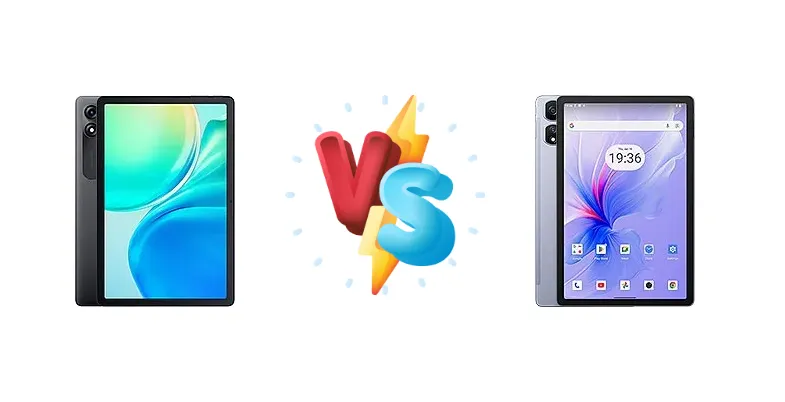
Blackview has carved a niche in the budget tablet space, offering compelling features at aggressive price points. The Tab90WiFi and Tab 16 Pro represent two distinct approaches: prioritizing extreme battery endurance versus a slight performance boost. This comparison dissects the key differences to determine which tablet best suits your needs.
🏆 Quick Verdict
For the average user prioritizing longevity and sustained use, the Blackview Tab90WiFi is the clear winner. Its exceptional 128:54h endurance significantly outpaces the Tab 16 Pro’s 97:36h, making it ideal for travel, extended reading, or situations where frequent charging isn't possible. While the Tab 16 Pro offers a modest performance edge, the battery trade-off isn't worth it for most.
| Network |
|---|
| 2G bands | N/A | GSM 850 / 900 / 1800 / 1900 |
| 3G bands | N/A | HSDPA 900 / 2100 |
| 4G bands | N/A | 1, 3, 7, 8, 19, 20, 40, 41 |
| EDGE | No | - |
| GPRS | No | - |
| Speed | - | HSPA, LTE |
| Technology | No cellular connectivity | GSM / HSPA / LTE |
| Launch |
|---|
| Announced | 2024, June | 2024, May |
| Status | Available. Released 2024, June | Available. Released 2024, May |
| Body |
|---|
| Dimensions | 256.9 x 168.5 x 9.5 mm (10.11 x 6.63 x 0.37 in) | 256.8 x 167 x 7.5 mm (10.11 x 6.57 x 0.30 in) |
| SIM | No | Nano-SIM + Nano-SIM |
| Weight | 540 g (1.19 lb) | 503 g (1.11 lb) |
| Display |
|---|
| Protection | Mohs level 7 | Mohs level 5 |
| Resolution | 800 x 1280 pixels, 16:10 ratio (~138 ppi density) | 1200 x 1920 pixels, 16:10 ratio (~206 ppi density) |
| Size | 10.92 inches, 345.8 cm2 (~79.9% screen-to-body ratio) | 11.0 inches, 350.9 cm2 (~81.8% screen-to-body ratio) |
| Type | IPS LCD | IPS LCD |
| Platform |
|---|
| CPU | Octa-core (2x1.6 GHz Cortex-A75 & 6x1.6 GHz Cortex-A55) | Octa-core (2x2.0 GHz Cortex-A75 & 6x1.8 GHz Cortex-A55) |
| Chipset | Unisoc T606 (12 nm) | Unisoc Tiger T616 (12 nm) |
| GPU | Mali-G57 MP1 | Mali-G57 MP1 |
| OS | Android 14, DokeOS_P 4.0 | Android 14 |
| Memory |
|---|
| Card slot | microSDXC (dedicated slot) | microSDXC (uses shared SIM slot) |
| Internal | 128GB 4GB RAM | 256GB 8GB RAM |
| Main Camera |
|---|
| Dual | - | 13 MP
2 MP |
| Features | LED flash | LED flash |
| Single | 13 MP | - |
| Video | 1080p@30fps | 1080p@30fps |
| Selfie camera |
|---|
| Single | 8 MP | 8 MP |
| Video | Yes | Yes |
| Sound |
|---|
| 35mm jack | Yes | No |
| Loudspeaker | Yes, with stereo speakers | Yes, with stereo speakers |
| Comms |
|---|
| Bluetooth | 5.0, A2DP | 5.0, A2DP |
| NFC | No | No |
| Positioning | No | GPS, GLONASS, GALILEO, BDS |
| Radio | No | Unspecified |
| USB | USB Type-C 2.0, OTG | USB Type-C, OTG |
| WLAN | Wi-Fi 802.11 a/b/g/n/ac, dual-band | Wi-Fi 802.11 a/b/g/n/ac, dual-band |
| Features |
|---|
| Sensors | Accelerometer | Accelerometer |
| Battery |
|---|
| Charging | 10W wired | 18W wired |
| Type | 8200 mAh | 7700 mAh |
| Misc |
|---|
| Colors | Ink Grey, Frost Blue, Blush Pink | Gray, Blue, Violet |
| EU LABEL |
|---|
| Battery | 128:54h endurance, 800 cycles | 97:36h endurance, 1200 cycles |
| Energy | Class D | Class E |
| Free fall | Class C (136 falls) | Class B (156 falls) |
| Repairability | Class B | Class B |
Blackview Tab90WiFi
- Exceptional battery life (128:54h endurance)
- Longer battery lifespan (800 charge cycles)
- Excellent value for money
- Slower charging speed (10W)
- Slightly less powerful processor
Blackview Tab 16 Pro
- Faster processor (Unisoc Tiger T616)
- Faster charging speed (18W)
- Higher battery cycle count (1200 cycles)
- Significantly shorter battery life (97:36h endurance)
- Potentially more frequent charging
Display Comparison
Both tablets utilize 12nm process technology, suggesting similar display power draw. However, detailed display specs (resolution, panel type, brightness) are missing. Without this data, a direct comparison is limited. We can infer that Blackview likely targets similar display quality across both models to maintain cost-effectiveness. The absence of LTPO or high refresh rate technology suggests a focus on efficiency rather than visual fidelity.
Camera Comparison
Camera specifications are absent, making a detailed comparison impossible. Given the budget nature of these tablets, we can expect basic camera setups focused on casual photography. Image processing will likely be similar across both devices, prioritizing simplicity over advanced features. Without sensor size or aperture information, it’s difficult to assess image quality differences.
Performance
The Blackview Tab 16 Pro’s Unisoc Tiger T616 chipset, with its 2x2.0 GHz Cortex-A75 cores and 6x1.8 GHz Cortex-A55 cores, represents a modest performance upgrade over the Tab90WiFi’s Unisoc T606 (2x1.6 GHz Cortex-A75 & 6x1.6 GHz Cortex-A55). The higher clock speeds on the T616 will translate to slightly faster app loading times and smoother multitasking. However, the core architecture remains identical, meaning the performance difference won’t be dramatic. The T616’s advantage is likely most noticeable in sustained workloads, where thermal throttling could become a factor. RAM configurations are not specified, but both likely utilize LPDDR4X to balance performance and cost.
Battery Life
The battery is where the Tab90WiFi truly shines. Its 128:54h endurance is a significant advantage over the Tab 16 Pro’s 97:36h. This translates to roughly 30% more usage time on a single charge. While the Tab 16 Pro boasts 18W wired charging compared to the Tab90WiFi’s 10W, the faster charging speed is partially offset by the smaller battery capacity. The Tab90WiFi’s 800 charge cycles suggest a longer overall battery lifespan, indicating greater long-term value. The Tab 16 Pro’s 1200 cycles is a notable improvement, suggesting a focus on battery health over time.
Buying Guide
Buy the Blackview Tab90WiFi if you need a tablet that can reliably last through multiple days of moderate use, prioritizing battery life above all else. This is the perfect choice for students, commuters, or anyone who frequently uses their tablet on the go. Buy the Blackview Tab 16 Pro if you prefer a slightly more responsive experience for light gaming or multitasking, and are willing to accept a considerably shorter battery life and more frequent charging.
Frequently Asked Questions
❓ Will the Tab 16 Pro’s 18W charging make a huge difference compared to the Tab90WiFi’s 10W?
While 18W is faster, the Tab 16 Pro’s smaller battery capacity means the charging time difference won’t be massive. You’ll likely see a quicker initial charge, but the Tab90WiFi’s larger battery will take longer to fully replenish regardless. The Tab90WiFi’s longer endurance means you’ll need to charge it less frequently, mitigating the slower charging speed.
❓ Is the performance difference between the Unisoc T606 and T616 noticeable for everyday tasks like browsing and video streaming?
For typical usage scenarios like web browsing, video playback, and social media, the performance difference between the two chipsets will be minimal. Both are capable of handling these tasks smoothly. The T616’s advantage becomes more apparent in more demanding applications or when multitasking heavily.
❓ How does the 800 charge cycle rating of the Tab90WiFi compare to the 1200 cycle rating of the Tab 16 Pro in terms of long-term battery health?
A higher cycle count generally indicates a longer expected lifespan for the battery. However, the Tab90WiFi’s significantly longer endurance means you may not reach 800 cycles as quickly as you would with the Tab 16 Pro. Both ratings suggest a commitment to battery longevity, but the Tab 16 Pro is designed to withstand more charge/discharge cycles over its lifetime.