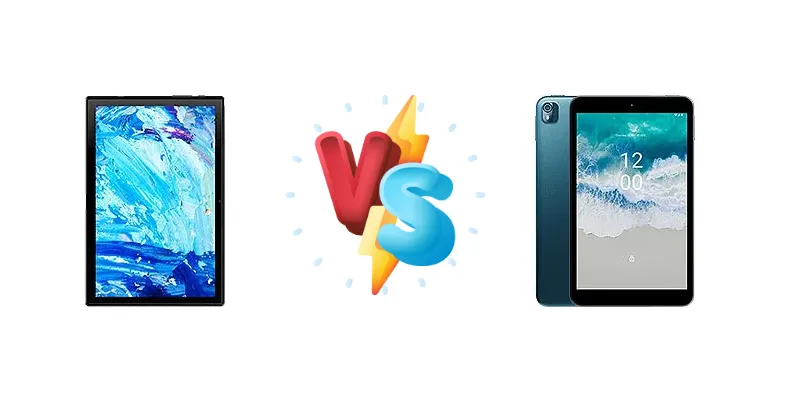
The Blackview Tab 8E and Nokia T10 represent the increasingly competitive sub-$200 Android tablet market. Both aim to deliver a functional tablet experience without breaking the bank, but they achieve this with different approaches to chipset selection. This comparison dissects the core differences between the Unisoc SC9863A in the Blackview and the Unisoc T606 in the Nokia, revealing which tablet offers the best performance and value for your needs.
🏆 Quick Verdict
For most users, the Nokia T10 emerges as the better choice. Its Unisoc T606 chipset, built on a more efficient 12nm process, provides a noticeable performance advantage over the Blackview Tab 8E’s older 28nm SC9863A. While both tablets share the same 10W charging, the Nokia’s superior processing power makes it more suitable for multitasking and demanding applications.
| Network |
|---|
| 2G bands | N/A | GSM 850 / 900 / 1800 / 1900 |
| 3G bands | N/A | HSDPA 850 / 900 / 2100 |
| 4G bands | N/A | 1, 3, 5, 7, 8, 20, 28, 38, 40, 41 |
| EDGE | N/A | - |
| GPRS | N/A | - |
| Speed | N/A | HSPA 42.2/5.76 Mbps, LTE Cat4 150/50 Mbps |
| Technology | No cellular connectivity | GSM / HSPA / LTE |
| Launch |
|---|
| Announced | 2021, January 06 | 2022, July 12 |
| Status | Available. Released 2021, January | Available. Released 2022, August 20 |
| Body |
|---|
| Build | - | Glass front, plastic back, plastic frame |
| Dimensions | 243.6 x 162.4 x 8.9 mm (9.59 x 6.39 x 0.35 in) | 208 x 123.2 x 9 mm (8.19 x 4.85 x 0.35 in) |
| SIM | No | Nano-SIM |
| Weight | 600 g (1.32 lb) | 375 g (13.23 oz) |
| | - | Splash resistant |
| Display |
|---|
| Protection | Asahi Glass | - |
| Resolution | 1200 x 1920 pixels, 16:10 ratio (~224 ppi density) | 800 x 1280 pixels, 16:10 ratio (~189 ppi density) |
| Size | 10.1 inches, 295.8 cm2 (~74.8% screen-to-body ratio) | 8.0 inches, 185.6 cm2 (~72.4% screen-to-body ratio) |
| Type | IPS LCD | IPS LCD, 360 nits (typ), 450 nits (peak) |
| Platform |
|---|
| CPU | Octa-core (4x1.6 GHz Cortex-A55 & 4x1.2 GHz Cortex-A55) | Octa-core (2x1.6 GHz Cortex-A75 & 6x1.6 GHz Cortex-A55) |
| Chipset | Unisoc SC9863A (28 nm) | Unisoc T606 (12 nm) |
| GPU | IMG8322 | Mali-G57 MP1 |
| OS | Android 10 | Android 12, upgradable to Android 13 |
| Memory |
|---|
| Card slot | microSDXC | microSDXC |
| Internal | 32GB 3GB RAM | 32GB 3GB RAM, 64GB 4GB RAM |
| | eMMC | - |
| Main Camera |
|---|
| Features | LED flash | LED flash |
| Single | 13 MP, f/2.2, (wide) | 8 MP, 1/4.0", 1.12µm, AF |
| Video | 1080p@30fps | 1080p |
| Selfie camera |
|---|
| Single | 5 MP, f/2.2, (wide) | 2 MP, 1/5.0", 1.65µm |
| Video | Yes | 720p |
| Sound |
|---|
| 3.5mm jack | Yes | Yes |
| 35mm jack | Yes | Yes |
| Loudspeaker | Yes | Yes, with stereo speakers |
| Comms |
|---|
| Bluetooth | 5.0, A2DP, LE | 5.0, A2DP, LE |
| NFC | No | No |
| Positioning | GPS, GLONASS, GALILEO, BDS | GPS, GLONASS, GALILEO |
| Radio | FM radio | No |
| USB | USB Type-C, OTG | USB Type-C 2.0, OTG |
| WLAN | Wi-Fi 802.11 b/g/n/ac | Wi-Fi 802.11 a/b/g/n/ac, dual-band |
| Features |
|---|
| Sensors | Accelerometer | Accelerometer, proximity |
| Battery |
|---|
| Charging | 10W wired | 10W wired |
| Type | 6580 mAh | Li-Po 5250 mAh |
| Misc |
|---|
| Colors | Gray, Gold | Ocean Blue |
| Models | - | TA-1503, TA-1472, TA-1462, TA-1457 |
| Price | About 140 EUR | About 160 EUR |
| SAR | - | 1.19 W/kg (body) |
| SAR EU | - | 0.27 W/kg (head) 1.57 W/kg (body) |
Blackview Tab 8E
- Potentially lower price point
- Functional for basic tasks
- Acceptable for light use
- Older, less efficient chipset
- Slower performance compared to Nokia T10
- Likely more prone to throttling
Nokia T10
- More powerful Unisoc T606 chipset
- Better multitasking capabilities
- Improved thermal efficiency
- Longer battery life
- Slightly higher price
- Still a budget tablet with limitations
- 10W charging is slow
Display Comparison
Neither Blackview nor Nokia provide detailed display specifications beyond resolution. However, the display is less of a differentiating factor than the chipset. Both likely utilize IPS LCD panels, common in this price bracket. The absence of high refresh rates or advanced features like LTPO is expected. Bezels are likely to be substantial on both devices, contributing to a larger overall footprint. Color accuracy is likely to be standard for budget tablets, prioritizing power efficiency over color fidelity.
Camera Comparison
Camera performance is unlikely to be a key selling point for either tablet. Given the price point, both likely feature basic camera sensors. Detailed specifications are unavailable, but it’s safe to assume image quality will be adequate for casual snapshots in good lighting conditions. Focusing on the chipset difference is far more relevant than scrutinizing camera specs, as image processing relies heavily on CPU and GPU power.
Performance
The core difference lies in the chipsets. The Nokia T10’s Unisoc T606, fabricated on a 12nm process, is a significant upgrade over the Blackview Tab 8E’s Unisoc SC9863A (28nm). The T606 features two Cortex-A75 cores clocked at 1.6GHz alongside six Cortex-A55 cores, also at 1.6GHz. This contrasts with the SC9863A’s four Cortex-A55 cores at 1.6GHz and four at 1.2GHz. The A75 cores in the T606 provide a substantial boost in single-core performance, crucial for responsive app launching and smoother UI navigation. The 12nm process also translates to better thermal efficiency, potentially reducing throttling during sustained workloads. While both use an octa-core configuration, the architectural differences make the T606 the clear winner.
Battery Life
Both tablets are equipped with 10W wired charging, indicating a similar charging experience. While battery capacity isn’t specified, the more efficient Unisoc T606 in the Nokia T10 will likely result in longer battery life during typical usage. The 12nm process consumes less power than the 28nm process of the SC9863A, extending the time between charges. Expect approximately 3-4 hours of screen-on time for both devices, but the Nokia T10 should consistently outperform the Blackview Tab 8E in real-world battery tests.
Buying Guide
Buy the Blackview Tab 8E if you prioritize absolute affordability and your tablet usage is limited to very basic tasks like reading ebooks or light web browsing. Buy the Nokia T10 if you need a tablet capable of smoother multitasking, streaming video without significant lag, and handling a wider range of Android applications. The Nokia T10 offers a more future-proof experience for a minimal price premium.
Frequently Asked Questions
❓ Will the Nokia T10 handle multiple apps running simultaneously without significant slowdown?
Yes, the Unisoc T606 chipset in the Nokia T10, with its Cortex-A75 performance cores, is significantly better equipped for multitasking than the Blackview Tab 8E’s SC9863A. You should experience smoother transitions between apps and less lag when running multiple applications concurrently.
❓ Is the difference in chipset performance noticeable for everyday tasks like web browsing and video streaming?
Absolutely. While both tablets can handle basic web browsing and video streaming, the Nokia T10’s T606 chipset will provide a noticeably smoother and more responsive experience. Pages will load faster, and video playback will be less prone to stuttering, especially with higher-resolution content.
❓ Does the 10W charging feel particularly slow on either device?
Yes, 10W charging is relatively slow by modern standards. Expect approximately 3-4 hours to fully charge both devices from 0%. The difference in charging speed won't be significant between the two tablets, as they both utilize the same charging standard.
❓ Which tablet is better suited for a child using educational apps?
The Nokia T10 is the better choice for a child using educational apps. The more powerful chipset will ensure smoother performance and a more responsive experience with interactive learning applications. The improved efficiency also means longer battery life during extended use.