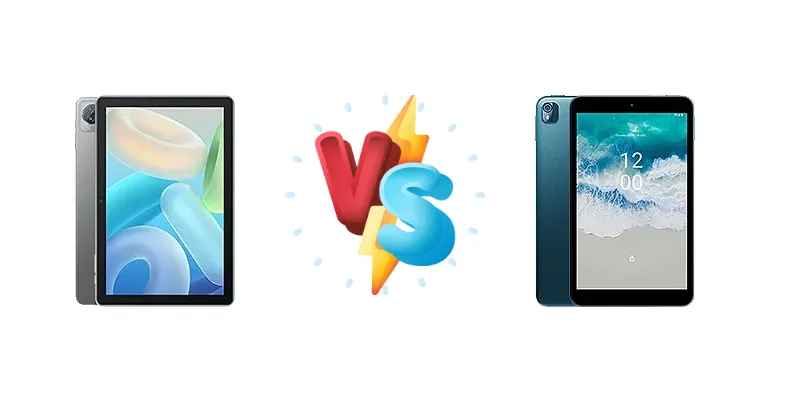
The budget tablet market is fiercely competitive, with options like the Blackview Tab 8 WiFi and Nokia T10 vying for attention. Both aim to deliver an affordable Android experience, but they take different approaches. The Blackview Tab 8 focuses on simplicity, while the Nokia T10 leverages a more modern chipset. This comparison dissects their strengths and weaknesses to determine which tablet offers the best value.
🏆 Quick Verdict
For most users, the Nokia T10 emerges as the better choice. Its Unisoc T606 octa-core processor provides a significantly smoother and more responsive experience than the Blackview Tab 8’s quad-core CPU, making it better suited for multitasking and demanding apps. While charging is slow, the overall performance advantage justifies the trade-off.
| Network |
|---|
| 2G bands | N/A | GSM 850 / 900 / 1800 / 1900 |
| 3G bands | N/A | HSDPA 850 / 900 / 2100 |
| 4G bands | N/A | 1, 3, 5, 7, 8, 20, 28, 38, 40, 41 |
| EDGE | No | - |
| GPRS | No | - |
| Speed | - | HSPA 42.2/5.76 Mbps, LTE Cat4 150/50 Mbps |
| Technology | No cellular connectivity | GSM / HSPA / LTE |
| Launch |
|---|
| Announced | 2023, May | 2022, July 12 |
| Status | Available. Released 2023, May | Available. Released 2022, August 20 |
| Body |
|---|
| Build | - | Glass front, plastic back, plastic frame |
| Dimensions | 246.5 x 163 x 9.9 mm (9.70 x 6.42 x 0.39 in) | 208 x 123.2 x 9 mm (8.19 x 4.85 x 0.35 in) |
| SIM | No | Nano-SIM |
| Weight | 520.5 g (1.15 lb) | 375 g (13.23 oz) |
| | - | Splash resistant |
| Display |
|---|
| Resolution | 800 x 1280 pixels, 16:10 ratio (~149 ppi density) | 800 x 1280 pixels, 16:10 ratio (~189 ppi density) |
| Size | 10.1 inches, 295.8 cm2 (~73.6% screen-to-body ratio) | 8.0 inches, 185.6 cm2 (~72.4% screen-to-body ratio) |
| Type | IPS LCD | IPS LCD, 360 nits (typ), 450 nits (peak) |
| Platform |
|---|
| CPU | Quad-core | Octa-core (2x1.6 GHz Cortex-A75 & 6x1.6 GHz Cortex-A55) |
| Chipset | - | Unisoc T606 (12 nm) |
| GPU | - | Mali-G57 MP1 |
| OS | Android 12, DokeOS_P 3.0 | Android 12, upgradable to Android 13 |
| Memory |
|---|
| Card slot | microSDXC | microSDXC |
| Internal | 128GB 4GB RAM | 32GB 3GB RAM, 64GB 4GB RAM |
| Main Camera |
|---|
| Features | LED flash | LED flash |
| Single | 13 MP | 8 MP, 1/4.0", 1.12µm, AF |
| Video | 1080p@30fps | 1080p |
| Selfie camera |
|---|
| Single | 8 MP | 2 MP, 1/5.0", 1.65µm |
| Video | Yes | 720p |
| Sound |
|---|
| 3.5mm jack | - | Yes |
| 35mm jack | Yes | Yes |
| Loudspeaker | Yes, with stereo speakers | Yes, with stereo speakers |
| Comms |
|---|
| Bluetooth | 5.0, A2DP | 5.0, A2DP, LE |
| NFC | No | No |
| Positioning | No | GPS, GLONASS, GALILEO |
| Radio | No | No |
| USB | USB Type-C 2.0, OTG | USB Type-C 2.0, OTG |
| WLAN | Wi-Fi 802.11 a/b/g/n/ac/6, dual-band | Wi-Fi 802.11 a/b/g/n/ac, dual-band |
| Features |
|---|
| Sensors | Accelerometer | Accelerometer, proximity |
| Battery |
|---|
| Charging | - | 10W wired |
| Type | 6580 mAh | Li-Po 5250 mAh |
| Misc |
|---|
| Colors | Space Grey, Ice Blue | Ocean Blue |
| Models | - | TA-1503, TA-1472, TA-1462, TA-1457 |
| Price | About 80 EUR | About 160 EUR |
| SAR | - | 1.19 W/kg (body) |
| SAR EU | - | 0.27 W/kg (head) 1.57 W/kg (body) |
Blackview Tab 8 WiFi
- Potentially lower price point (depending on retailer)
- Simple and straightforward Android experience
- May be lighter due to simpler components
- Significantly weaker processor performance
- Likely limited multitasking capabilities
- Display specifications are unknown and potentially subpar
Nokia T10
- More powerful Unisoc T606 octa-core processor
- Smoother multitasking and app performance
- Better power efficiency with the 12nm chipset
- Slow 10W charging
- Display is basic, lacking advanced features
- May be slightly more expensive than the Blackview Tab 8
Display Comparison
Neither tablet boasts a particularly impressive display. The Blackview Tab 8’s display specifications are largely unavailable, suggesting a standard LCD panel. The Nokia T10 features an 8-inch IPS LCD, which is adequate for viewing angles and color reproduction, but lacks the vibrancy of more advanced panel technologies. Both likely feature similar resolutions, around 1280x800, resulting in a pixel density that isn’t exceptionally sharp. Bezels are expected to be noticeable on both devices, reflecting their budget positioning. Without specific brightness data, it’s safe to assume neither will excel in direct sunlight.
Camera Comparison
Camera performance is unlikely to be a key differentiator for either tablet. Both are expected to feature basic camera setups primarily intended for video calls and occasional snapshots. Detailed camera specifications for the Blackview Tab 8 are unavailable, but budget tablets typically feature low-resolution sensors. The Nokia T10’s camera specs are also modest, suggesting image quality will be acceptable in good lighting conditions but struggle in low light. Focusing on camera quality for either device would be a misallocation of expectations.
Performance
This is where the Nokia T10 pulls ahead decisively. The Blackview Tab 8’s quad-core processor is a generation behind and significantly less capable than the Nokia T10’s Unisoc T606. The T606’s octa-core configuration (2x1.6 GHz Cortex-A75 & 6x1.6 GHz Cortex-A55) provides a substantial boost in multitasking and app loading speeds. The Cortex-A75 cores offer a performance uplift over typical budget tablet CPUs. While neither tablet is a gaming powerhouse, the Nokia T10 will handle casual games and streaming services with greater ease. The 12nm process node of the Unisoc T606 also suggests better power efficiency compared to potentially older, larger-node processors in the Blackview Tab 8.
Battery Life
Battery life will depend heavily on usage patterns. While the exact battery capacity of the Blackview Tab 8 is unknown, it’s likely comparable to the Nokia T10’s 5250mAh battery. However, the Nokia T10’s 10W wired charging is notably slow. Expect a lengthy charge time from 0-100%. The Blackview Tab 8’s charging speed is also likely similar, given its budget positioning. The more efficient Unisoc T606 in the Nokia T10 *could* translate to slightly longer real-world battery life, offsetting the similar battery capacities.
Buying Guide
Buy the Blackview Tab 8 WiFi if you prioritize extreme simplicity and have very basic tablet needs – primarily media consumption with minimal multitasking. It’s a viable option for users who want a no-frills device for reading ebooks or watching videos. Buy the Nokia T10 if you value a more responsive user experience, even for everyday tasks, and anticipate using multiple apps simultaneously. The Nokia T10 is the better choice for students, casual gamers, and anyone who wants a tablet that feels less sluggish.
Frequently Asked Questions
❓ Will the Nokia T10 struggle with demanding apps like video editing software?
Yes, the Nokia T10 is not designed for intensive tasks like video editing. While it can handle basic productivity apps and streaming, its Unisoc T606 chipset lacks the power for resource-heavy applications. Expect significant lag and slowdowns if you attempt to edit videos directly on the tablet.
❓ Is the Blackview Tab 8 a good choice for elderly users who primarily want to video call and browse the web?
The Blackview Tab 8 could be suitable for elderly users with very basic needs. Its simplicity might be appealing, but the slower processor could lead to frustration when loading websites or switching between apps. The Nokia T10, despite the slower charging, offers a more responsive experience that might be preferable in the long run.
❓ Can either tablet be used for light gaming?
The Nokia T10 is the better option for light gaming. The Unisoc T606 chipset provides enough power to run casual games smoothly, while the Blackview Tab 8’s quad-core processor will likely struggle with even simple titles. Don't expect to play graphically intensive games on either device.