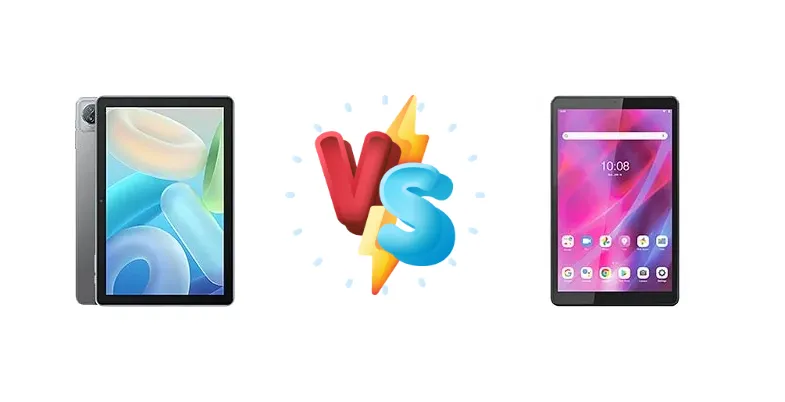
The budget tablet market is fiercely competitive, and the Blackview Tab 8 WiFi and Lenovo Tab M8 (3rd Gen) represent two compelling options for users seeking affordable entertainment and productivity. While both aim for accessibility, they take different approaches to hardware, resulting in distinct performance characteristics. This comparison dives deep into the specifications to determine which tablet delivers the best value.
🏆 Quick Verdict
For the average user prioritizing responsiveness and multitasking, the Lenovo Tab M8 (3rd Gen) emerges as the better choice. Its Mediatek MT8768T Helio P22T chipset, with its octa-core CPU, provides a significantly smoother experience than the Blackview Tab 8 WiFi’s quad-core processor, making it more suitable for everyday tasks and light gaming.
| Network |
|---|
| 2G bands | N/A | GSM 850 / 900 / 1800 / 1900 |
| 3G bands | N/A | HSDPA 850 / 900 / 1700(AWS) / 1900 / 2100 - International |
| 4G bands | N/A | 1, 2, 3, 4, 5, 19, 7, 8, 20, 26, 28, 38, 40, 41 - International |
| EDGE | No | - |
| GPRS | No | - |
| Speed | - | HSPA, LTE - cellular model only |
| Technology | No cellular connectivity | GSM / CDMA / HSPA / LTE |
| | - | 1, 3, 5, 7, 8, 34, 38, 39, 40, 41 - China |
| Launch |
|---|
| Announced | 2023, May | 2021, June 28 |
| Status | Available. Released 2023, May | Available. Released 2022, February |
| Body |
|---|
| Build | - | Glass front, aluminum back, aluminum frame |
| Dimensions | 246.5 x 163 x 9.9 mm (9.70 x 6.42 x 0.39 in) | 199.1 x 121.8 x 8.2 mm (7.84 x 4.80 x 0.32 in) |
| SIM | No | Nano-SIM (cellular model only) |
| Weight | 520.5 g (1.15 lb) | 305 g (10.76 oz) |
| Display |
|---|
| Resolution | 800 x 1280 pixels, 16:10 ratio (~149 ppi density) | 800 x 1280 pixels, 16:10 ratio (~189 ppi density) |
| Size | 10.1 inches, 295.8 cm2 (~73.6% screen-to-body ratio) | 8.0 inches, 185.6 cm2 (~76.5% screen-to-body ratio) |
| Type | IPS LCD | TDDI IPS LCD, 350 nits (typ) |
| Platform |
|---|
| CPU | Quad-core | Octa-core (4x2.3 GHz Cortex-A53 & 4x1.8 GHz Cortex-A53) |
| Chipset | - | Mediatek MT8768T Helio P22T (12 nm) |
| GPU | - | PowerVR GE8320 |
| OS | Android 12, DokeOS_P 3.0 | Android 11 (Go edition) - 2 GB RAM versionAndroid 11 - 3 GB RAM version |
| Memory |
|---|
| Card slot | microSDXC | microSDXC (dedicated slot) |
| Internal | 128GB 4GB RAM | 32GB 2GB RAM, 32GB 3GB RAM |
| | - | eMMC 5.1 |
| Main Camera |
|---|
| Features | LED flash | - |
| Single | 13 MP | 5 MP, AF |
| Video | 1080p@30fps | 1080p |
| Selfie camera |
|---|
| Single | 8 MP | 2 MP |
| Video | Yes | 720p |
| Sound |
|---|
| 3.5mm jack | - | Yes |
| 35mm jack | Yes | Yes |
| Loudspeaker | Yes, with stereo speakers | Yes |
| Comms |
|---|
| Bluetooth | 5.0, A2DP | 5.0, A2DP, LE |
| NFC | No | No |
| Positioning | No | GPS, GLONASS, BDS - cellular model only |
| Radio | No | FM radio |
| USB | USB Type-C 2.0, OTG | USB Type-C 2.0, OTG |
| WLAN | Wi-Fi 802.11 a/b/g/n/ac/6, dual-band | Wi-Fi 802.11 a/b/g/n, dual-band, Wi-Fi Direct |
| Features |
|---|
| Sensors | Accelerometer | Accelerometer, proximity |
| Battery |
|---|
| Type | 6580 mAh | Li-Po 5100 mAh |
| Misc |
|---|
| Colors | Space Grey, Ice Blue | Iron Grey, Platinum Grey |
| Price | About 80 EUR | - |
Blackview Tab 8 WiFi
- Potentially lower price point
- Simple and straightforward user experience
- Lightweight and portable
- Significantly weaker processor
- Limited multitasking capabilities
- Lack of detailed specifications
Lenovo Tab M8 (3rd Gen)
- Octa-core processor for smoother performance
- More efficient 12nm chipset
- Better suited for multitasking and streaming
- May be slightly more expensive
- Camera performance is likely basic
- Display specifications are not high-end
Display Comparison
Both tablets likely feature similar LCD panels, given their price points. However, detailed display specifications like resolution, brightness (in nits), and color gamut coverage are unavailable for the Blackview Tab 8 WiFi. The Lenovo Tab M8 (3rd Gen) is expected to have a standard 8-inch display, but without specific brightness data, it's difficult to assess its outdoor visibility. The absence of information regarding PWM dimming frequency on either device makes it impossible to determine which is better for users sensitive to screen flicker.
Camera Comparison
Camera performance is unlikely to be a key differentiator in this price range. Detailed camera specifications for the Blackview Tab 8 WiFi are unavailable. The Lenovo Tab M8 (3rd Gen) typically features a modest rear camera setup, and image quality will likely be adequate for casual snapshots but not for serious photography. Without sensor size or aperture information, a detailed comparison is impossible, but it's safe to assume both tablets prioritize functionality over photographic excellence.
Performance
The core difference lies in the processing power. The Blackview Tab 8 WiFi utilizes a quad-core CPU, while the Lenovo Tab M8 (3rd Gen) boasts the Mediatek MT8768T Helio P22T, an octa-core processor built on a more efficient 12nm process. This means the Lenovo tablet has double the processing cores, split into four Cortex-A53 cores clocked at 2.3 GHz and four at 1.8 GHz. This architecture allows for better multitasking and smoother performance in demanding applications. The 12nm fabrication process of the Helio P22T also suggests improved thermal efficiency compared to the Blackview’s processor, potentially leading to less throttling during sustained use.
Battery Life
Battery capacity details for the Blackview Tab 8 WiFi are missing. The Lenovo Tab M8 (3rd Gen) typically includes a 5100mAh battery. Without knowing the Blackview’s battery size or charging wattage, it’s difficult to compare battery life directly. However, the more efficient Mediatek Helio P22T chipset in the Lenovo Tab M8 (3rd Gen) could translate to longer runtimes, even with a similar battery capacity. Charging speeds are also unknown for both devices.
Buying Guide
Buy the Blackview Tab 8 WiFi if you need a basic tablet for extremely light tasks like reading ebooks or simple web browsing, and your budget is the absolute lowest it can be. Buy the Lenovo Tab M8 (3rd Gen) if you prefer a more responsive experience for streaming video, social media, and light multitasking, and are willing to spend a little more for improved performance.
Frequently Asked Questions
❓ Will the Lenovo Tab M8 (3rd Gen) handle multiple apps simultaneously without lagging?
The Mediatek MT8768T Helio P22T’s octa-core CPU and efficient architecture are designed for multitasking. While it won’t compete with flagship tablets, it should handle several apps – like a web browser, video player, and messaging app – concurrently without significant lag, unlike the Blackview Tab 8 WiFi’s quad-core processor.
❓ Is the Lenovo Tab M8 (3rd Gen) suitable for playing demanding mobile games?
The Lenovo Tab M8 (3rd Gen) is best suited for light gaming. While it can run some mobile games, don’t expect high frame rates or maximum graphics settings in titles like PUBG or Call of Duty. The integrated GPU is not designed for intensive gaming workloads. The Blackview Tab 8 WiFi will likely perform similarly or worse.
❓ What kind of storage options are available on the Lenovo Tab M8 (3rd Gen)?
The Lenovo Tab M8 (3rd Gen) typically comes with 32GB or 64GB of internal storage, and supports microSD card expansion up to 128GB. This allows you to store a significant amount of media and apps. Storage options for the Blackview Tab 8 WiFi are currently unknown.