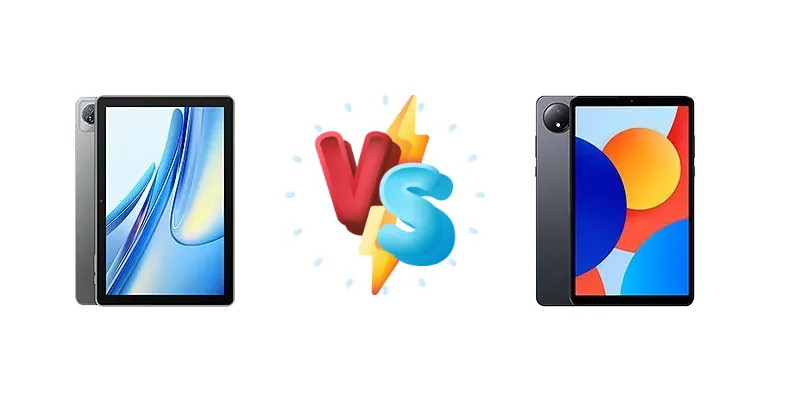
The budget tablet market is heating up, with the Blackview Tab 70 WiFi and Xiaomi Redmi Pad SE 8.7 vying for dominance. Both aim to deliver a functional Android experience without breaking the bank, but they take different approaches. The Blackview prioritizes longevity, while the Redmi Pad SE focuses on a more modern chipset and faster charging, creating a clear distinction for potential buyers.
🏆 Quick Verdict
For the average user prioritizing sustained usage and minimal downtime, the Blackview Tab 70 WiFi emerges as the winner. Its exceptional 112-hour endurance and 800-cycle battery life significantly outweigh the Redmi Pad SE’s faster charging, especially given the relatively modest power demands of typical tablet tasks.
| Network |
|---|
| 2G bands | N/A | GSM 850 / 900 / 1800 / 1900 |
| 3G bands | N/A | HSDPA 800 / 850 / 900 / 1700(AWS) / 1900 / 2100 |
| 4G bands | N/A | 1, 2, 3, 4, 5, 7, 8, 13, 18, 19, 20, 26, 28, 38, 40, 41, 66 |
| EDGE | No | - |
| GPRS | No | - |
| Speed | - | HSPA, LTE - cellular model only |
| Technology | No cellular connectivity | GSM / HSPA / LTE |
| Launch |
|---|
| Announced | 2023, September | 2024, July 29 |
| Status | Available. Released 2023, September | Available. Released 2024, August 08 |
| Body |
|---|
| Build | - | Glass front (Gorilla Glass 3) |
| Dimensions | 246.5 x 163 x 9.9 mm (9.70 x 6.42 x 0.39 in) | 211.6 x 125.5 x 8.8 mm (8.33 x 4.94 x 0.35 in) |
| SIM | No | Nano-SIM + Nano-SIM (cellular model only) |
| Weight | 520.5 g (1.15 lb) | 370 / 373 / 375 g (13.05 oz) |
| Display |
|---|
| Protection | Mohs level 7 | Corning Gorilla Glass 3 |
| Resolution | 800 x 1280 pixels, 16:10 ratio (~149 ppi density) | 800 x 1340 pixels, 5:3 ratio (~179 ppi density) |
| Size | 10.1 inches, 295.8 cm2 (~73.6% screen-to-body ratio) | 8.7 inches, 214.9 cm2 (~80.9% screen-to-body ratio) |
| Type | IPS LCD | IPS LCD, 1B colors, 90Hz, 600 nits (HBM) |
| Platform |
|---|
| CPU | Quad-core | Octa-core (2x2.0 GHz Cortex-A75 & 6x1.8 GHz Cortex-A55) |
| Chipset | - | Mediatek Helio G85 (12 nm) |
| GPU | - | Mali-G52 MC2 |
| OS | Android 13, DokeOS_P 3.0 | Android 14, HyperOS |
| Memory |
|---|
| Card slot | microSDXC | microSDXC (dedicated slot) |
| Internal | 64GB 3GB RAM | 64GB 4GB RAM, 128GB 4GB RAM, 128GB 6GB RAM |
| Main Camera |
|---|
| Features | LED flash | LED flash |
| Single | 5 MP | 8 MP, f/2.0, (wide), 1/4.0", 1.12µm |
| Video | Yes | 1080p@30fps |
| Selfie camera |
|---|
| Single | 2 MP | 5 MP, f/2.2, (wide), 1/5.0", 1.12µm |
| Video | Yes | 1080p@30fps |
| Sound |
|---|
| 35mm jack | Unspecified | Yes |
| Loudspeaker | Yes, with stereo speakers | Yes, with stereo speakers |
| Comms |
|---|
| Bluetooth | 5.0, A2DP, LE | 5.3, A2DP, LE |
| Infrared port | - | Yes |
| NFC | No | No |
| Positioning | No | GPS, GALILEO, GLONASS, BDS - cellular model only |
| Radio | No | FM radio |
| USB | USB Type-C 2.0, OTG | USB Type-C 2.0 |
| WLAN | Wi-Fi 802.11 a/b/g/n/ac/6, dual-band | Wi-Fi 802.11 a/b/g/n/ac, dual-band |
| Features |
|---|
| Sensors | Accelerometer, proximity (accessories only) | Accelerometer, proximity (accessories only), compass |
| Battery |
|---|
| Charging | 10W wired | 18W wired (Int'l)
10W wired (India) |
| Type | 6580 mAh | 6650 mAh |
| Misc |
|---|
| Colors | Space Grey, Twilight Blue | Aurora Green (Forest Green), Sky Blue (Ocean Blue), Graphite Gray (Urban Grey) |
| Models | - | 220233L2G |
| Price | - | About 120 EUR |
| SAR | - | 0.90 W/kg (head) 0.65 W/kg (body) |
| SAR EU | - | 0.40 W/kg (head) 0.99 W/kg (body) |
| EU LABEL |
|---|
| Battery | 112:06h endurance, 800 cycles | - |
| Energy | Class D | - |
| Free fall | Class C (147 falls) | - |
| Repairability | Class B | - |
Blackview Tab 70 WiFi
- Exceptional battery life (112+ hours)
- High battery cycle count (800 cycles)
- Reliable for extended use without charging
- Quad-core processor limits performance
- Slow 10W charging
Xiaomi Redmi Pad SE 8.7
- More powerful Mediatek Helio G85 processor
- Faster 18W charging (International)
- Potentially smoother multitasking and gaming
- Shorter battery life compared to Blackview
- 10W charging in India limits convenience
Display Comparison
Neither device provides detailed display specifications, but the Redmi Pad SE’s 8.7-inch size suggests a slightly more portable form factor. Without knowing panel type (IPS, TFT) or resolution, it’s difficult to assess image quality. However, the Redmi Pad SE’s chipset suggests it *could* support a higher refresh rate, though this is unconfirmed. The Blackview Tab 70’s display is likely optimized for power efficiency, potentially at the expense of peak brightness and color accuracy.
Camera Comparison
Given the budget nature of both tablets, camera performance is unlikely to be a key differentiator. Detailed camera specs are absent, suggesting both devices feature basic sensors for video calls and casual snapshots. It’s safe to assume image quality will be adequate in good lighting conditions but will struggle in low light. Focusing on camera capabilities for these devices would be a misdirection of expectations.
Performance
The core difference lies in the processing power. The Blackview Tab 70 WiFi utilizes a Quad-core CPU, a configuration suitable for basic tasks like web browsing and video playback. In contrast, the Xiaomi Redmi Pad SE 8.7 boasts a Mediatek Helio G85 Octa-core processor (2x2.0 GHz Cortex-A75 & 6x1.8 GHz Cortex-A55). This architecture provides a substantial performance boost, particularly in multi-threaded applications and gaming. The Helio G85’s 12nm process node is more efficient than a typical older node used in Quad-core chips, offering better performance per watt. This translates to smoother multitasking and a more responsive user experience for the Redmi Pad SE.
Battery Life
The Blackview Tab 70 WiFi’s standout feature is its incredible 112:06h endurance and 800-cycle battery life. This suggests a large battery capacity and optimized power management. While the Redmi Pad SE doesn’t disclose battery capacity, its 18W (International) / 10W (India) charging capability indicates a smaller battery. The faster charging is beneficial, but the Blackview’s longevity is far more impactful for users who prioritize extended usage between charges. The Redmi Pad SE’s charging speed advantage is diminished in India, where it’s limited to 10W, matching the Blackview.
Buying Guide
Buy the Blackview Tab 70 WiFi if you need a tablet that can reliably last through long flights, extended reading sessions, or as a dedicated device for children without constant charging. Buy the Xiaomi Redmi Pad SE 8.7 if you prefer a more responsive user experience for light gaming and multitasking, and value the convenience of faster charging, even if it means more frequent top-ups.
Frequently Asked Questions
❓ Does the Redmi Pad SE’s Helio G85 chip get noticeably hot during extended gaming sessions?
While the Helio G85 is a capable chip, its thermal performance in the Redmi Pad SE is unknown. However, given the tablet’s form factor and likely passive cooling, prolonged gaming at maximum settings could lead to thermal throttling, reducing sustained performance. The Blackview Tab 70, with its less demanding processor, is less likely to experience overheating.
❓ How does the 800-cycle battery life of the Blackview Tab 70 translate to real-world usage over several years?
An 800-cycle battery means the battery can be fully charged and discharged 800 times with minimal capacity degradation. Assuming a daily charge cycle, this equates to over two years of reliable battery performance. While battery capacity will eventually decline, the Blackview Tab 70 is designed to maintain a usable charge for a significantly longer period than tablets with lower cycle counts.
❓ Is the difference between 10W and 18W charging on the Redmi Pad SE substantial?
Yes, 18W charging (available internationally) is noticeably faster than 10W. However, the difference isn't dramatic. A full charge with 18W will still take several hours. The Blackview Tab 70’s slower charging is less of a concern given its exceptional battery life, as you won’t need to charge it as frequently.