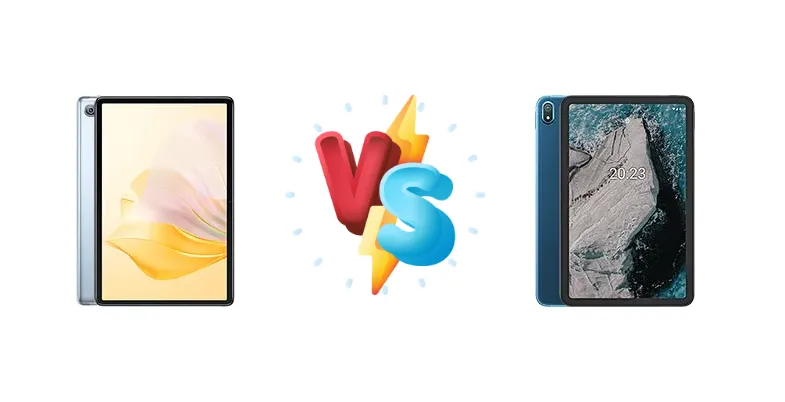
The budget tablet market is fiercely competitive, and the Blackview Tab 7 and Nokia T20 represent compelling options for users seeking affordable Android experiences. Both tablets aim to deliver essential functionality without breaking the bank, but they take different approaches to achieving this goal. This comparison dissects their key specifications to determine which tablet offers the best value.
🏆 Quick Verdict
For most users, the Nokia T20 emerges as the better choice. Its octa-core Unisoc T610 chipset provides a noticeable performance advantage over the Blackview Tab 7’s quad-core Tiger T310, and the brighter 422 nit display enhances media consumption. While charging is slightly faster on the Nokia, the overall experience is smoother and more responsive.
| Network |
|---|
| 2G bands | GSM 850 / 900 / 1800 / 1900 | GSM 850 / 900 / 1800 / 1900 |
| 3G bands | HSDPA 900 / 2100 | HSDPA 850 / 900 / 1700(AWS) / 1900 / 2100 - US, LATAM |
| 4G bands | 1, 3, 7, 8, 20, 40 | 1, 2, 3, 4, 5, 7, 8, 12, 13, 17, 20, 28, 40, 66 - US, LATAM |
| Speed | HSPA, LTE | HSPA, LTE Cat4 150/50 Mbps - cellular model only |
| Technology | GSM / HSPA / LTE | GSM / HSPA / LTE |
| | - | 1, 3, 5, 7, 8, 20, 28, 38, 40, 41 - International |
| Launch |
|---|
| Announced | 2022, July 05 | 2021, October 06 |
| Status | Available. Released 2022, July 05 | Available. Released 2021, November 02 |
| Body |
|---|
| Build | - | Glass front, aluminum back |
| Dimensions | 241.3 x 160 x 8.9 mm (9.50 x 6.30 x 0.35 in) | 247.6 x 157.5 x 7.8 mm (9.75 x 6.20 x 0.31 in) |
| SIM | Nano-SIM + Nano-SIM | Nano-SIM (cellular model only) |
| Weight | 536 g (1.18 lb) | 465 g (Wi-Fi), 470 g (LTE) (1.03 lb) |
| | - | Splash resistant |
| Display |
|---|
| Protection | Asahi Glass | Scratch-resistant glass |
| Resolution | 800 x 1280 pixels, 16:10 ratio (~149 ppi density) | 1200 x 2000 pixels, 5:3 ratio (~224 ppi density) |
| Size | 10.1 inches, 295.8 cm2 (~76.6% screen-to-body ratio) | 10.4 inches, 307.9 cm2 (~78.9% screen-to-body ratio) |
| Type | IPS LCD | IPS LCD, 400 nits (typ) |
| Platform |
|---|
| CPU | Quad-core (1x2.0 GHz Cortex-A75 & 3x1.8 GHz Cortex-A55) | Octa-core (2x1.8 GHz Cortex-A75 & 6x1.8 GHz Cortex-A55) |
| Chipset | Unisoc Tiger T310 (12 nm) | Unisoc T610 (12 nm) |
| GPU | PowerVR GE8300 | Mali-G52 MP2 |
| OS | Android 11 | Android 11, upgradable to Android 13 |
| Memory |
|---|
| Card slot | microSDXC (uses shared SIM slot) | microSDXC (dedicated slot) |
| Internal | 32GB 3GB RAM | 32GB 3GB RAM, 64GB 4GB RAM |
| | eMMC 5.1 | eMMC 5.1 |
| Main Camera |
|---|
| Features | LED flash | LED flash |
| Single | 5 MP, f/2.0 | 8 MP, AF |
| Video | 1080p@30fps | 1080p@30fps |
| Selfie camera |
|---|
| Single | 2 MP, f/2.8 | 5 MP |
| Video | Yes | Yes |
| Sound |
|---|
| 3.5mm jack | Yes | Yes |
| 35mm jack | Yes | Yes |
| Loudspeaker | Yes | Yes, with stereo speakers |
| Comms |
|---|
| Bluetooth | 5.0, A2DP | 5.0, A2DP, LE |
| NFC | No | No |
| Positioning | GPS, GLONASS, GALILEO, BDS | GPS - cellular model only |
| Radio | FM Radio | FM radio |
| USB | USB Type-C, OTG | USB Type-C 2.0 |
| WLAN | Wi-Fi 802.11 a/b/g/n/ac, dual-band | Wi-Fi 802.11 a/b/g/n/ac, dual-band |
| Features |
|---|
| Sensors | Accelerometer | Accelerometer |
| Battery |
|---|
| Charging | 10W wired | 15W wired |
| Type | 6580 mAh | Li-Po 8200 mAh |
| Misc |
|---|
| Colors | Grey, Blue, Silver | Deep Ocean |
| Models | - | TA-1397, TA-1394, TA-1392 |
| Price | About 140 EUR | About 200 EUR |
| SAR | - | 1.34 W/kg (body) |
| SAR EU | - | 1.35 W/kg (body) |
Blackview Tab 7
- Potentially lower price point
- Lightweight and portable
- Basic functionality for simple tasks
- Slower processor
- Likely dimmer display
- Slower charging speed
Nokia T20
- Faster octa-core processor
- Brighter and higher contrast display
- Faster 15W charging
- Slightly higher price
- May be slightly heavier
- Still limited camera capabilities
Display Comparison
The Nokia T20 boasts a significant advantage in display quality, achieving a measured peak brightness of 422 nits. This is crucial for outdoor visibility and a more vibrant viewing experience compared to the Blackview Tab 7, which lacks published brightness data and is likely considerably dimmer. The Nokia T20’s 1786:1 contrast ratio further enhances image clarity and depth. While both likely utilize IPS LCD panels, the Nokia’s superior brightness and contrast make it the clear winner for media consumption and general usability.
Camera Comparison
Neither tablet is positioned as a photography powerhouse, and detailed camera specs are limited. However, focusing on practical use, the camera systems are likely comparable in image quality. Given the budget nature of both devices, image processing will be basic, and low-light performance will be limited. Without specific sensor details, it’s difficult to declare a winner; however, the Nokia T20’s slightly higher overall system performance may translate to marginally faster image processing.
Performance
The core difference lies in the chipsets: the Blackview Tab 7 utilizes the Unisoc Tiger T310, a quad-core processor, while the Nokia T20 features the Unisoc T610, an octa-core unit. The T610’s configuration – 2x1.8 GHz Cortex-A75 and 6x1.8 GHz Cortex-A55 – provides a substantial boost in multi-tasking and application responsiveness. The A75 cores in the T610 are more powerful than the single A75 core in the T310, resulting in smoother performance during demanding tasks. While both chipsets are built on a 12nm process, the increased core count and architectural improvements of the T610 give the Nokia T20 a clear edge.
Battery Life
Battery capacity isn’t specified for the Blackview Tab 7, making a direct comparison challenging. The Nokia T20 supports 15W wired charging, which, while not exceptionally fast, is 50% faster than the Blackview Tab 7’s 10W charging. This translates to quicker top-ups, reducing downtime. Assuming similar battery capacities (likely in the 5000-6000 mAh range for both), the Nokia T20’s faster charging will be a noticeable convenience for users.
Buying Guide
Buy the Blackview Tab 7 if you prioritize extreme affordability and only need a tablet for very basic tasks like reading ebooks or light web browsing. Its lower price point makes it suitable for users on a tight budget or as a secondary device. Buy the Nokia T20 if you value a more responsive user experience, a brighter and more enjoyable display for media, and a tablet capable of handling multitasking and moderately demanding apps without significant slowdown.
Frequently Asked Questions
❓ Will the Nokia T20 handle video streaming services like Netflix and YouTube smoothly?
Yes, the Nokia T20’s Unisoc T610 chipset and octa-core architecture are well-suited for streaming video content at 1080p resolution. The brighter display further enhances the viewing experience, making it ideal for enjoying movies and shows on the go.
❓ Is the Blackview Tab 7 suitable for running multiple apps simultaneously?
The Blackview Tab 7’s quad-core processor may struggle with heavy multitasking. While it can handle basic app switching, running multiple demanding applications concurrently may result in noticeable slowdowns and lag. It’s best suited for running one app at a time.
❓ What type of storage does the Nokia T20 use, and is it expandable?
The Nokia T20 typically comes with eMMC storage, which is standard for this price range. It also supports microSD card expansion, allowing you to increase storage capacity for media and files. This is a significant advantage for users who plan to store a large amount of content on their tablet.
❓ How long will the Nokia T20’s battery last on a single charge with typical usage?
With typical usage (web browsing, video streaming, social media), the Nokia T20’s battery is expected to last around 8-10 hours. Battery life will vary depending on screen brightness, app usage, and network connectivity.