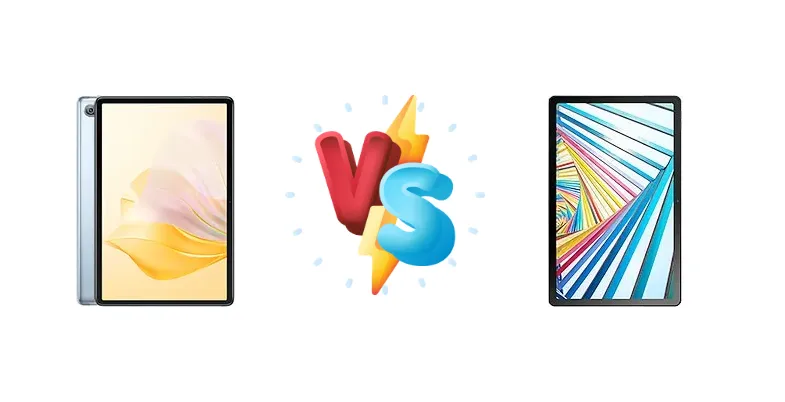
The budget tablet market is fiercely competitive, offering a range of options for users seeking entertainment, productivity, or a simple connected experience. The Blackview Tab 7 and Lenovo Tab M10 Plus (3rd Gen) represent compelling choices in this space, but cater to slightly different priorities. We dissect their core specifications to determine which tablet delivers the best overall value.
🏆 Quick Verdict
For most users, the Lenovo Tab M10 Plus (3rd Gen) emerges as the superior choice. Its Snapdragon 680 chipset (or Helio G80 in Wi-Fi models) provides a significant performance advantage over the Blackview Tab 7’s Unisoc Tiger T310, and the 20W charging is a welcome upgrade, making it better suited for demanding tasks and longer usage sessions.
| Network |
|---|
| 2G bands | GSM 850 / 900 / 1800 / 1900 | GSM 850 / 900 / 1800 / 1900 |
| 3G bands | HSDPA 900 / 2100 | HSDPA 800 / 850 / 900 / 1900 / 2100 |
| 4G bands | 1, 3, 7, 8, 20, 40 | 1, 2, 3, 4, 5, 7, 8, 19, 20, 26, 28, 28, 38, 40, 41 |
| Speed | HSPA, LTE | HSPA 42.2/5.76 Mbps, LTE Cat13 390/75 Mbps - cellular model only |
| Technology | GSM / HSPA / LTE | GSM / HSPA / LTE |
| Launch |
|---|
| Announced | 2022, July 05 | 2022, May |
| Status | Available. Released 2022, July 05 | Available. Released 2022, May |
| Body |
|---|
| Dimensions | 241.3 x 160 x 8.9 mm (9.50 x 6.30 x 0.35 in) | 251.2 x 158.8 x 7.5 mm (9.89 x 6.25 x 0.30 in) |
| SIM | Nano-SIM + Nano-SIM | Nano-SIM (cellular model only) |
| Weight | 536 g (1.18 lb) | 465 g (1.03 lb) |
| | - | Stylus support |
| Display |
|---|
| Protection | Asahi Glass | - |
| Resolution | 800 x 1280 pixels, 16:10 ratio (~149 ppi density) | 1200 x 2000 pixels, 5:3 ratio (~220 ppi density) |
| Size | 10.1 inches, 295.8 cm2 (~76.6% screen-to-body ratio) | 10.61 inches, 320.4 cm2 (~80.3% screen-to-body ratio) |
| Type | IPS LCD | IPS LCD, 400 nits (typ) |
| Platform |
|---|
| CPU | Quad-core (1x2.0 GHz Cortex-A75 & 3x1.8 GHz Cortex-A55) | Octa-core (4x2.4 GHz Kryo 265 Gold & 4x1.9 GHz Kryo 265 Silver) - LTE model Octa-core (2x2.0 GHz Cortex-A75 & 6x1.8 GHz Cortex-A55) - Wi-Fi only model |
| Chipset | Unisoc Tiger T310 (12 nm) | Qualcomm SM6225 Snapdragon 680 4G (6 nm) - LTE model Mediatek MT6769V/CU Helio G80 (12 nm) - Wi-Fi only model |
| GPU | PowerVR GE8300 | Adreno 610 - LTE model Mali-G52 MC2 - Wi-Fi only model |
| OS | Android 11 | Android 12 |
| Memory |
|---|
| Card slot | microSDXC (uses shared SIM slot) | microSDXC (dedicated slot) |
| Internal | 32GB 3GB RAM | 32GB 3GB RAM, 64GB 4GB RAM, 128GB 4GB RAM, 128GB 6GB RAM |
| | eMMC 5.1 | eMCP/uMCP |
| Main Camera |
|---|
| Features | LED flash | - |
| Single | 5 MP, f/2.0 | 8 MP, AF |
| Video | 1080p@30fps | 1080p |
| Selfie camera |
|---|
| Single | 2 MP, f/2.8 | 8 MP |
| Video | Yes | - |
| Sound |
|---|
| 3.5mm jack | Yes | Yes |
| 35mm jack | Yes | Yes |
| Loudspeaker | Yes | Yes, with stereo speakers (4 speakers) |
| Comms |
|---|
| Bluetooth | 5.0, A2DP | 5.0, A2DP, LE |
| NFC | No | No |
| Positioning | GPS, GLONASS, GALILEO, BDS | GPS, GLONASS, BDS - cellular model only |
| Radio | FM Radio | FM Radio |
| USB | USB Type-C, OTG | USB Type-C 2.0 |
| WLAN | Wi-Fi 802.11 a/b/g/n/ac, dual-band | Wi-Fi 802.11 a/b/g/n/ac, dual-band, Wi-Fi Direct |
| Features |
|---|
| Sensors | Accelerometer | Accelerometer, proximity, gyro |
| Battery |
|---|
| Charging | 10W wired | 20W wired |
| Type | 6580 mAh | Li-Po 7700 mAh |
| Misc |
|---|
| Colors | Grey, Blue, Silver | Storm Grey, Frost Blue |
| Price | About 140 EUR | About 260 EUR |
Blackview Tab 7
- Most affordable option
- Acceptable for basic tasks
- Lightweight and portable
- Significantly weaker performance
- Slow 10W charging
- Limited multitasking capabilities
Lenovo Tab M10 Plus (3rd Gen)
- Faster and more efficient processor
- 20W fast charging
- Potential for 4G LTE connectivity
- Slightly higher price point
- Display quality is average
- Camera performance is likely basic
Display Comparison
Neither tablet boasts a particularly standout display. Both likely utilize IPS LCD panels, common in this price bracket. However, details regarding resolution, peak brightness, and color gamut are missing. The Lenovo Tab M10 Plus benefits from a slightly larger 10.61-inch screen compared to the Blackview Tab 7’s 10.1-inch display, potentially offering a more immersive viewing experience. The absence of high refresh rate or HDR support on both devices suggests they are geared towards casual content consumption rather than critical viewing.
Camera Comparison
Camera quality is unlikely to be a deciding factor for buyers in this segment. Both tablets likely feature basic camera setups primarily intended for video calls and occasional snapshots. Detailed sensor information is unavailable, but it’s safe to assume neither device will excel in low-light conditions or offer advanced photographic features. Focusing on megapixel counts alone would be misleading; image processing and sensor size play a more crucial role, and data on these aspects is lacking.
Performance
The performance gap is the most significant differentiator. The Lenovo Tab M10 Plus (3rd Gen) offers two chipset options: the Qualcomm Snapdragon 680 (6nm) in LTE models and the MediaTek Helio G80 (12nm) in Wi-Fi only models. Both represent a substantial leap over the Blackview Tab 7’s Unisoc Tiger T310 (12nm). The Snapdragon 680’s octa-core configuration (4x2.4 GHz Kryo 265 Gold & 4x1.9 GHz Kryo 265 Silver) and 6nm process provide superior efficiency and processing power for multitasking and demanding applications. Even the Helio G80, while less efficient, offers an octa-core setup (2x2.0 GHz Cortex-A75 & 6x1.8 GHz Cortex-A55) compared to the Blackview’s quad-core (1x2.0 GHz Cortex-A75 & 3x1.8 GHz Cortex-A55). This translates to noticeably faster app loading times and smoother overall system responsiveness on the Lenovo.
Battery Life
Battery capacity details are missing for both devices. However, the Lenovo Tab M10 Plus (3rd Gen) gains a clear advantage with its 20W wired charging capability, compared to the Blackview Tab 7’s slower 10W charging. This faster charging speed will significantly reduce downtime and allow users to quickly top up their battery when needed. While a larger battery capacity on the Blackview Tab 7 could partially offset this difference, the faster charging of the Lenovo is a more tangible benefit for everyday use.
Buying Guide
Buy the Blackview Tab 7 if you prioritize extreme affordability and basic tablet functionality for light tasks like reading ebooks or casual browsing. It’s a suitable option for users on a very tight budget who don’t require significant processing power. Buy the Lenovo Tab M10 Plus (3rd Gen) if you value smoother performance for multitasking, streaming, and light gaming, alongside faster charging and potentially 4G connectivity, making it a more versatile and future-proof investment.
Frequently Asked Questions
❓ Will the Blackview Tab 7 struggle with multiple apps open simultaneously?
Yes, the Unisoc Tiger T310 chipset and limited RAM (spec not provided, but likely 3-4GB) in the Blackview Tab 7 will likely result in noticeable slowdowns and app reloading when multitasking. It's best suited for running one app at a time.
❓ Does the Lenovo Tab M10 Plus (3rd Gen) support video playback in HD resolution?
While specific resolution support isn't explicitly stated, the Snapdragon 680 (or Helio G80) chipset is capable of decoding HD and even Full HD video content. Streaming services like Netflix and YouTube should function without issue at 1080p, assuming a stable internet connection.
❓ Is the difference between the Snapdragon 680 and Helio G80 versions of the Lenovo Tab M10 Plus significant?
Yes, the Snapdragon 680 offers a performance and efficiency advantage over the Helio G80 due to its 6nm process and more advanced CPU architecture. The Snapdragon version will provide a smoother experience, especially for gaming and demanding applications. However, the Helio G80 is still a capable processor for everyday tasks.