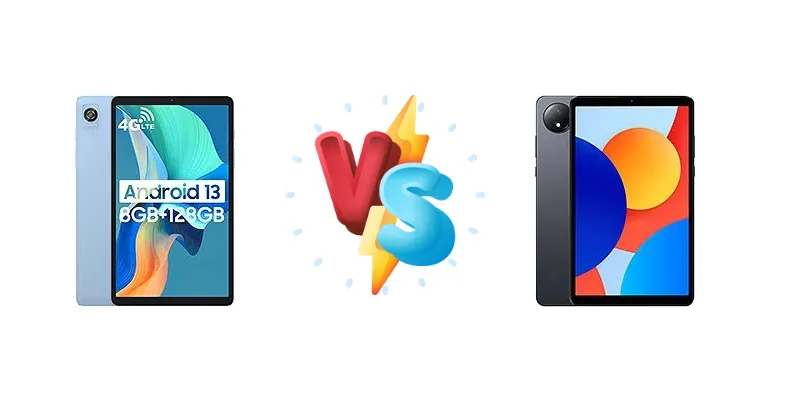
The sub-$200 tablet market is heating up, with the Blackview Tab 60 and Xiaomi Redmi Pad SE 8.7 vying for dominance. Both offer a large-screen Android experience at an accessible price, but significant differences in their core components dictate which tablet is best suited for different users. This comparison dives deep into the silicon, battery life, and overall value proposition of each device.
🏆 Quick Verdict
For most users, the Xiaomi Redmi Pad SE 8.7 emerges as the better choice. Its Mediatek Helio G85 chipset provides a noticeable performance edge over the Blackview Tab 60’s Unisoc T606, translating to smoother multitasking and a more responsive user experience. While charging speeds vary by region, the overall package offers a more refined experience.
| Network |
|---|
| 2G bands | GSM 850 / 900 / 1800 / 1900 | GSM 850 / 900 / 1800 / 1900 |
| 3G bands | HSDPA 900 / 2100 | HSDPA 800 / 850 / 900 / 1700(AWS) / 1900 / 2100 |
| 4G bands | 1, 3, 7, 8, 20, 40 | 1, 2, 3, 4, 5, 7, 8, 13, 18, 19, 20, 26, 28, 38, 40, 41, 66 |
| Speed | HSPA, LTE | HSPA, LTE - cellular model only |
| Technology | GSM / HSPA / LTE | GSM / HSPA / LTE |
| Launch |
|---|
| Announced | 2023, September | 2024, July 29 |
| Status | Available. Released 2023, September | Available. Released 2024, August 08 |
| Body |
|---|
| Build | - | Glass front (Gorilla Glass 3) |
| Dimensions | 211.7 x 124.4 x 8.4 mm (8.33 x 4.90 x 0.33 in) | 211.6 x 125.5 x 8.8 mm (8.33 x 4.94 x 0.35 in) |
| SIM | Nano-SIM + Nano-SIM | Nano-SIM + Nano-SIM (cellular model only) |
| Weight | 338 g (11.92 oz) | 370 / 373 / 375 g (13.05 oz) |
| Display |
|---|
| Protection | - | Corning Gorilla Glass 3 |
| Resolution | 800 x 1340 pixels, 5:3 ratio (~180 ppi density) | 800 x 1340 pixels, 5:3 ratio (~179 ppi density) |
| Size | 8.68 inches, 213.9 cm2 (~81.2% screen-to-body ratio) | 8.7 inches, 214.9 cm2 (~80.9% screen-to-body ratio) |
| Type | IPS LCD | IPS LCD, 1B colors, 90Hz, 600 nits (HBM) |
| Platform |
|---|
| CPU | Octa-core (2x1.6 GHz Cortex-A75 & 6x1.6 GHz Cortex-A55) | Octa-core (2x2.0 GHz Cortex-A75 & 6x1.8 GHz Cortex-A55) |
| Chipset | Unisoc T606 (12 nm) | Mediatek Helio G85 (12 nm) |
| GPU | Mali-G57 MP1 | Mali-G52 MC2 |
| OS | Android 13, Doke OS_P 3.0 | Android 14, HyperOS |
| Memory |
|---|
| Card slot | microSDXC (uses shared SIM slot) | microSDXC (dedicated slot) |
| Internal | 128GB 4GB RAM, 128GB 6GB RAM | 64GB 4GB RAM, 128GB 4GB RAM, 128GB 6GB RAM |
| Main Camera |
|---|
| Features | - | LED flash |
| Single | 8 MP | 8 MP, f/2.0, (wide), 1/4.0", 1.12µm |
| Video | 1080p@30fps | 1080p@30fps |
| Selfie camera |
|---|
| Single | 5 MP | 5 MP, f/2.2, (wide), 1/5.0", 1.12µm |
| Video | Yes | 1080p@30fps |
| Sound |
|---|
| 35mm jack | Yes | Yes |
| Loudspeaker | Yes, with stereo speakers | Yes, with stereo speakers |
| Comms |
|---|
| Bluetooth | 5.0, A2DP | 5.3, A2DP, LE |
| Infrared port | - | Yes |
| NFC | No | No |
| Positioning | GPS, GLONASS, GALILEO, BDS | GPS, GALILEO, GLONASS, BDS - cellular model only |
| Radio | FM Radio | FM radio |
| USB | USB Type-C, OTG | USB Type-C 2.0 |
| WLAN | Wi-Fi 802.11 a/b/g/n/ac, dual-band | Wi-Fi 802.11 a/b/g/n/ac, dual-band |
| Features |
|---|
| Sensors | Accelerometer, proximity (accessories only) | Accelerometer, proximity (accessories only), compass |
| Battery |
|---|
| Charging | - | 18W wired (Int'l)
10W wired (India) |
| Type | 6050 mAh | 6650 mAh |
| Misc |
|---|
| Colors | Grey, Blue, Green | Aurora Green (Forest Green), Sky Blue (Ocean Blue), Graphite Gray (Urban Grey) |
| Models | - | 220233L2G |
| Price | - | About 120 EUR |
| SAR | - | 0.90 W/kg (head) 0.65 W/kg (body) |
| SAR EU | - | 0.40 W/kg (head) 0.99 W/kg (body) |
Blackview Tab 60
- Potentially larger battery capacity (based on size)
- Competitive price point
- Solid build quality (typical of Blackview)
- Unisoc T606 chipset offers lower performance
- Likely slower charging speeds
- Limited software updates expected
Xiaomi Redmi Pad SE 8.7
- More powerful Mediatek Helio G85 chipset
- Faster charging (18W in some regions)
- Better gaming performance
- Xiaomi’s MIUI software offers more features
- Potentially smaller battery capacity
- MIUI can be resource-intensive
- Regional charging speed variations
Display Comparison
Both tablets utilize 12nm process technology, suggesting similar power efficiency in display operation. However, detailed display specs (resolution, panel type, brightness) are missing. Given the price point, both likely employ IPS LCD panels. The Redmi Pad SE’s slightly larger 8.7-inch screen offers a bit more viewing real estate. Without specific brightness data, it’s difficult to assess which offers a better outdoor viewing experience. Bezels are likely comparable, reflecting the budget nature of both devices.
Camera Comparison
Camera performance is unlikely to be a deciding factor for either tablet. Both are likely equipped with basic camera sensors suitable for casual snapshots and video calls. Without detailed sensor specifications, it’s difficult to make a meaningful comparison. The focus should be on the overall system performance, as image processing on these chipsets will be limited. Expect similar results in good lighting conditions, with both struggling in low-light scenarios.
Performance
The core difference lies in the chipsets. The Xiaomi Redmi Pad SE 8.7’s Mediatek Helio G85 boasts a higher CPU clock speed (2.0 GHz vs 1.6 GHz on the Blackview Tab 60’s Unisoc T606) for its Cortex-A75 cores. This, combined with a slightly faster Cortex-A55 cluster (1.8 GHz vs 1.6 GHz), translates to a tangible performance advantage in CPU-intensive tasks. While both use an octa-core configuration, the Helio G85’s architecture provides a more responsive experience. The GPU within the Helio G85 is also superior, making the Redmi Pad SE the clear winner for gaming. RAM configurations are not specified, but the chipset difference will be the dominant factor.
Battery Life
Battery capacity is not specified for either device. However, the Blackview Tab 60’s larger physical size *suggests* a potentially larger battery. The Redmi Pad SE 8.7 offers 18W wired charging (international markets) or 10W (India), providing a faster charging experience where available. The faster charging speed partially offsets any potential battery capacity disadvantage. Real-world battery life will depend heavily on usage patterns, but the Redmi Pad SE’s more efficient chipset may result in comparable endurance despite a potentially smaller battery.
Buying Guide
Buy the Blackview Tab 60 if you prioritize a potentially longer lifespan due to its larger battery capacity and are primarily focused on basic tasks like reading, web browsing, and light video consumption. Buy the Xiaomi Redmi Pad SE 8.7 if you value performance for gaming, streaming, and multitasking, and are willing to potentially compromise slightly on battery endurance. The Redmi Pad SE is the better option for users who want a more responsive and versatile tablet experience.
Frequently Asked Questions
❓ Does the Redmi Pad SE 8.7’s Helio G85 chipset get hot during extended gaming sessions?
The Helio G85 is a relatively efficient chipset. While it will generate heat during prolonged gaming, it’s unlikely to experience significant thermal throttling due to the tablet’s larger surface area for heat dissipation. Expect playable frame rates for most mobile games, but don’t anticipate flagship-level performance.
❓ Which tablet is better for taking notes with a stylus?
Neither tablet is specifically marketed with stylus support. While a capacitive stylus *may* work with both devices, the experience will likely be limited and lack pressure sensitivity. These tablets are not ideal for serious note-taking or digital art.
❓ Is the 10W charging on the Indian Redmi Pad SE 8.7 a significant drawback?
Yes, the 10W charging in India is considerably slower than the 18W option available in other regions. This will result in significantly longer charging times, potentially taking over 4 hours for a full charge. This is a notable compromise for Indian buyers.
❓ What kind of storage options are available on these tablets?
Storage configurations are not specified in the provided data. However, based on market trends, both tablets likely offer options ranging from 32GB to 128GB, with microSD card support for expansion. Check retailer listings for specific configurations.