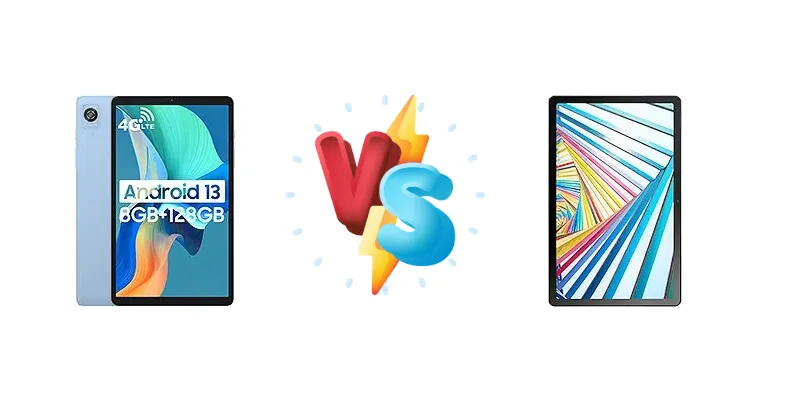
The budget tablet market is fiercely competitive, and the Blackview Tab 60 and Lenovo Tab M10 Plus (3rd Gen) are two contenders vying for your attention. While both aim to deliver an affordable Android experience, they take different approaches to chipset selection and overall feature sets. This comparison dives deep into the specifications to determine which tablet offers the best value for everyday tasks, media consumption, and light productivity.
🏆 Quick Verdict
For most users, the Lenovo Tab M10 Plus (3rd Gen) with the Snapdragon 680 offers a smoother, more responsive experience thanks to its more efficient 6nm process and generally faster CPU cores. While the Blackview Tab 60 is a viable option, the Lenovo’s performance edge justifies the potential price difference.
| Network |
|---|
| 2G bands | GSM 850 / 900 / 1800 / 1900 | GSM 850 / 900 / 1800 / 1900 |
| 3G bands | HSDPA 900 / 2100 | HSDPA 800 / 850 / 900 / 1900 / 2100 |
| 4G bands | 1, 3, 7, 8, 20, 40 | 1, 2, 3, 4, 5, 7, 8, 19, 20, 26, 28, 28, 38, 40, 41 |
| Speed | HSPA, LTE | HSPA 42.2/5.76 Mbps, LTE Cat13 390/75 Mbps - cellular model only |
| Technology | GSM / HSPA / LTE | GSM / HSPA / LTE |
| Launch |
|---|
| Announced | 2023, September | 2022, May |
| Status | Available. Released 2023, September | Available. Released 2022, May |
| Body |
|---|
| Dimensions | 211.7 x 124.4 x 8.4 mm (8.33 x 4.90 x 0.33 in) | 251.2 x 158.8 x 7.5 mm (9.89 x 6.25 x 0.30 in) |
| SIM | Nano-SIM + Nano-SIM | Nano-SIM (cellular model only) |
| Weight | 338 g (11.92 oz) | 465 g (1.03 lb) |
| | - | Stylus support |
| Display |
|---|
| Resolution | 800 x 1340 pixels, 5:3 ratio (~180 ppi density) | 1200 x 2000 pixels, 5:3 ratio (~220 ppi density) |
| Size | 8.68 inches, 213.9 cm2 (~81.2% screen-to-body ratio) | 10.61 inches, 320.4 cm2 (~80.3% screen-to-body ratio) |
| Type | IPS LCD | IPS LCD, 400 nits (typ) |
| Platform |
|---|
| CPU | Octa-core (2x1.6 GHz Cortex-A75 & 6x1.6 GHz Cortex-A55) | Octa-core (4x2.4 GHz Kryo 265 Gold & 4x1.9 GHz Kryo 265 Silver) - LTE model Octa-core (2x2.0 GHz Cortex-A75 & 6x1.8 GHz Cortex-A55) - Wi-Fi only model |
| Chipset | Unisoc T606 (12 nm) | Qualcomm SM6225 Snapdragon 680 4G (6 nm) - LTE model Mediatek MT6769V/CU Helio G80 (12 nm) - Wi-Fi only model |
| GPU | Mali-G57 MP1 | Adreno 610 - LTE model Mali-G52 MC2 - Wi-Fi only model |
| OS | Android 13, Doke OS_P 3.0 | Android 12 |
| Memory |
|---|
| Card slot | microSDXC (uses shared SIM slot) | microSDXC (dedicated slot) |
| Internal | 128GB 4GB RAM, 128GB 6GB RAM | 32GB 3GB RAM, 64GB 4GB RAM, 128GB 4GB RAM, 128GB 6GB RAM |
| | - | eMCP/uMCP |
| Main Camera |
|---|
| Single | 8 MP | 8 MP, AF |
| Video | 1080p@30fps | 1080p |
| Selfie camera |
|---|
| Single | 5 MP | 8 MP |
| Video | Yes | - |
| Sound |
|---|
| 3.5mm jack | - | Yes |
| 35mm jack | Yes | Yes |
| Loudspeaker | Yes, with stereo speakers | Yes, with stereo speakers (4 speakers) |
| Comms |
|---|
| Bluetooth | 5.0, A2DP | 5.0, A2DP, LE |
| NFC | No | No |
| Positioning | GPS, GLONASS, GALILEO, BDS | GPS, GLONASS, BDS - cellular model only |
| Radio | FM Radio | FM Radio |
| USB | USB Type-C, OTG | USB Type-C 2.0 |
| WLAN | Wi-Fi 802.11 a/b/g/n/ac, dual-band | Wi-Fi 802.11 a/b/g/n/ac, dual-band, Wi-Fi Direct |
| Features |
|---|
| Sensors | Accelerometer, proximity (accessories only) | Accelerometer, proximity, gyro |
| Battery |
|---|
| Charging | - | 20W wired |
| Type | 6050 mAh | Li-Po 7700 mAh |
| Misc |
|---|
| Colors | Grey, Blue, Green | Storm Grey, Frost Blue |
| Price | - | About 260 EUR |
Blackview Tab 60
- Most affordable option
- Decent for basic tasks
- Lightweight and portable
- Unisoc T606 chipset is less powerful
- Likely slower RAM speeds
- Potentially shorter battery life
Lenovo Tab M10 Plus (3rd Gen)
- More powerful Snapdragon 680 (or Helio G80)
- Faster charging (20W)
- Potential for 4G connectivity
- Generally more expensive
- Display quality is standard for the price range
- Camera performance is basic
Display Comparison
Neither device boasts a particularly standout display. Both likely utilize IPS LCD panels, common in this price bracket. The key difference lies under the hood. While specific display specs (resolution, brightness) are missing for the Blackview Tab 60, the Lenovo Tab M10 Plus (3rd Gen) is expected to offer a standard 1920x1200 resolution. The Snapdragon 680’s ISP may offer slightly better image processing for video playback. Bezels are likely comparable, being relatively thick on both to maintain affordability.
Camera Comparison
Camera performance is unlikely to be a deciding factor for either tablet. Both will likely feature basic camera setups suitable for casual snapshots and video calls. Given the context data, focusing on the main sensors is key. The Lenovo Tab M10 Plus (3rd Gen) likely has a more capable main sensor than the Blackview Tab 60, though specific megapixel counts are not provided. The inclusion of features like phase detection autofocus (PDAF) on the Lenovo would be a plus, but is unconfirmed. The 2MP macro cameras often found in this segment are generally of limited utility on both devices.
Performance
The performance gap is the most significant differentiator. The Lenovo Tab M10 Plus (3rd Gen) offers two chipset options: the Qualcomm Snapdragon 680 (6nm) and the MediaTek Helio G80 (12nm). The Snapdragon 680, even in its 4G configuration, represents a substantial upgrade over the Blackview Tab 60’s Unisoc T606 (12nm). The Snapdragon 680’s Kryo 265 Gold cores, clocked at 2.4 GHz, outperform the Cortex-A75 cores in the T606 (1.6 GHz). Furthermore, the 6nm process of the Snapdragon 680 translates to better power efficiency and reduced thermal throttling during sustained workloads. The Wi-Fi only model with the Helio G80 will still offer a performance boost over the Unisoc T606, but not as significant as the Snapdragon variant. The Lenovo’s potential for faster RAM (likely LPDDR4X vs the Tab 60’s likely LPDDR4) further contributes to a snappier experience.
Battery Life
Battery life will depend heavily on usage patterns. While specific battery capacities are missing, the more efficient Snapdragon 680 in the Lenovo Tab M10 Plus (3rd Gen) will likely result in longer runtimes on a single charge. The Lenovo also supports 20W wired charging, which will allow for faster top-ups compared to the Blackview Tab 60, which lacks specified charging speeds. The 6nm process of the Snapdragon contributes to lower power consumption, extending battery life during video playback and web browsing.
Buying Guide
Buy the Blackview Tab 60 if you prioritize absolute affordability and are primarily focused on basic tasks like web browsing, video playback, and light social media. It’s a good choice for users who need a secondary tablet for simple entertainment. Buy the Lenovo Tab M10 Plus (3rd Gen) if you value a more fluid user experience, better multitasking capabilities, and the potential for 4G connectivity (depending on the model). It’s ideal for students, travelers, or anyone who wants a tablet that can handle a wider range of applications without significant lag.
Frequently Asked Questions
❓ Does the Snapdragon 680 in the Lenovo Tab M10 Plus (3rd Gen) get hot during extended gaming sessions?
The Snapdragon 680 is a relatively efficient chip, and the Lenovo Tab M10 Plus (3rd Gen) is not designed for intensive gaming. However, during prolonged gaming, some heat buildup is expected. The 6nm process helps mitigate throttling, but demanding titles may experience some performance reduction after extended play.
❓ Is the 4G connectivity on the Lenovo Tab M10 Plus (3rd Gen) worth the extra cost?
The value of 4G connectivity depends on your usage. If you frequently travel or need internet access in areas without Wi-Fi, the 4G model is a worthwhile investment. However, if you primarily use the tablet at home or in locations with reliable Wi-Fi, the Wi-Fi-only model will suffice and save you money.
❓ Can the Blackview Tab 60 handle video editing or other demanding tasks?
The Blackview Tab 60’s Unisoc T606 chipset is not well-suited for demanding tasks like video editing. While it can handle basic photo editing, expect significant lag and slow processing times with more complex projects. It's best suited for media consumption and light productivity.