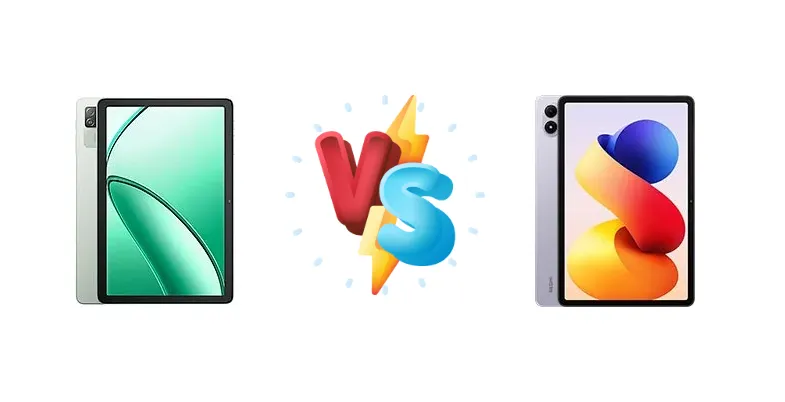
The tablet market offers a wide range of options, but finding the right balance between price, performance, and battery life can be challenging. We pit the Blackview Tab 60 WiFi, a budget-focused endurance champion, against the Xiaomi Redmi Pad 2 Pro, a more powerful device aiming for a premium experience, to determine which tablet best suits your needs.
🏆 Quick Verdict
For users prioritizing all-day battery life and affordability, the Blackview Tab 60 WiFi is the clear winner. However, the Xiaomi Redmi Pad 2 Pro delivers significantly superior performance and faster charging, making it the better choice for demanding tasks and users who value speed.
| Network |
|---|
| 2G bands | GSM 850 / 900 / 1800 / 1900 N/A | N/A |
| 3G bands | N/A | N/A |
| 4G bands | N/A | - |
| EDGE | No | N/A |
| GPRS | No | N/A |
| Technology | GSM | No cellular connectivity |
| Launch |
|---|
| Announced | 2025, January | 2025, September 24 |
| Status | Available. Released 2025, January | Available. Released 2025, September 24 |
| Body |
|---|
| Build | - | Glass front, aluminum frame, aluminum back |
| Dimensions | 242.7 x 161.5 x 8.5 mm (9.56 x 6.36 x 0.33 in) | 279.8 x 181.7 x 7.5 mm (11.02 x 7.15 x 0.30 in) |
| SIM | No | No |
| Weight | 538 g (1.19 lb) | 610 g (1.34 lb) |
| Display |
|---|
| Protection | Mohs level 5 | Mohs level 6 |
| Resolution | 800 x 1280 pixels, 16:10 ratio (~149 ppi density) | 1600 x 2560 pixels, 16:10 ratio (~249 ppi density) |
| Size | 10.1 inches, 295.8 cm2 (~75.5% screen-to-body ratio) | 12.1 inches, 424.5 cm2 (~83.5% screen-to-body ratio) |
| Type | IPS LCD | IPS LCD, 1B colors, 120Hz, Dolby Vision, 600 nits (HBM) |
| Platform |
|---|
| CPU | Octa-core | Octa-core (1x2.7 GHz Cortex-A720 & 3x2.4 GHz Cortex-A720 & 4x1.8 GHz Cortex-A520) |
| Chipset | AllWinner A523 | Qualcomm SM7635-AC Snapdragon 7s Gen 4 (4 nm) |
| GPU | Mali-G57 | Adreno 810 |
| OS | Android 14, Doke OS_P 4.0 | Android 15, HyperOS 2 |
| Memory |
|---|
| Card slot | microSDXC (dedicated slot) | microSDXC (dedicated slot) |
| Internal | 128GB 4GB RAM | 128GB 6GB RAM, 256GB 8GB RAM |
| Main Camera |
|---|
| Features | LED flash | Color spectrum sensor, LED flash, HDR |
| Single | 8 MP | 8 MP, f/2.0, (wide), 1/4.0", 1.12µm |
| Video | 1080p@30fps | 1080p@30fps |
| Selfie camera |
|---|
| Single | 5 MP | 8 MP, f/2.3, (wide), 1/4.0", 1.12µm |
| Video | Yes | 1080p@30fps |
| Sound |
|---|
| 35mm jack | Yes | Yes |
| Loudspeaker | Yes, with stereo speakers | Yes, with stereo speakers, Dolby Atmos (4 speakers) |
| Comms |
|---|
| Bluetooth | 5.2, A2DP, LE | 5.4, A2DP, LE, aptX HD, aptX Adaptive |
| NFC | No | No |
| Positioning | No | No |
| Radio | FM Radio | No |
| USB | USB Type-C, OTG | USB Type-C 2.0, OTG |
| WLAN | Wi-Fi 802.11 a/b/g/n/ac/6, dual-band | Wi-Fi 802.11 a/b/g/n/a/6, dual-band, Wi-Fi Direct |
| Features |
|---|
| Sensors | Accelerometer | Accelerometer, gyro, proximity (accessories only), compass |
| Battery |
|---|
| Charging | 10W wired | 33W wired, PD3.0, QC3+
27W reverse wired |
| Type | 5100 mAh | 12000 mAh |
| Misc |
|---|
| Colors | Grey, Blue, Green | Graphite Gray, Silver, Lavender Purple, Matte Glass Version |
| Models | - | 25099RP13G |
| Price | About 90 EUR | About 300 EUR |
| EU LABEL |
|---|
| Battery | 67:13h endurance, 800 cycles | 103:18h endurance, 1000 cycles |
| Energy | Class E | Class G |
| Free fall | Class B (156 falls) | Class A (208 falls) |
| Repairability | Class B | Class C |
Blackview Tab 60 WiFi
- Exceptional battery endurance (67:13h)
- Long battery lifespan (800 cycles)
- More affordable price point
- Significantly weaker performance
- Slow 10W charging
Xiaomi Redmi Pad 2 Pro
- Powerful Snapdragon 7s Gen 4 chipset
- Fast 33W charging with PD3.0/QC3+
- Superior performance for gaming and multitasking
- Shorter battery endurance (103:18h)
- Higher price
Display Comparison
While both tablets likely feature IPS LCD panels (data not provided), the core difference lies elsewhere. The Redmi Pad 2 Pro’s Snapdragon 7s Gen 4 chipset will contribute to smoother scrolling and animations. The Blackview Tab 60’s display specs are unknown, but given its price point, it likely prioritizes size over resolution or color accuracy. The Redmi Pad 2 Pro’s chipset allows for potentially better image processing, enhancing the visual experience, especially with video content.
Camera Comparison
Camera performance is likely a secondary consideration for both tablets, but the Redmi Pad 2 Pro likely holds an advantage due to its more powerful ISP (Image Signal Processor) integrated within the Snapdragon chipset. Without specific sensor details for the Blackview Tab 60, it’s difficult to assess its image quality. The Redmi Pad 2 Pro’s chipset allows for better noise reduction, dynamic range, and overall image processing capabilities. We anticipate the Redmi Pad 2 Pro will deliver more consistent and detailed photos and videos.
Performance
The performance gap is substantial. The Xiaomi Redmi Pad 2 Pro’s Qualcomm Snapdragon 7s Gen 4 (4nm) is a modern, efficient chipset built on a smaller fabrication node. This translates to significantly higher processing power and improved energy efficiency compared to the Blackview Tab 60’s AllWinner A523. The Snapdragon’s octa-core configuration, with a mix of Cortex-A720 and A520 cores clocked up to 2.7 GHz, provides a noticeable advantage in multitasking, gaming, and demanding applications. The Allwinner A523, while capable for basic tasks, will struggle with resource-intensive workloads. The Redmi Pad 2 Pro’s likely use of LPDDR5x RAM further enhances performance.
Battery Life
Battery life is where the Blackview Tab 60 shines. Its 67:13h endurance rating significantly surpasses the Redmi Pad 2 Pro’s 103:18h endurance. However, the Redmi Pad 2 Pro’s active use score of 12:55h suggests a more realistic usage scenario. The Blackview Tab 60’s 800 battery cycles indicate a longer lifespan before significant capacity degradation. The Redmi Pad 2 Pro’s 33W charging with PD3.0 and QC3+ is a game-changer, offering significantly faster charging times compared to the Blackview Tab 60’s 10W wired charging. The Redmi Pad 2 Pro also offers 27W reverse wired charging, a feature absent on the Blackview Tab 60.
Buying Guide
Buy the Blackview Tab 60 WiFi if you need a tablet primarily for extended media consumption, reading, or basic productivity tasks, and battery life is your top concern. It’s ideal for travel or situations where access to power is limited. Buy the Xiaomi Redmi Pad 2 Pro if you prefer a smoother, more responsive experience for gaming, multitasking, or creative applications, and you’re willing to trade some battery endurance for significantly improved performance and faster charging capabilities.
Frequently Asked Questions
❓ How much faster is the Redmi Pad 2 Pro's charging compared to the Blackview Tab 60 WiFi?
The Redmi Pad 2 Pro's 33W charging is significantly faster than the Blackview Tab 60 WiFi's 10W charging. Expect a full charge on the Redmi Pad 2 Pro in approximately 1.5-2 hours, while the Blackview Tab 60 WiFi will likely take 5+ hours. The Redmi Pad 2 Pro also supports fast charging protocols like PD3.0 and QC3+, further optimizing charging speed.
❓ Will the Allwinner A523 in the Blackview Tab 60 WiFi struggle with demanding games?
Yes, the Allwinner A523 is a budget-oriented chipset and will likely struggle with graphically intensive games. You may experience noticeable lag, frame drops, and reduced graphical settings. The Redmi Pad 2 Pro’s Snapdragon 7s Gen 4 is far better suited for gaming, offering a smoother and more enjoyable experience.
❓ How does the battery cycle count affect the Blackview Tab 60 WiFi's long-term performance?
The Blackview Tab 60 WiFi's 800 battery cycle rating indicates that the battery is designed to retain a significant portion of its capacity after 800 full charge cycles. This suggests a longer lifespan and more consistent performance over time compared to tablets with lower cycle counts.
❓ Can the Xiaomi Redmi Pad 2 Pro charge other devices?
Yes, the Xiaomi Redmi Pad 2 Pro supports 27W reverse wired charging. This allows you to use the tablet as a power bank to charge other devices, such as smartphones or wireless earbuds, although the charging speed will be slower than using a dedicated charger.