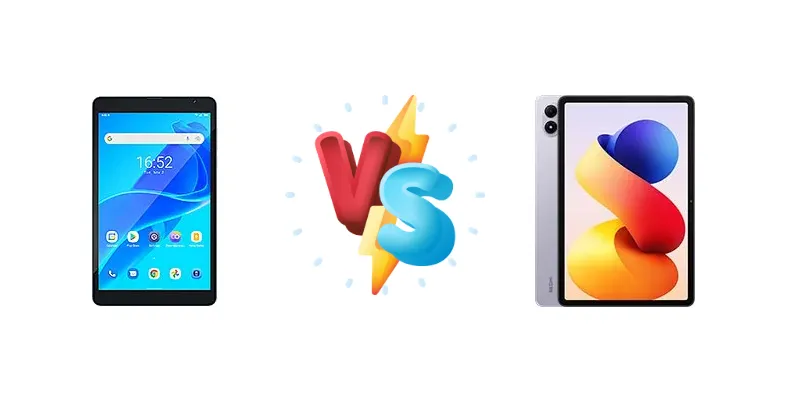
The tablet market has seen a surge in affordable options, but performance and features vary wildly. We pit the Blackview Tab 6, a value-focused offering, against the Xiaomi Redmi Pad 2 Pro, a step up in processing power and battery endurance, to determine which tablet delivers the best experience for your money.
🏆 Quick Verdict
For the average user, the Xiaomi Redmi Pad 2 Pro is the clear winner. Its Snapdragon 7s Gen 4 chipset provides significantly faster performance and better efficiency than the Blackview Tab 6’s Unisoc Tiger T310, justifying the price difference. While the Tab 6 offers a compelling entry point, the Redmi Pad 2 Pro delivers a smoother, more future-proof experience.
| Network |
|---|
| 2G bands | GSM 850 / 900 / 1800 / 1900 | N/A |
| 3G bands | HSDPA 900 / 2100 | N/A |
| 4G bands | 1, 3, 7, 8, 20 | - |
| EDGE | - | N/A |
| GPRS | - | N/A |
| Speed | HSPA, LTE | - |
| Technology | GSM / HSPA / LTE | No cellular connectivity |
| Launch |
|---|
| Announced | 2021, November 15 | 2025, September 24 |
| Status | Available. Released 2021, November | Available. Released 2025, September 24 |
| Body |
|---|
| Build | - | Glass front, aluminum frame, aluminum back |
| Dimensions | 207.6 x 124 x 9.5 mm (8.17 x 4.88 x 0.37 in) | 279.8 x 181.7 x 7.5 mm (11.02 x 7.15 x 0.30 in) |
| SIM | Nano-SIM + Nano-SIM | No |
| Weight | 365 g (12.87 oz) | 610 g (1.34 lb) |
| Display |
|---|
| Protection | Innolux Glass | Mohs level 6 |
| Resolution | 800 x 1280 pixels, 16:10 ratio (~189 ppi density) | 1600 x 2560 pixels, 16:10 ratio (~249 ppi density) |
| Size | 8.0 inches, 185.6 cm2 (~72.1% screen-to-body ratio) | 12.1 inches, 424.5 cm2 (~83.5% screen-to-body ratio) |
| Type | IPS LCD | IPS LCD, 1B colors, 120Hz, Dolby Vision, 600 nits (HBM) |
| Platform |
|---|
| CPU | Quad-core (1x2.0 GHz Cortex-A75 & 3x1.8 GHz Cortex-A55) | Octa-core (1x2.7 GHz Cortex-A720 & 3x2.4 GHz Cortex-A720 & 4x1.8 GHz Cortex-A520) |
| Chipset | Unisoc Tiger T310 (12 nm) | Qualcomm SM7635-AC Snapdragon 7s Gen 4 (4 nm) |
| GPU | PowerVR GE8300 | Adreno 810 |
| OS | Android 11 | Android 15, HyperOS 2 |
| Memory |
|---|
| Card slot | microSDXC | microSDXC (dedicated slot) |
| Internal | 32GB 3GB RAM | 128GB 6GB RAM, 256GB 8GB RAM |
| | eMMC | - |
| Main Camera |
|---|
| Features | LED flash | Color spectrum sensor, LED flash, HDR |
| Single | 5 MP, f/2.2, (wide) | 8 MP, f/2.0, (wide), 1/4.0", 1.12µm |
| Video | Yes | 1080p@30fps |
| Selfie camera |
|---|
| Single | 2 MP, f/2.2, (wide) | 8 MP, f/2.3, (wide), 1/4.0", 1.12µm |
| Video | Yes | 1080p@30fps |
| Sound |
|---|
| 3.5mm jack | Yes | - |
| 35mm jack | Yes | Yes |
| Loudspeaker | Yes | Yes, with stereo speakers, Dolby Atmos (4 speakers) |
| Comms |
|---|
| Bluetooth | 5.0, A2DP, LE | 5.4, A2DP, LE, aptX HD, aptX Adaptive |
| NFC | No | No |
| Positioning | GPS, GLONASS, GALILEO, BDS | No |
| Radio | FM radio | No |
| USB | USB Type-C, OTG | USB Type-C 2.0, OTG |
| WLAN | Wi-Fi 802.11 a/b/g/n/ac, dual-band | Wi-Fi 802.11 a/b/g/n/a/6, dual-band, Wi-Fi Direct |
| Features |
|---|
| Sensors | Accelerometer | Accelerometer, gyro, proximity (accessories only), compass |
| Battery |
|---|
| Charging | - | 33W wired, PD3.0, QC3+
27W reverse wired |
| Type | 5580 mAh | 12000 mAh |
| Misc |
|---|
| Colors | Gray, Gold, Blue | Graphite Gray, Silver, Lavender Purple, Matte Glass Version |
| Models | - | 25099RP13G |
| Price | About 120 EUR | About 300 EUR |
| EU LABEL |
|---|
| Battery | - | 103:18h endurance, 1000 cycles |
| Energy | - | Class G |
| Free fall | - | Class A (208 falls) |
| Repairability | - | Class C |
Blackview Tab 6
- Lower price point makes it accessible.
- Suitable for basic tasks like reading and browsing.
- Potentially lighter and more portable.
- Significantly weaker performance compared to the Redmi Pad 2 Pro.
- Likely lower quality display.
- Inferior battery life and charging speed.
Xiaomi Redmi Pad 2 Pro
- Much faster and more efficient Snapdragon 7s Gen 4 processor.
- Excellent battery life and fast 33W charging.
- Likely higher resolution and quality display.
- Higher price point.
- May be slightly heavier than the Blackview Tab 6.
- Potentially more expensive to repair.
Display Comparison
Context data lacks display specifics for both devices. However, given the Redmi Pad 2 Pro’s positioning, it likely features an IPS LCD panel with a resolution of at least 2.5K, potentially with a higher refresh rate. The Blackview Tab 6, being more budget-oriented, likely uses a standard IPS LCD with a lower resolution. The Redmi Pad 2 Pro’s likely higher resolution and potentially faster refresh rate will translate to sharper visuals and smoother scrolling. Bezels are also likely thinner on the Redmi Pad 2 Pro, contributing to a more immersive viewing experience.
Camera Comparison
Neither device is expected to excel in photography. Context data doesn’t provide camera specs beyond the existence of cameras. Given the price points, both tablets likely feature basic camera setups. The Redmi Pad 2 Pro may have a slightly better sensor and image processing, but neither should be considered a primary camera replacement. Expect acceptable results in good lighting conditions, but poor performance in low light.
Performance
The performance gap is substantial. The Xiaomi Redmi Pad 2 Pro’s Qualcomm Snapdragon 7s Gen 4 (4nm) is a modern, octa-core processor built on a significantly more efficient node than the Blackview Tab 6’s Unisoc Tiger T310 (12nm). The Snapdragon 7s Gen 4’s Cortex-A720 cores offer a considerable performance uplift over the Tab 6’s Cortex-A75. This translates to faster app loading times, smoother multitasking, and a better gaming experience on the Redmi Pad 2 Pro. The 4nm process also means better thermal management, reducing the likelihood of performance throttling during sustained workloads. The Redmi Pad 2 Pro will handle demanding apps and games with ease, while the Tab 6 may struggle with more intensive tasks.
Battery Life
The Xiaomi Redmi Pad 2 Pro boasts impressive battery endurance, with a reported 103:18h endurance and 12:55h active use score. Its 33W wired charging with PD3.0 and QC3+ support allows for rapid recharging, and the 27W reverse wired charging is a useful addition. While the Blackview Tab 6’s battery capacity is unknown, it’s unlikely to match the Redmi Pad 2 Pro’s longevity. The faster charging speed of the Redmi Pad 2 Pro is a significant advantage, minimizing downtime and maximizing usability.
Buying Guide
Buy the Blackview Tab 6 if you need a basic tablet for light tasks like web browsing, reading, and occasional video streaming, and your budget is extremely limited. It’s a suitable option for children or as a secondary device. Buy the Xiaomi Redmi Pad 2 Pro if you prioritize performance for multitasking, gaming, and demanding applications, and value long battery life with fast charging. It’s ideal for students, professionals, and anyone who wants a versatile tablet experience.
Frequently Asked Questions
❓ Will the Unisoc Tiger T310 in the Blackview Tab 6 struggle with multitasking?
Yes, the Unisoc Tiger T310 is a budget-focused processor. While it can handle basic multitasking, running multiple demanding apps simultaneously will likely result in noticeable slowdowns and lag. The Redmi Pad 2 Pro’s Snapdragon 7s Gen 4 is far better equipped for heavy multitasking.
❓ How long will it take to fully charge the Xiaomi Redmi Pad 2 Pro from 0%?
With its 33W fast charging support, the Xiaomi Redmi Pad 2 Pro should fully charge from 0% to 100% in approximately 1 hour and 45 minutes to 2 hours, depending on usage during charging. This is significantly faster than the Blackview Tab 6, which likely has a slower charging rate.
❓ Is the Redmi Pad 2 Pro a good choice for playing graphically intensive games?
The Redmi Pad 2 Pro is a much better choice for gaming than the Blackview Tab 6. The Snapdragon 7s Gen 4 offers significantly more GPU power, allowing for smoother frame rates and better graphics settings in most games. The Tab 6 may struggle to run demanding games at playable settings.
❓ Does the Blackview Tab 6 support expandable storage via microSD card?
This information is not provided in the context data. However, given its budget nature, it's *likely* the Blackview Tab 6 includes a microSD card slot for expandable storage, a feature often found in lower-cost tablets. The Redmi Pad 2 Pro's storage options are unknown without further specification.